Former Rep. Mike Rogers (R., Mich.) is leading Democratic nominee Abdul El-Sayed in the closely-watched Michigan Senate race, according to a new poll obtained exclusively by the Washington Reporter.
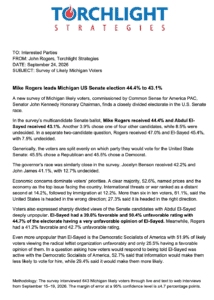
A poll, commissioned by Common Sense for America PAC, finds Rogers at 44.4 percent and El-Sayed at 43.1 percent; 8.5 percent of voters remain undecided, and 3.9 percent are backing the litany of third party candidates, which will act as vote sinks for both Rogers and El-Sayed.
The PAC, whose honorary chair is Sen. John Kennedy (R., La.), also found that Rep. John James (R., Mich.) is in a much closer race for governor than many other pollsters have found; 41.1 percent of voters back James, compared to 42.2 percent, who back Democrat Jocelyn Benson. 12.7 percent remain undecided.
The poll found that in a generic ballot, 45.5 percent of voters would support a Republican; 45.5 percent would back a Democrat. As is the case with races across America, economic concerns are at the top of voters’ priorities.
52.6 percent said that the economy and prices are the top issues facing their country; only 14.2 percent named international issues as the top issue, a distant second; immigration came in at a close third.
Fortunately for Rogers, a clear majority of voters view El-Sayed negatively; the Democrat has been inundated with attack ads targeting his close associations with pro-9/11 figures like streamer Hasan Piker for months. 50.4 percent of voters view El-Sayed unfavorably, compared to only 39.8 percent who view him favorably.
El-Sayed is in further trouble due to his past close associations with the Democratic Socialists of America (DSA). 51.9 percent of voters view the DSA unfavorably, and only 25.5 percent view it favorably. When respondents were told that El-Sayed has a history with the DSA, 52.7 percent said it would make them less likely to vote for him.
Rogers also is net unfavorable rating, but only by a narrow margin. 42.7 percent of voters view him unfavorably, compared to 41.2 percent who view him favorably.
The survey by Torchlight Strategies interviewed 643 likely voters through live and text to web interviews from September 15–19; its margin of error is 4.7 percentage.