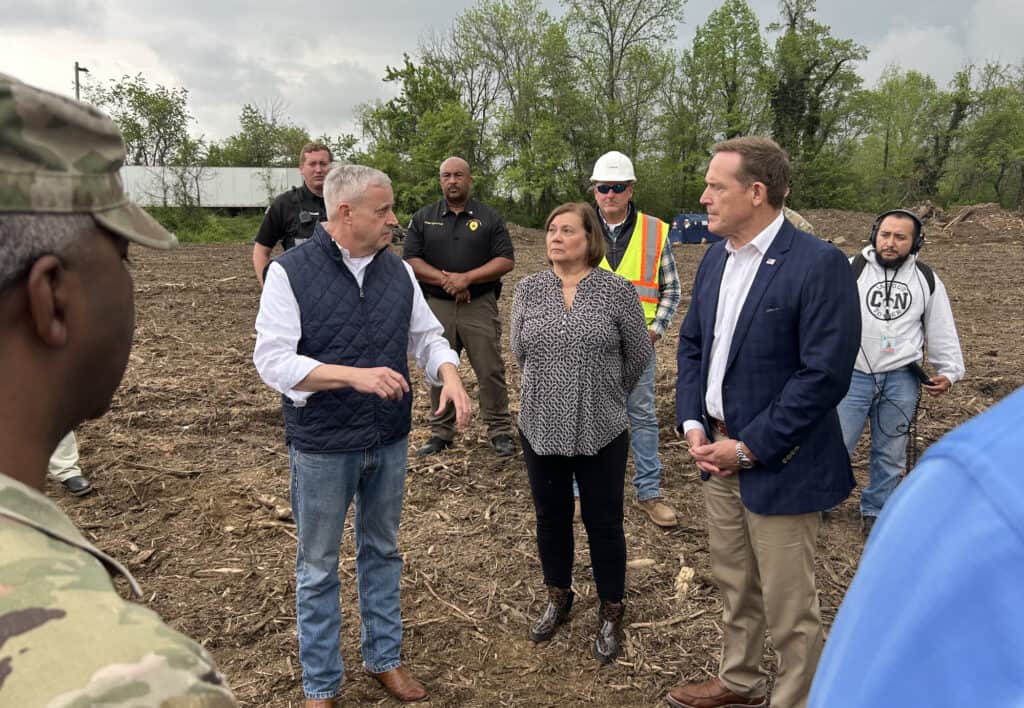
Two years ago, Hurricane Helene struck Western North Carolina, killing over 100 people. It brought widespread devastation to over 20 counties, destroying homes, roads, water systems, and lives in the process.
Within hours, North Carolinians mobilized to help. Michael Whatley, then serving as the Chairman of the Republican National Committee (RNC), joined forces with Samaritan’s Purse to help Watauga County — where Whatley grew up — to help deliver supplies to those in need. Whatley also called President Donald Trump during his 2024 campaign to assist those who were suffering. Whatley was the “number one advocate” for Helene recovery, according to Trump. “The Democrats didn’t do a damned thing,” Trump said.
Whatley managed to secure billions of dollars for western North Carolina despite holding no federal office and having never run for office before. Now, as the state looks to two years since the disaster, local leaders told the Washington Reporter how vital Whatley’s work was.
Bill Lapsley, who was serving on the Henderson County Board of Commissioners during the storm, told the Reporter in an interview that the “bottom line is, as far as Henderson County is concerned, Michael Whatley is a great friend for us, and I would do anything I can to help him show my appreciation for the taxpayers of our county.”
Lapsley explained how Whatley lined up millions of dollars for Henderson County to be able to rebuild following Helene. “Michael got on the phone and and told [the Department of Homeland Security] that on behalf of the president, we need to get this straightened out, not only for Henderson County, but for the others that are in the same shape…About five days later, I get a phone call from the assistant secretary, and she says ‘check your bank account.’ We checked our bank account, and they had wired us about 15 million bucks, and she said, ‘sorry for the problems. Here’s some of your money. We’ll see what we can do to get the rest.’”
State Representative Jake Johnson told the Reporter in an interview that Cooper’s failures with emergency response weren’t even limited to western North Carolina.
“I think it is laughable if Roy Cooper even tries to make hurricane recovery an issue in this campaign after how badly he fumbled not only Helene, but eastern North Carolina,” Johnson said. “He is trying to run from anything that reminds anyone of how bad he has handled natural disasters in this state.”
“I chair our House Oversight Committee,” Johnson continued, “so part of my job was bringing in his department that was overseeing the rebuild effort in Eastern North Carolina, which I’m not from…I didn’t know how bad it was until we started going through the numbers. They lost hundreds of millions of dollars, and people were still living in hotels six and eight years later after these events. I’m talking about families that were supposed to be in a rebuilt house, but the money was mismanaged so badly that they were going in and not only couldn’t tell us where the money was, but couldn’t even give us a real timeline on when this would be resolved.”
“Who knows what would have happened if we had not really started digging into this and people reaching out to us and saying it’s been six and eight years, and there are still hundreds of families living in hotels,” he added.
But Johnson experienced Cooper’s failures closer to home when Helene hit. Cooper, he said, “was nowhere to be found.”
The hurricane hit during Cooper’s final months in office, but Johnson said that “I would say to him that because your term is winding down doesn’t mean you’re done with the job. I don’t know if he was looking for the next thing on his resume and not paying attention to his current job, but he was nowhere to be found, and not only that, he took no action to get resources really where they needed to be… the Biden administration and the Cooper administration really dropped the ball.”
Johnson said that Whatley, by contrast, was “on the ground. We have had multiple roundtables with him with local elected officials saying, ‘here’s where the roadblocks are,’ and even though Whatley is not an elected official, what he’s done such an effective job of doing is keeping the pressure on Homeland Security…There were certain thresholds [at DHS] that if it was over a certain dollar amount, they were having to personally sign off on these things as department heads, and if you think of everything that’s over $100,000 in a $60 billion storm, it’s most things for repairs. There was this huge backlog, and Michael Whatley came in and said, ‘we cannot continue to operate this way. I’ve seen it with my own eyes. I brought the president to see it with his own eyes.’ When Trump took office, it was the first stop he made. Whatley brought him to North Carolina so he could put eyes on it, and Trump said, ‘we cannot do this and keep these people waiting for years and years and years and years.’”
In the months since, Johnson said, “Whatley kept the pressure on elected officials. We were just with him and Cameron Hamilton, the new FEMA director, who did a fantastic job of talking to elected officials. Hamilton said ‘where are those bottlenecks? I will clean them out.’ But that would have never happened without Michael Whatley getting their eyes on it and getting them on the ground.”
Trump joined local leaders in pointing to Whatley’s help in securing assistance and Starlink from Elon Musk in the wake of the hurricane; Musk gave free Starlink so that North Carolinians could connect with the outside world to better receive assistance, free of charge; Trump acknowledged Whatley’s help in securing Starlink when he visited North Carolina immediately following the Republican National Committee’s (RNC) midterm convention.
“The first phone call I got as soon as I got to the Oval Office…was Michael Whatley. He said ‘do me a favor…sir, you have to come down immediately to North Carolina, because Cooper didn’t do anything.’…It was Michael Whatley who got me to move my ass…sometimes he’s too aggressive.”
When Trump visited North Carolina as president, Whatley was named to the Federal Emergency Management Agency (FEMA) Review Council, where he — alongside the other members — was tasked with reviewing FEMA processes and find a more efficient way for aid to reach communities like Western North Carolina.
Throughout this process Whatley kept the pressure on the Trump administration, calling cabinet secretaries across the administration to ensure that each continued to send crucial aid to the much-needed sectors of Western North Carolina.
Whatley’s efficacy was on full display when Secretary of Homeland Security Markwayne Mullin visited western North Carolina in his first trip following his bipartisan Senate confirmation. Whatley called Mullin hours after he was confirmed and asked him to come to western North Carolina, which he did in June, 2026.
Since then, Whatley has been in close contact with Mullin and Adam Telles, the Assistant Secretary of the Army for Civil Works, to ensure the Army Corps of Engineers continues to assist western North Carolina as it recovers from the storm.
During his Senate campaign, Whatley has continued his focus on the region, remaining in constant contact with state, community, and local officials to help communities across Western North Carolina receive the assistance they deserve.
Since Whatley announced his run on July 31, 2025, he has held nearly 60 meetings in the region across more than 40 days in the mountains, including meeting with local leaders, visiting sites devastated by the storm, and meeting with government officials to ensure the aid that is needed reaches the necessary communities.
Cooper’s Senate campaign has taken the opposite tack; during the storm itself, Cooper was at a climate change gala in New York City. During his campaign for the Senate, he has spent only three days in Western North Carolina, by the Whatley campaign’s calculations, and those stops were focused on affordability not hurricane recovery, as Johnson noted to the Reporter.
“Roy Cooper was the sitting governor and abandoned Western North Carolina, whereas Michael Whatley — as a private citizen who has served in no elected office — has helped to deliver more than $11 billion to the region in the last two years,” DJ Griffin, a Whatley campaign spokesman, told the Reporter.
“This is more money than any federal relief effort in the history of North Carolina combined,” Griffin added. “If that is any indication of what Michael Whatley could do in the U.S. Senate, he will reach new heights and help to deliver even more money to the people of Western North Carolina to fully recover and build back even better than before the storm occurred.”
While Cooper has maintained a steady polling lead, an analysis by the Reporter’s Tayte Christensen found that Whatley is already polling ahead of where Sen. Thom Tillis (R., N.C.) was during his successful 2020 reelection campaign.