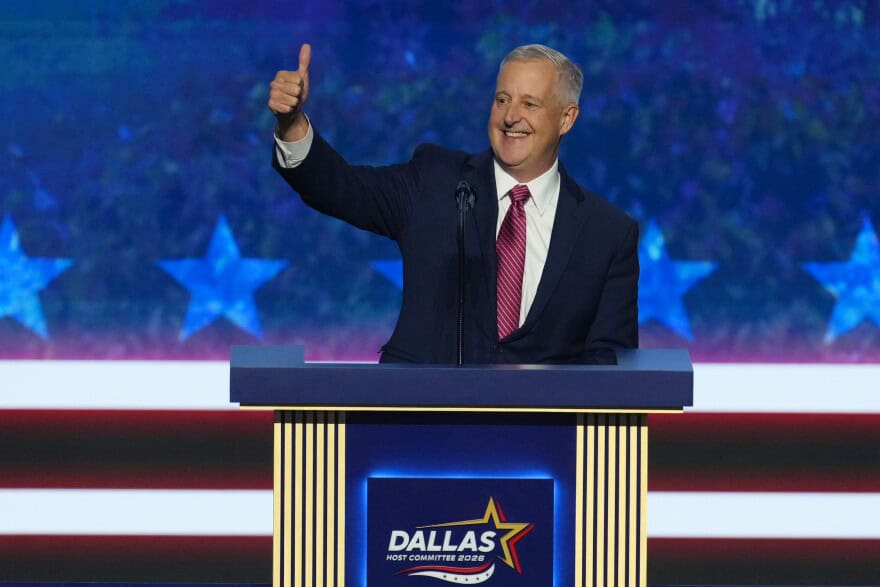
Six years ago this week, two polls showed Sen. Thom Tillis (R., N.C.) struggling to reach 40 percent in a North Carolina Senate race he would go on to win by just under two points. In this year’s race, Republican Michael Whatley is already polling ahead of Tillis’s numbers against former Gov. Roy Cooper (D., N.C.), according to a Washington Reporter analysis of North Carolina’s polling trends.
One September 2020 poll by the New York Times and Siena placed Tillis at 37 percent against Democratic nominee Cal Cunningham’s 42 percent. Another poll from USA Today and Suffolk University put Tillis at 38 percent to Cunningham’s 42 percent. In this year’s race, a RealClearPolitics polling average from September 16 places Whatley at 42 percent, putting him four to five points higher than Tillis was at the same point in 2020.
Whatley is facing a more established candidate in Cooper than Tillis did in Cunningham, yet is polling better than Tillis, suggesting Whatley has built a larger support base than Tillis had by the same time in 2020; in 2025, Tillis announced that he would retire rather than run for reelection after he fought with President Donald Trump over some of Trump’s cabinet nominees. Whatley’s polling numbers could put Democrats on defense in a race in which they are currently polling ahead.
While Cooper currently leads Whatley in polling, the Washington Post reported that Cooper is “running like he is behind”
“This race is going to be close,” Cooper said. “It’s going to be a one to three point race regardless of what you’re seeing [in] these polls now.”
Cooper’s decades of public office, spanning back to when Ronald Reagan was president, have given him a leg-up against Whatley in name recognition. A September Elon University poll found that 71 percent of registered voters had heard at least “some” about Cooper. Only 47 percent said the same about Whatley, giving the latter major room to grow. Fifteen percent had heard “nothing” about Whatley, while only four percent said that about Cooper.
Yet despite that gap, Whatley is polling several points higher than Tillis did after nearly six years in the Senate. And while Whatley faces national headwinds, he also benefits from North Carolina’s recent movement toward Republicans.
Trump has won North Carolina in three consecutive presidential elections, including in 2024 by about three points. The state has only four Democrats currently serving in Washington, D.C., while both Senators and 10 representatives are Republican. And in January, the number of registered Republicans was larger than that of Democrats for the first time in state history, while unaffiliated voters remain the state’s largest group, with nearly 3 million registrations.
Yet despite Trump’s 2024 victory in the state, the Elon poll found that 31 percent of North Carolina adults approved of President Donald Trump’s job performance, while 54 percent disapproved. The same survey found broad dissatisfaction with the economy and the cost of living.
But Republican registration growth and recent federal election results give Whatley a stronger state-level voter base than national trends might suggest.
Cooper’s lengthy history in government includes a 2021 deal between the Cooper administration and various social justice groups that released 3,500 inmates from prison. The New York Post found 18 of those inmates had been charged with murder since their release.
The Senate Leadership Fund’s (SLF) Communications Director, Chris Gustafson, said this record is a liability for Cooper as the race moves forward.
“Roy Cooper released thousands of violent criminals from prison and the consequences of his soft-on-crime agenda are still being felt by the grieving families left in his wake,” Gustafson told the Reporter. “Michael Whatley is running a strong campaign and closing the gap as voters learn more about Cooper’s deadly record.”
Also under Cooper’s leadership, North Carolina saw historic spikes in prices across the board, including an 85 percent increase in housing prices, and the most expensive healthcare in the nation. North Carolinians’ energy bill also increased by 30 percent under Cooper while his family allegedly profited from an energy deal he made as governor.
“Roy Cooper spent 40 years in office enriching himself while driving up healthcare costs and releasing thousands of criminals,” the National Republican Senatorial Committee’s (NRSC) Regional Press Secretary Nick Puglia told the Reporter. “North Carolinians have had enough and will reject him in November.”
With under two months left in the race and roughly four weeks until early voting begins, Republican organizations are continuing to devote substantial resources to the race, putting pressure on the Cooper campaign to defend the former governor’s failing record.
In April, SLF announced it would reserve $71 million to support Whatley through Election Day. The group’s spending has brought the race closer over the summer, with $23.5 million still yet to spend in the final weeks before the election.
Meanwhile, Americans for Prosperity Action announced more than $2.75 million in North Carolina advertising across three separate investments, including more than $1 million in February, $750,000 in June and another seven-figure campaign in August. No Going Back, a PAC connected to MAGA Inc., has reserved approximately $5 million in the Senate race.
The reservations and spending are not additive, but AdImpact’s broader calculation found that total Republican spending in the contest had surpassed $50 million through mid-September, The Associated Press reported.
The scale of those commitments shows that Republican groups continue to treat North Carolina as a priority, while Cooper and the Democrat establishment are acting accordingly.
The Democratic-aligned Senate Majority PAC announced $42 million in television investment in North Carolina, as Cooper holds $20.7 million in cash on hand to Whatley’s $3.46 million.
The 2020 campaign shows how much North Carolina’s numbers can change in the last weeks of a race. After polling at 37 percent and 38 percent in mid-September, Tillis finished at nearly 49% and defeated Cunningham by almost two points.
Cooper himself admitted that North Carolina Democrats tend to “be ahead in the summertime and be behind in the fall,” a trend he hopes to defy.
Whatley spokesman DJ Griffin told the Reporter that Cooper’s awareness of this trend doesn’t make up for his disastrous record as governor.
“Roy Cooper is running NC Democrats’ same playbook as they did in 2016, 2020, and 2022, lead in the summer and lose in November,” Griffin explained. “North Carolina voters, especially Republicans, tune in late and tend to break late surging Republicans across the finish line come election day. Cooper knows this and that Whatley will continue to expose his radical left record including his release of 4,200 hardened criminals that went on to murder 25 innocent North Carolinians.”
Whatley has more support today than Tillis had at the same stage of a campaign Tillis ultimately won. Whatley has reached 42 percent with lower name recognition and against a more established opponent. While Cooper remains ahead, Whatley’s current support is stronger than Tillis’s was six years ago in a race he ended up winning.
“Michael Whatley is surging ahead now, and come November we expect him to be the next U.S. Senator,” Griffin added.