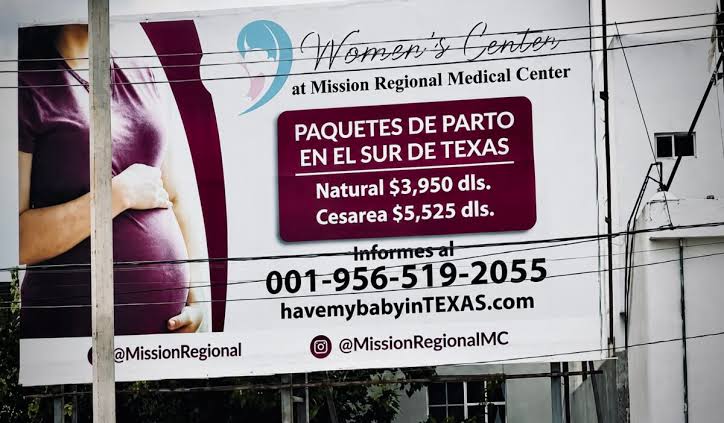
A taxpayer-subsidized, nonprofit Texas hospital that participates in the federal 340B drug discount program is under investigation after it was caught advertising discounted “birth packages” across the border in Mexico, prompting government watchdogs to demand new scrutiny of how hospitals receiving lucrative federal benefits are spending their money.
Mission Regional Medical Center, a private nonprofit hospital in the Rio Grande Valley, confirmed that it was behind Spanish-language billboards in Mexico advertising “Birth Packages in South Texas,” according to reports from NewsNation and Fox News. The advertisements offered natural deliveries starting at $3,950 and C-sections for $5,525 and directed potential customers to a website called “Have My Baby in Texas.”
The campaign immediately raised concerns that the hospital was marketing its maternity ward to foreign nationals seeking to give birth on American soil, a practice commonly known as “birth tourism.” President Donald Trump himself pointed to the case in arguing that the Supreme Court should rehear his arguments about the constitutionality of birth tourism.
On Capitol Hill, the scandal gave renewed life to the push by Sen. Rick Scott (R., Fla.) to pass his landmark SAFE Kids Act, which would ban the use of U.S. surrogacy by foreign nationals and penalize broker. In Texas itself, Gov. Greg Abbott (R., Texas) ordered the Texas Health and Human Services Commission to launch an “immediate and thorough investigation” into the hospital and pursue any potential civil, criminal, or administrative violations. “American citizenship is not for sale and Texas will not permit our healthcare system to be used as a magnet for birth tourism,” Abbott said.
But the controversy is also raising new questions about federal hospital subsidies and the sprawling 340B Drug Pricing Program. The House Ways and Means committee advanced a bill addressing this issue just last week, as the Washington Reporter previously reported.
The Reporter has also detailed some of the waste, fraud, and abuse connected to the 340B program, including a high-profile case in which a Haitian scammer stole millions from taxpayers under the guise of 340B, and lawmakers responded by fiercely criticizing the program’s abuses.
Mission Regional describes itself as a private, nonprofit hospital and a member of the Prime Healthcare Foundation, a 501(c)(3) public charity.
Public records from Hidalgo County also show that Mission Regional participates in the federal 340B program. Under a memorandum of understanding with the county, the hospital acknowledged that it registered with the Health Resources and Services Administration in 2016 as a 340B disproportionate share hospital.
The agreement specifically states that, to qualify for 340B, the hospital contracted with local government and committed to providing health care services to low-income individuals who are not eligible for Medicare or Medicaid.
That arrangement allows Mission Regional to purchase outpatient prescription drugs at steep federally mandated discounts under a program intended to help safety-net providers stretch limited resources and serve vulnerable patients.
Now watchdogs are asking why a hospital receiving those substantial federal benefits was spending resources marketing discounted maternity packages outside the United States.
“A Texas nonprofit hospital was just caught advertising ‘birth packages’ for discounted labor and delivery services in Mexico, using taxpayer dollars to facilitate birth tourism and sell out the country,” the nonprofit government watchdog Save Our States noted.
Another government watchdog, Public Policy Solutions, argued that the scandal highlights the need for broader 340B oversight. “You can’t make this up: A taxpayer-subsidized 340B hospital put up billboards near the border advertising childbirth packages to illegal immigrants. Americans are footing the bill for this insanity,” the group wrote. “340B was created for vulnerable American patients, not billboards inviting illegal immigrants to give birth in Texas. Oversight is long overdue.”
The episode could provide fresh ammunition to lawmakers who have warned that the 340B program has grown with little transparency into how participating hospitals use the financial benefits generated by discounted drugs.
For 340B watchdogs, the episode presents a simple question: if a nonprofit hospital is receiving federal benefits premised on its role serving low-income and vulnerable patients, should taxpayers and policymakers have greater visibility into how the hospital deploys the resulting financial advantages? Abbott has already promised to work with the Texas Legislature to strengthen state law targeting birth tourism.
The pressure may now spread to Washington, where lawmakers have increasingly debated transparency and accountability requirements for tax-exempt and 340B hospitals.
For critics of the current system, a federally subsidized safety-net hospital advertising “birth packages” on billboards in Mexico may become the latest exhibit in their case that oversight is long overdue.