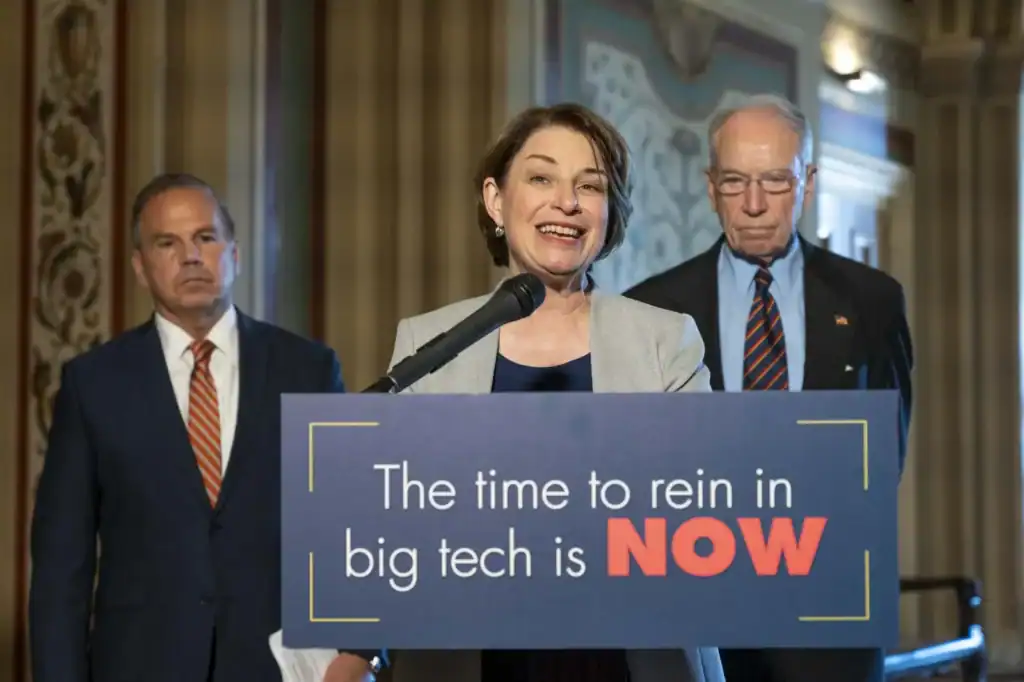
Bipartisan legislation backed by Sens. Chuck Grassley (R., Iowa) and Amy Klobuchar (D., Minn.) that the lawmakers say would “lower prices, expand consumer choice and restore online competition in the digital marketplace” is running into major obstacles from tech giants like Apple.
According to Grassley, his legislation — the American Innovation and Choice Online Act —
“would allow the Department of Justice (DOJ), the Federal Trade Commission (FTC) and state attorneys general to challenge the world’s largest online platforms for discriminatory or exclusionary conduct that harms competition.” It also “preserves legitimate safety, privacy, intellectual property, national security and constitutional protections, as well as popular services provided by large digital platforms,” he added.
But shortly after the bipartisan duo introduced AICOA, an Apple spokesperson told the Washington Reporter why the company is opposed to AICOA, which Apple views as “European-style regulation that would hamper innovation and force changes consumers never asked for, while undermining the privacy, security and child safety protections they rely on every day.”
The “European-style regulation” that Apple is concerned about is the European Union’s Digital Markets Act (DMA); the Reporter has covered the opposition that Trump administration figures and national security experts have towards the DMA and towards European implementation of Digital Services Taxes that would hit American companies like Amazon and Microsoft. Michael Lucci, the founder and CEO of State Armor, said following the potential tax levy that it comes at “the worst time for Europe to pick yet another unnecessary fight with the U.S.”
Apple, for its part, is “proud to be an engine of innovation, job creation, and economic growth in the U.S., where some of the world’s most innovative companies have designed technology that has changed the world,” its spokesperson added. “Importing Europe’s failed policies will not increase competition — it will make it more difficult to do business right here at home.”
The DMA has had a series of problems in Europe following its implementation; in a survey conducted by Trusted Future, over 70 percent of respondents in Southern Europe said they prefer the pre-DMA status quo. Tech policy experts warn that the AICOA copies the interoperability mandates at the core of DMA, which has created a litany of problems for European users.
American think tanks, like the Center for Strategic and International Studies, which have studied the DMA’s impacts found that the DMA and the Digital Services Act could increase costs on European businesses by up to €71 billion every year — and nearly half of those costs would fall on small and medium-sized European businesses.
Joining Grassley and Klobuchar in the initial rollout of AICOA were Sens. Dick Durbin (D., Ill.), Josh Hawley (R., Mo.), Sheldon Whitehouse (D., R.I.), and Cory Booker (D., N.J.).