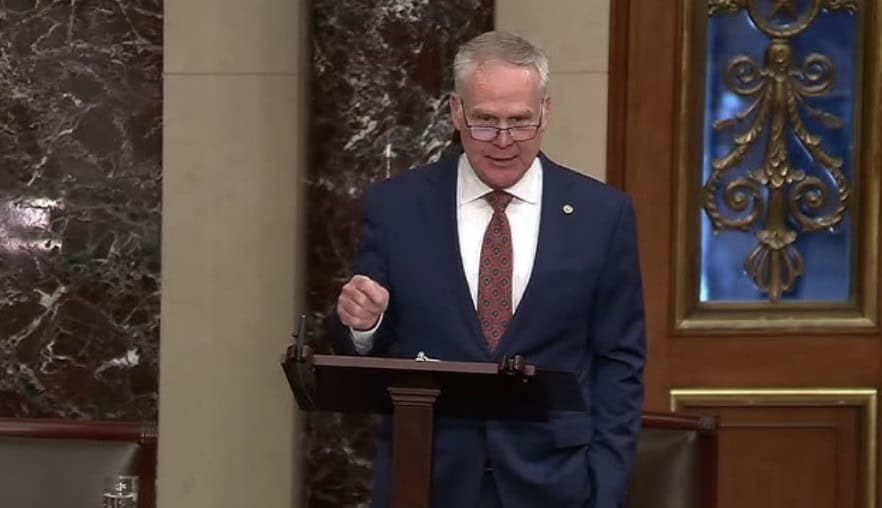
Fresh off rolling out a high-profile legislative push to overhaul America’s broken permitting system, Sen. Alan Armstrong (R., Okla.) took to the Senate floor to deliver his inaugural floor speech — a rite of passage that the former energy executive used to issue a blistering indictment of Washington’s culture of complacency, especially when it comes to permitting reform, which the new senator is using his short stint in Washington, D.C. to make a priority, as he explained in a Washington Reporter interview.
A senator’s maiden speech has long been treated with a distinct institutional reverence in the Upper Chamber. New members of the Senate use the opportunity to lay down their defining marker, signaling to colleagues on both sides of the aisle what their focus will be during their tenure. Members from both sides of the aisle showed up to watch Armstrong deliver his speech in person, including Senate Majority Leader John Thune (R., S.D.) and Sens. Tom Cotton (R., Ark.), Rick Scott (R., Fla.), Thom Tillis (R., N.C.), Ted Budd (R., N.C.), Catherine Cortez Masto (D., Nev.), Lisa Blunt Rochester (D., Del.), Tina Smith (D., Minn.), Jeff Merkley (D., Ore.), and John Hickenlooper (D., Colo.).
For Armstrong, his marker is unvarnished, pro-growth realism. Drawing heavily on his decades of experience as the former CEO of the Williams Companies, Armstrong bypassed the typical platitudes of freshman senators. Instead, he delivered a commanding, policy-rich address that framed permitting reform not as a partisan talking point, but as an existential necessity for American global leadership.
“For generations, Americans understood that building our critical infrastructure was not a partisan cause,” Armstrong declared from the Senate floor. “It was a national responsibility.”
The centerpiece of Armstrong’s speech was a direct connection to the real-world business consequences of inaction from the government. He recounted the exact moments where bureaucratic overreach and judicial activism actively penalized American infrastructure builders.
“I saw this problem firsthand while leading Williams Companies,” Armstrong said, detailing the saga of the Constitution Pipeline — a 120-mile project designed to bring low-cost Pennsylvania natural gas to the energy-starved Northeast. “We had our federal certificate. We had bought the pipe and the right-of-way. We were already clearing the route. But we were stopped by a state government that used Section 401 of the Clean Water Act as a political veto, waiting until Earth Day to deny a permit for reasons that had absolutely nothing to do with water quality.”
Armstrong didn’t stop there. He cited a separate billion-dollar pipeline project into New Jersey that was fully operational and serving customers for nine months before a court abruptly vacated its certificate.
“Put yourself in that boardroom for a minute,” Armstrong said to his colleagues. “Imagine explaining to your board that you just spent a billion dollars on a project the government now says you have no license to operate. What do you think that board is going to say the next time you bring them a large project to build?”
But as Armstrong made clear, it’s not just corporate board members who suffer from this regulatory paralysis — it’s American families, particularly those trapped in the Northeast energy market.
Flexing the deep industry expertise that has quickly made him a heavyweight on energy policy, Armstrong pointed out the stark economic contradictions currently plaguing the American Northeast. He noted that while Pennsylvania sits on some of the most prolific natural gas formations on earth, families just a few hundred miles away in New England pay skyrocketing electricity rates due to an artificial scarcity created by a lack of infrastructure to move that natural gas to the communities that need it.
To drive that point home, Armstrong brought up the 2018 bomb cyclone, the historic winter storm that brought blizzard-like conditions up and down the East Coast. In the aftermath of the storm — which left communities across New England without power — the region was forced to burn fuel oil, which is much “dirtier” than natural gas, and import liquefied natural gas (LNG) from Vladimir Putin’s Russia just to keep the lights on.
“That outcome was not caused by a shortage of American energy,” Armstrong said. “It was caused by a shortage of American infrastructure — and by years of political decisions that made blocking projects easier than building them.” The points that Armstrong made should sound familiar to Reporter readers, because he made many of them in his interview.
He also took a sharp swipe at political double standards, noting that while Senate Democrats frequently rail against gasoline prices, they remain silent as retail electricity prices in states like New York skyrocketed by roughly 60 percent over the last five years.
In the most aggressive segment of the speech, Armstrong turned his sights on the forces keeping American builders trapped in what he described as an endless loop of reviews, appeals, and litigation. He directly called out the special interest groups and trial lawyers who profit off delaying critical projects.
“Unless you are a trial lawyer looking for a payout or a foreign adversary looking for a weakened America, there is no reason to be against this,” Armstrong said flatly. “These interest groups have increasingly used administrative tools — originally intended to protect legitimate environmental interests — to stall or block projects for political purposes and end up doing more harm than good for the environment.”
Armstrong concluded his historic first speech with a reminder of why he was appointed to the Senate in the first place: not to launch a career, but to get something done.
“I am retired from the industry. I have zero political ambition beyond this seat,” Armstrong said, delivering a passionate closing to his address. “I am here because I have seen how this system strangles our great country. Let’s stop choosing short-term popularity over long-term economic and national security…We cannot let what has been one of our greatest strengths turn into our biggest vulnerability. It is time for this Senate to show courage and lead. It is time to restore confidence in America’s capacity to outrun our competition. It is time to get America building again.”
Armstrong’s speech quickly received praise from organizations like the Natural Gas Supply Association and the Electric Power Supply Association. The former noted that “as energy demand continues to grow, permitting reform is essential to building the infrastructure needed to deliver America’s abundant natural gas resources to the communities that depend on it” and the latter added that it “supports Armstrong’s legislation to accelerate construction of critical energy infrastructure, secure reliable electricity, and advance America’s economic growth.”