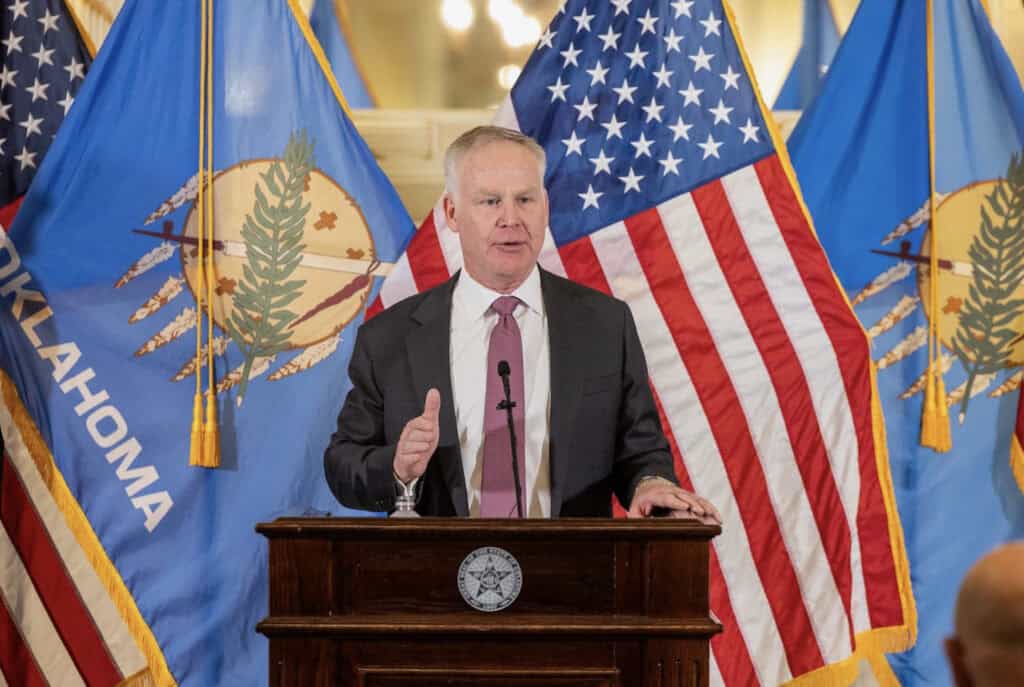
Sen. Alan Armstrong (R., Okla.) is the Upper Chamber’s newest member, but he told the Washington Reporter in a lengthy interview focused on his permitting reform work that becoming a senator wasn’t exactly in his long term plans.
“Never in my career” did he want to be a senator, he said. But that career, which took Armstrong from building pipelines in the fields to the C-suite of Williams Companies to the United States Senate, gives him the discipline and the know-how to tackle one of America’s most pressing needs: permitting reform, which he is “optimistic” can be done this Congress.
Permitting reform, Armstrong said, is important “for the sake of our country.”
“We really need to get back to where we have an abundance of energy available, not constraints that we’ve let develop around ourselves,” he said, laying out his vision for a bipartisan permitting reform that the oil and gas, solar, and hydropower industries can all get behind. “There’s no reason for a permitting bill not to be good for everybody. It’s not a zero sum game; we can lift the opportunity for everybody, and we’ve been very focused on making sure that we really get that brought together in terms of what people really understand…When we first got here, we did a listening tour of the transmission developers and the renewable side. We don’t want to just do a permit reform that is good for the pipelines, because that’s never going to make it through this gauntlet.”
“At the end of the day, this is about our country being competitive,” he said, and he is leaning on his time as CEO of Williams to make this happen. “I remember when I went to COP26 in Dubai, and one of the folks from the UAE wanted to show me around some of their energy complex there,” he recounted. “He took me from the edge of town to this 100 square mile solar farm that they had built right next to the three nuclear plants that they had built right next to their big desalinators, and I was shocked. I asked ‘how long did it take?’ It took them four years to build those nuclear plants, from the day they said ‘let’s build this’ to the day it was online. We don’t even get an application made in four years here, because the litigation is going to be so intense, and they took me on this 100 square mile solar farm, and I asked: ‘this is a huge amount of land that was taken up right next to the city here, how long did it take to get this permitted?’ and the guy literally looked at me like the word permit did not translate at all.”
While permitting can be done with almost impossible ease in countries like the United Arab Emirates (UAE), Armstrong said that “it’s not like I want to live in a country where there’s a dictator telling us what to do, but it does tell you, that you’d better have a process of democracy that still allows you to get stuff built, as long as you’re really trying to protect the environment as you’re getting it done, and the regulatory process ought to be focused on that, not on thinking that their job is to stop projects.”
Armstrong, who is in many ways an accidental senator, assumed his latest role when then-Sen. Markwayne Mullin (R., Okla.) was tapped by President Donald Trump to run the Department of Homeland Security. Because Oklahoma law does not allow for appointed senators to run for office, Armstrong knew from the onset that he’d have limited time to make an impact in Washington, D.C.
Those unusual circumstances led to him homing in on permitting reform as the single item he’d like to accomplish before he leaves office in January.
“We’ve been very focused” on it, he said. “I always tell people that it’s easy to say something’s your priority and your focus, but that also means you have to say other things are not your focus and priority, and that kind of discipline is not around here very much. People say that they’re focused on something, but as soon as there’s a shiny object, they’re quickly pursuing that. From my standpoint, I bring a discipline from business; I know that when you have a strategy, you have to really be disciplined about sticking to it, or you’re never going to know if your strategy was right or not. That’s the same way I think about what we’re doing here; if we’re not willing to put all of our energy and effort into one particular direction, we shouldn’t be surprised that a diffused effort is not going to be very successful, especially when I’m here for a short period of time.”
“I know I’ll only be a senator for a few months, which means I have so much less political clout,” Armstrong acknowledged. “As a very junior senator, you’re going to have much impact here on general issues. I don’t think that much of myself to think that I could do anything other than something very narrow and something I actually know a lot about.”
But, Armstrong is optimistic that he can be be the missing piece. Rep. Mariannette Miller-Meeks (R., Iowa) is one who thinks he can be. “There was an Armstrong who was the first man to walk on the moon, and I think it’s gonna be another Armstrong that finally gets permitting reform done here in Washington, D.C.”
“That was a very generous quote on her part,” Armstrong said of Miller-Meeks’s praise. “I’m not going to quit being optimistic about it. We’re bringing a lot of attention to it. I get encouraged every day. The event I just did really brought some energy to the issue; my legislative team back there has done an equally great job of developing a really strong bill that we’ve been connecting with the House on, so that we don’t surprise anybody over there, and so that we maintain support when we do get through the Senate. I’m optimistic because of the great work that people are doing.”
The event in question, which was covered by the Reporter, was Armstrong’s shot across the Capitol Hill bow, and it landed. Joining him and Miller-Meeks in attendance were Sens. John Barrasso (R., Wyo.), Senator Peter Welch (D., Vt.), Cynthia Lummis (R., Wyo.), Lisa Murkowski (R., Alaska), Steve Daines (R., Mont.), Jon Husted (R., Ohio), Gov. Kevin Stitt (R., Okla.), Reps. Mike Collins (R., Ga.), Troy Balderson (R., Ohio), and Pete Stauber (R., Minn.).
That familiarity with what Democrats are working on and on what the House is working on is essential, because “the House already has a bunch of different bipartisan bills,” Armstrong noted.
“The elements of a great bill have already come out of the House on a bipartisan basis,” he added. “The reason it’s not been done here is because I’m convinced that the Democratic leadership doesn’t want to see anything positive get done in this environment. It’s not much more complicated than that, because I think there are a lot of moderate Democrats who really want to see something get done, but there are a few sticky issues that need to be dealt with and that some people need to be educated on, but I think it’s a matter of getting enough moderate Democrats to stand up and say they really want to make this happen, and I think that’s what’ll get this done. If you’re coming at this from a ‘we want to do it just for transmission’ standpoint or from a ‘we want to do it just for renewables’ standpoint, or if you were coming in saying ‘I just want to do it for pipelines,’ or ‘I’m just going to do it for mining,’ I think you are going to have problems getting it done. Instead, I want to make it easier to get it done and support it. In fact, I don’t want it to just be easier, I actually want to have the government supporting getting projects invested in.”
Ironically, Armstrong’s work on permitting reform is not going to help his former colleagues at Williams out. “This is the funny thing,” he said. “A lot of people say ‘you’re a pipeline guy. Of course, you’re going to be in here fighting for permitting reform.’ Let me tell you, my former business will not benefit from this push; all you have to go do is look at our stock price over the last five or ten years. The harder permitting has gotten, the more money we’ve made on the same pipeline, because nobody can build new ones. If you already own a bunch of the pipelines, it’s a bonanza. If anybody wants anything new built, you’re the only person that can just add incremental capacity along your existing system. The returns we’ve been making are really way out of market compared to what we used to get.”
But now that Armstrong is representing Oklahomans in the Senate, his priorities have shifted. “This isn’t necessarily a good thing for an incumbent pipeline company, but it is a terrible thing for our country to not deal with this,” he explained. “The cost to the consumer, it bottlenecks, it’s not lack of energy, it’s just bottlenecks, and the more growth and the more demand that we get, and therefore the more attempt to grow, the pricier it’s going to get across those bottlenecks. To the north of us in Pennsylvania is some of the cheapest natural gas anywhere in the world, not just in the U.S., but in the world, and yet in Boston, 120 miles away, is some of the most expensive gas in the wintertime that is anywhere in the world, and it’s simply because the state of New York won’t let a pipeline get built across the state, and it’s not for environmental reasons; it’s purely because of how much the NGOs and the environmental movement contribute to the governor’s campaign there. That’s the kind of thing that we’re letting hold up our country. People want to say their utility bills are higher because of climate change, or they’re higher because of the loss of tax credits for renewables. Well, that happens in 2027; that is a really, really ridiculous argument. I don’t even think anybody believes that. They just say that because they get away with it, but it really is those bottlenecks and lack of infrastructure that is driving people’s prices up.”
As Welch’s presence at Armstrong’s event signified, permitting reform doesn’t have to be a partisan issue. But over Armstrong’s career in oil and gas, he’s seen how activist groups are eager to attack energy companies to raise money for their own coffers.
“Over time, it just got sillier and sillier and worse and worse, in terms of not being able to actually go do things the right way,” Armstrong said of the evolving regulations and protests targeting his industry. “No matter how perfectly you did it, there would be problems. Our company took pride in really doing things right, but at the end of the day, that really wasn’t what people were after. Instead, we were dealing with people raising money on the backs of a good fight, because they could raise money on it, and the process just kept enabling itself to lawsuits and fights, and I’ve just seen so much money and effort wasted on attorneys and paperwork, not on actually protecting the environment. That’s the part that’s really caught my attention: the amount of money we could spend on actually improving the environment versus these fights that really didn’t do anybody any good, and certainly cost the consumer a lot of money.”
For much of his career, he said that he couldn’t “recall the business of construction being a politicized issue[]; the Federal Energy Regulatory Commission was the primary regulator of getting things built, and I didn’t even know there was any political influence on that until eight years or so ago,” he said. “It never dawned on me; it didn’t really seem to change the agency. The agency was independent, and I literally couldn’t have told you if they were Republican or Democrat, and that was great. That provided continuity; it didn’t make things politicized. When we entered the era of climate change, first it was an attack on coal, and I remember the coal industry telling us ‘you guys had better be careful; you’re going to be next. You think you’re all clean and everything, but you guys are going to be next,’ and I was thinking ‘what are they talking about? We’re the cleanest fuel there is.’ But that’s certainly what happened…Some people don’t want to power transmission line built through the area, and I think it’s become a ‘let’s stop anything and everything’ approach, because there’s money to be made in raising the fight.”
Then-CEO Armstrong first saw this happen firsthand with Williams’s Constitution Pipeline. “We had already been issued a federal certificate, and we actually had already bought what we needed to build it; we bought all the pipe, and we were actually in the process of clearing the forest through an area in Pennsylvania; we were full speed ahead, because there had never been a situation where a state had been able to preempt a federal certificate,” he explained. “It had never happened before, to actually have a certificate and then get stopped by a state. That was 2014 when that project got started. It sat on the sidelines in 2018; it was really the state of New York that challenged us.”
Armstrong’s decades in business also give him a unique perspective of some of the other top issues the Trump administration is focused on: tackling fraud and a rogue Iranian regime.
In the wake of reports of Haitian migrants stealing tens of millions of dollars from 340B programs, Armstrong said that he doesn’t think the problem is “a law issue.”
“It’s an enforcement issue, and an administrative issue, really, to make sure that we’re governing those dollars,” he explained. “In safety, and in the pipeline business, I call it the normalization of deviance. I think people have gotten used to really low standards, and people see that there is lots of money there, and that it’s no big deal, but once you lose the pursuit of excellence in business, once you start lowering your standards, it is really hard to get that turned back up. I think that’s where we’ve gotten as a country on stuff like that, that we’ve just become very tolerant of wasting money. It does sound like there are a lot of good efforts going on on that front right now, and I’m really thankful for them. The cabinet is really working hard to bring practical solutions to a lot of issues, and I’m super thankful for that, and hopefully some of those cultures can start to be turned around, but as you know, that doesn’t happen fast.”
When it comes to dealing with Iran, which is regularly violating its ceasefire with Trump, Armstrong explained that the Strait of Hormuz has been a known risk for a lot of years within the energy industry.”
“From the energy side, nobody ever thought that that was not a problem,” he said of the Strait. “Everybody always knew that was a huge risk; I don’t think that was a surprise to anybody in the energy sector. It’s a very liquid market. Somebody asked me a couple of months ago in the hall here about what I thought oil prices should do. I said ‘this is very responsive market, both on the demand side, those kind of prices will kill demand, which they started to pretty significantly, and on the production side, production started to ramp in other areas very significantly, so these are very effective market forces that take on these changes,’ so I’m not surprised at all at seeing how fast crude market is upon it.”
“The president has been worked up about gasoline prices not moving,” he added. “Somebody bought that oil that’s running through a refinery right now a week ago, and it takes about two weeks for that to come through and clear through the markets, number one. Number two, this is always where the retail side makes their money, in what they call the shelf in the business; but on the other side that is pretty painful, when prices are going up and they’re having to pay higher prices, and they can’t push it through because they’re competing with the guy posting their price next door and he hasn’t raised his price yet, so that is a double-edged sword. The market will respond. The government has over and over and over and over investigated oil companies for collusion, and they always find the same thing.”
Armstrong’s ability to strong arm the leadership of Senate Democrats into working with Republicans and even some Democrats on permitting reform remains to be seen, but with the light already visible at the end of the tunnel in the Senate, he has some advice to both Rep. Kevin Hern (R., Okla.) — his likely successor, and to all the other incoming freshman senators.
Hern, he said, has “got a good energy background, just being from Oklahoma. He doesn’t have direct energy experience, but being from Oklahoma he has understanding of it. I would suggest keeping his eye on the most important issues, not necessarily the most popular issues, because he has the luxury of being able to stay in the position for at least six years and probably 12 years, and that allows him to actually focus on these long-term systemic issues like permitting that are really important to our country.”
“Some of the stuff that gets focused on, like NIL, for instance, is the shiny object,” Armstrong noted. “I’m a huge college sports fan. I know it’s a serious problem, but comparing that to the importance of getting permitting right for our country are two very different things. One will get you news, you’ll be in the news because it was your bill on NIL, but the other is really, really important. That would be my suggestion: take advantage of the durability of your position to be able to really focus on things that are really important for our country.”
Armstrong’s advice to both Hern and to all other incoming lawmakers is that “it’s important to really work hard to get across the aisle as soon as you can. You’re going to have plenty of friends on the Republican side, but really work hard to get across the aisle soon, because that is the only way you’re going to get something of importance done around here.”
Below is a transcript of our interview with Sen. Alan Armstrong (R., Okla.), lightly edited for clarity.
Washington Reporter:
When you were growing up, did you ever predict that you’d be a senator? Was this ever something that you wanted?
Sen. Alan Armstrong:
Never in my career.
Washington Reporter:
You spent decades in oil and gas. Take us back to when you started, and compare that to where that industry is now. How have you seen that change?
Sen. Alan Armstrong:
That’s a great question. I started out primarily in what they call the midstream business; the pipeline, the business of gathering the gas from the fields, and then moving it through big processing plants, and then transporting it to places like Louisiana, Texas, and Oklahoma. Those pipelines literally run across the country. Building projects back then when I first started as a field engineer, and then as a project engineer, there was always some issue, but generally it was a pretty practical approach to getting things built. It didn’t feel like the agencies were there to not let you build it; they were there to make sure that you did it in a way that you didn’t harm the environment. That’s what I grew up with when I was the boots on the ground and in the business of building stuff, but over time, it just got sillier and sillier and worse and worse, in terms of not being able to actually go do things the right way. No matter how perfectly you did it, there would be problems. Our company took pride in really doing things right, but at the end of the day, that really wasn’t what people were after. Instead, we were dealing with people raising money on the backs of a good fight, because they could raise money on it, and the process just kept enabling itself to lawsuits and fights, and I’ve just seen so much money and effort wasted on attorneys and paperwork, not on actually protecting the environment. That’s the part that’s really caught my attention: the amount of money we could spend on actually improving the environment versus these fights that really didn’t do anybody any good, and certainly cost the consumer a lot of money.
Washington Reporter:
How have the politics of American energy production changed? When you started, Oklahoma would regularly elect Democrats statewide; now, that is basically an impossibility. How has that changed what you were just describing?
Sen. Alan Armstrong:
That’s really good point. I don’t recall the business of construction being a politicized issue back then; the Federal Energy Regulatory Commission was the primary regulator of getting things built, and I didn’t even know there was any political influence on that until eight years or so ago. It never dawned on me; it didn’t really seem to change the agency. The agency was independent, and I literally couldn’t have told you if they were Republican or Democrat, and that was great. That provided continuity; it didn’t make things politicized. When we entered the era of climate change, first it was an attack on coal, and I remember the coal industry telling us ‘you guys had better be careful; you’re going to be next. You think you’re all clean and everything, but you guys are going to be next,’ and I was thinking ‘what are they talking about? We’re the cleanest fuel there is.’ But that’s certainly what happened, and it moved from being a legitimate concern about how you protect the environment when you construct pipelines to just being an attempt to stop it no matter what, and no matter how good you do it, no matter how perfect you are at installing, no matter how much good you do in the community where you operate, they are going to try and stop you. I’ve got a long list of examples of where we would go into a community, find out what they really wanted in the area, whether it was cleaning up a trout stream that had been polluted over time by poultry farms or whether it was protecting a particular species, like a bat species, and us investing in having universities develop fungicide to actually protect the bat in a much bigger way than the impact of building a pipeline was going to be through the area. There are all kinds of things that we did that I felt good about, where we left a place better than when we found it, and that worked for a while, but then it just became just completely politicized as you’re either for fossil fuels or you’re against fossil fuels. Now, the interesting thing to me is that that has expanded into everything. It’s no longer just about fossil fuel. Some people don’t want to power transmission line built through the area, and I think it’s become a ‘let’s stop anything and everything’ approach, because there’s money to be made in raising the fight.
Washington Reporter:
You noticed this change more or less eight years ago; what was the flashpoint to you that came across your desk as a CEO, where you realized, ‘the coal industry was right to be worrying us’?
Sen. Alan Armstrong:
The first big project that we had stopped as Williams was the Constitution Pipeline; we had a federal certificate. We had already been issued a federal certificate, and we actually had already bought what we needed to build it; we bought all the pipe, and we were actually in the process of clearing the forest through an area in Pennsylvania; we were full speed ahead, because there had never been a situation where a state had been able to preempt a federal certificate. It had never happened before, to actually have a certificate and then get stopped by a state. That was 2014 when that project got started. It sat on the sidelines in 2018; it was really the state of New York that challenged us.
Washington Reporter:
Now that you’ve shifted into the Senate, I am curious about what has surprised you about being senator? You’ve interacted with Oklahoma lawmakers and federal lawmakers in your career; was there anything that has been unexpected?
Sen. Alan Armstrong:
Boy, that’s a long list. I don’t want to make this sound derogatory, because one of the things that I’ve been most impressed with around here is the amount of dedicated talent that works on these issues, and how hard people genuinely work to try to get things done. I’ve got a staff around here, and other people have great staffs. I think about the amount of really dedicated, hardworking talent that works here in the Senate, but it’s amazing to me how little production of actually making our laws better, solving problems, dealing with issues, comes from this. So little of that actually gets done with this much talent; maybe it’s just the case of the midterms, but it seems like there’s a lot more energy that goes into making sure the other side doesn’t get a win than there is on doing what’s right for our country. That part of it’s been disappointing. You see and hear it from the outside, but until you really see its ugly teeth while you’re here, it’s just theoretical. There are a lot of people on both sides of the aisle saying ‘let’s get something positive done,’ and we’ve had a lot of support on the permitting issue. There are a lot of moderate Democrats who really want to see something positive get done, but at a leadership level, they are being told that there is no way that we are going to do anything positive. I’m not throwing rocks uniquely at the Democrats, because it goes both ways. That’s been hard to swallow, just how much people will put their party winning in front of what’s good for our country, and I know that sounds super naive, but it really has struck me how the fifth thing or so that people talk about is what’s best for a country; that’s kind of disappointing.
Washington Reporter:
Sometimes CEOs and governors, who are functionally the CEO of a state, are frustrated by how things change when they go from that job to this job. How have you navigated being the head honcho to being the most junior senator?
Sen. Alan Armstrong:
This will sound really egotistical, but I really don’t mind that. I don’t have that big of an ego to mind that. I know that sounds conceited for me to say that, but I truly don’t. My ego is not ever what motivated me. People have been very respectful and welcoming for the most part. Every once in a while I step on somebody’s toes, even when I wasn’t meaning to, and it kind of surprises me, because people aren’t as frank around here as what you get in business. People will be generally more open and clear with you in business. I’ve had to have my sensitivity antennas up a little more. When you’ve been CEO of a big company like that, you get a lot of people treating you like you’re the king, but I would also say it surprises me how deferential the entire organization is around here to a senator; it bugs me that the senators have their own elevator and stuff like that. I don’t think that sends the right message.
Washington Reporter:
When you were CEO, you weathered different parties and different administrations; in the oil and gas industry and in energy production more broadly, you want some sort of certainty for what the regulatory environment is going to look like. How have you seen both Republicans and Democrats change as they look at your former industry?
Sen. Alan Armstrong:
What’s going on in some of these Democratic primaries is unfortunate; I’m a big believer that the pendulum swings, and sometimes it’s actually good. The quicker they swing over, the faster we’ll get back to the middle. I’m working very hard to respect each side of the aisle. I’m very moderate in my approach, and there remains a lot of room in the middle. Look at what just happened in New York; sometimes it takes those extreme things where people go, ‘woah, that’s not what we want.’ I’m hopeful that, while it’s hard to be in the middle of a car wreck and say ‘it’s no big deal, we’re going to live through this,’ I think of it that way — this is ugly, but sometimes it takes things getting really ugly for them swing back.
Washington Reporter:
We’ll get to permitting report now, which is your top priority here. You recently hosted an event on the Senate, and what was impressive to me was not as much that you had every oil and gas company there, but that you had junior and senior lawmakers, who many of whom you probably had never heard of two months ago, showing up and talking about the importance of this with you. How have you assembled that coalition in just a few weeks?
Sen. Alan Armstrong:
We’ve been very focused, and I always tell people that it’s easy to say something’s your priority and your focus, but that also means you have to say other things are not your focus and priority, and that kind of discipline is not around here very much. People say that they’re focused on something, but as soon as there’s a shiny object, they’re quickly pursuing that. From my standpoint, I bring a discipline from business; I know that when you have a strategy, you have to really be disciplined about sticking to it, or you’re never going to know if your strategy was right or not. That’s the same way I think about what we’re doing here; if we’re not willing to put all of our energy and effort into one particular direction, we shouldn’t be surprised that a diffused effort is not going to be very successful, especially when I’m here for a short period of time. I know I’ll only be a senator for a few months, which means I have so much less political clout. As a very junior senator, you’re going to have much impact here on general issues. I don’t think that much of myself to think that I could do anything other than something very narrow and something I actually know a lot about.
Washington Reporter:
Why exactly is permitting reform so important to not just the oil and gas industry itself, but to all Americans?
Sen. Alan Armstrong:
I hope you noticed how much of a cross section we had at my event; we had solar industry, we had the renewables side, we had hydropower there, we had labor there. It was not just oil and gas; that to me is one of the most important things that we’ve been doing. When we first got here, we did a listening tour of the transmission developers and the renewable side. We don’t want to just do a permit reform that is good for the pipelines, because that’s never going to make it through this gauntlet, number one, and number two, for the sake of our country, we really need to get back to where we have an abundance of energy available, not constraints that we’ve let develop around ourselves. There’s no reason for a permitting bill not to be good for everybody. It’s not a zero sum game; we can lift the opportunity for everybody, and we’ve been very focused on making sure that we really get that brought together in terms of what people really understand. At the end of the day, this is about our country being competitive. I remember when I went to COP26 in Dubai, and one of the folks from the UAE wanted to show me around some of their energy complex there. He took me from the edge of town to this 100 square mile solar farm that they had built right next to the three nuclear plants that they had built right next to their big desalinators, and I was shocked. I asked ‘how long did it take?’ It took them four years to build those nuclear plants, from the day they said ‘let’s build this’ to the day it was online. We don’t even get an application made in four years here, because the litigation is going to be so intense, and they took me on this 100 square mile solar farm, and I asked: ‘this is a huge amount of land that was taken up right next to the city here, how long did it take to get this permitted?’ and the guy literally looked at me like the word permit did not translate at all. It dawned on me, and by the way, it’s not like I want to live in a country where there’s a dictator telling us what to do, but it does tell you, that you’d better have a process of democracy that still allows you to get stuff built, as long as you’re really trying to protect the environment as you’re getting it done, and the regulatory process ought to be focused on that, not on thinking that their job is to stop projects.
Washington Reporter:
The logical question here, then, is what is standing in the way of this being done? You had Vermont’s Peter Welch there, a Democrat from a state very dissimilar to Oklahoma. What you’re saying doesn’t particularly partisan, and yet you haven’t already solved it.
Sen. Alan Armstrong:
The House already has a bunch of different bipartisan bills. The elements of a great bill have already come out of the House on a bipartisan basis. The reason it’s not been done here is because I’m convinced that the Democratic leadership doesn’t want to see anything positive get done in this environment. It’s not much more complicated than that, because I think there are a lot of moderate Democrats who really want to see something get done, but there are a few sticky issues that need to be dealt with and that some people need to be educated on, but I think it’s a matter of getting enough moderate Democrats to stand up and say they really want to make this happen, and I think that’s what’ll get this done. If you’re coming at this from a ‘we want to do it just for transmission’ standpoint or from a ‘we want to do it just for renewables’ standpoint, or if you were coming in saying ‘I just want to do it for pipelines,’ or ‘I’m just going to do it for mining,’ I think you are going to have problems getting it done. Instead, I want to make it easier to get it done and support it. In fact, I don’t want it to just be easier, I actually want to have the government supporting getting projects invested in. This is the funny thing; a lot of people say ‘you’re a pipeline guy. Of course, you’re going to be in here fighting for permitting reform.’ Let me tell you, my former business will not benefit from this push; all you have to go do is look at our stock price over the last five or ten years. The harder permitting has gotten, the more money we’ve made on the same pipeline, because nobody can build new ones. If you already own a bunch of the pipelines, it’s a bonanza. If anybody wants anything new built, you’re the only person that can just add incremental capacity along your existing system. The returns we’ve been making are really way out of market compared to what we used to get. So this isn’t necessarily a good thing for an incumbent pipeline company, but it is a terrible thing for our country to not deal with this. The cost to the consumer, it bottlenecks, it’s not lack of energy, it’s just bottlenecks, and the more growth and the more demand that we get, and therefore the more attempt to grow, the pricier it’s going to get across those bottlenecks. To the north of us in Pennsylvania is some of the cheapest natural gas anywhere in the world, not just in the U.S., but in the world, and yet in Boston, 120 miles away, is some of the most expensive gas in the wintertime that is anywhere in the world, and it’s simply because the state of New York won’t let a pipeline get built across the state, and it’s not for environmental reasons; it’s purely because of how much the NGOs and the environmental movement contribute to the governor’s campaign there. That’s the kind of thing that we’re letting hold up our country. People want to say their utility bills are higher because of climate change, or they’re higher because of the loss of tax credits for renewables. Well, that happens in 2027; that is a really, really ridiculous argument. I don’t even think anybody believes that. They just say that because they get away with it, but it really is those bottlenecks and lack of infrastructure that is driving people’s prices up. 20 years ago, pipeline companies would compete right over the top of each other, building into a market, and then the market could say ‘no, I don’t think I’ll buy it off of this pipe today, because it’s cheaper on another one.’ If you have an excess and an abundance of infrastructure, you actually took a huge positive for the consumer, and we’ve just taken that away from ourselves.
Washington Reporter:
Congresswoman Mariannette Miller-Meeks said that it took Neil Armstrong to land on the moon, and that it’ll take Alan Armstrong to get permitting reform done. Do you share that level of optimism?
Sen. Alan Armstrong:
That was a very generous quote on her part. I’m not going to quit being optimistic about it. We’re bringing a lot of attention to it. I get encouraged every day. The event I just did really brought some energy to the issue; my legislative team back there has done an equally great job of developing a really strong bill that we’ve been connecting with the House on, so that we don’t surprise anybody over there, and so that we maintain support when we do get through the Senate. I’m optimistic because of the great work that people are doing.
Washington Reporter:
While you’re focused on permitting reform yourself, there are a lot of other issues happening; one that I am interested in your perspective on as both a former CEO and now as a lawmaker is fraud. With the 340B program, for example, we just saw a Haitian national steal tens of millions of dollars from the American taxpayers; what do you make of how these contracts have been going out for so long with so little oversight?
Sen. Alan Armstrong:
I would say it’s not a law issue, it’s an enforcement issue, and an administrative issue, really, to make sure that we’re governing those dollars. In safety, and in the pipeline business, I call it the normalization of deviance. I think people have gotten used to really low standards, and people see that there is lots of money there, and that it’s no big deal, but once you lose the pursuit of excellence in business, once you start lowering your standards, it is really hard to get that turned back up. I think that’s where we’ve gotten as a country on stuff like that, that we’ve just become very tolerant of wasting money. It does sound like there are a lot of good efforts going on on that front right now, and I’m really thankful for them. The cabinet is really working hard to bring practical solutions to a lot of issues, and I’m super thankful for that, and hopefully some of those cultures can start to be turned around, but as you know, that doesn’t happen fast.
Washington Reporter:
You were CEO of Williams during much of this war with Iran; walk us through how energy companies have been viewing this, and what you would advise them now as a policymaker that they should be keeping abreast of that they might not necessarily have thought of.
Sen. Alan Armstrong:
The impressive thing about that is if you look at natural gas prices during that period, not only here in the U.S., but even in Europe, prices actually have gone lower on natural gas, which is amazing to me, because not here in the U.S., because we have such an abundance of supply here in the U.S., but even the fact that we’ve been able to keep up with the demands is pretty amazing. From a U.S. perspective, if you think about how incredibly cheap natural gas is, just on rough terms, you just multiply the price of the natural gas times six, and that gives you that price in oil. So, gas is three bucks right now, so the same energy equivalent for gas is $18 a barrel of proof, so why in the world wouldn’t we be taking advantage of that as a nation? Producers are trying to make sure that they are trying to get the infrastructure built for people to be able to take advantage of that. I wouldn’t want to be in the business of being in the fuel oil business, because if we get permitting right, all that expensive fuel gets taken out of the market.
Washington Reporter:
In your current and former roles, did you ever look at the map of the world, and think that there has got to be a way to lessen our reliance on the Strait of Hormuz?
Sen. Alan Armstrong:
That’s been a known risk for a lot of years within the energy industry. From the energy side, nobody ever thought that that was not a problem. Everybody always knew that was a huge risk; I don’t think that was a surprise to anybody in the energy sector. It’s a very liquid market. Somebody asked me a couple of months ago in the hall here about what I thought oil prices should do. I said ‘this is very responsive market, both on the demand side, those kind of prices will kill demand, which they started to pretty significantly, and on the production side, production started to ramp in other areas very significantly, so these are very effective market forces that take on these changes,’ so I’m not surprised at all at seeing how fast crude market is upon it. The president has been worked up about gasoline prices not moving. Somebody bought that oil that’s running through a refinery right now a week ago, and it takes about two weeks for that to come through and clear through the markets, number one. Number two, this is always where the retail side makes their money, in what they call the shelf in the business; but on the other side that is pretty painful, when prices are going up and they’re having to pay higher prices, and they can’t push it through because they’re competing with the guy posting their price next door and he hasn’t raised his price yet, so that is a double-edged sword. The market will respond. The government has over and over and over and over investigated oil companies for collusion, and they always find the same thing.
Washington Reporter:
When you hand the keys off to your successor in January, how do you want to look back on your time here? What does successful look like to you in this role?
Sen. Alan Armstrong:
That’s a really good question. Kevin Hern is the very likely successor to this seat, and he’s got a good energy background, just being from Oklahoma. He doesn’t have direct energy experience, but being from Oklahoma he has understanding of it. I would suggest keeping his eye on the most important issues, not necessarily the most popular issues, because he has the luxury of being able to stay in the position for at least six years and probably 12 years, and that allows him to actually focus on these long-term systemic issues like permitting that are really important to our country. Some of the stuff that gets focused on, like NIL, for instance, is the shiny object. I’m a huge college sports fan. I know it’s a serious problem, but comparing that to the importance of getting permitting right for our country are two very different things. One will get you news, you’ll be in the news because it was your bill on NIL, but the other is really, really important. That would be my suggestion: take advantage of the durability of your position to be able to really focus on things that are really important for our country.
Washington Reporter:
What is one thing that you wish that you knew before you took this job that you want to make sure that the incoming senators know in advance?
Sen. Alan Armstrong:
There are a lot of things that have become normal around here, that when you come in from the outside, you think are not normal. For example, it’s not normal, it’s not healthy to not stay connected with the House on the same issues; that’s something that’s kind of strange. With Kevin Hern coming from the House, he should be able to bring that understanding. More broadly, I’m always shocked when a good bill comes over from the House and it’s just a yawner around here. Let’s act on that, but instead we’re on our own agenda around here; I think that’s something that’s kind of broken, and I also think that the inefficiency of the floor time that gets sucked up by a lot of really not so important issues is something that needs to be addressed around here. I’m not sure how you’re going to do that as a freshman senator, but that’s certainly something to keep your eyes on for the long term. I would say it’s important to really work hard to get across the aisle as soon as you can. You’re going to have plenty of friends on the Republican side, but really work hard to get across the aisle soon, because that is the only way you’re going to get something of importance done around here.
Washington Reporter:
You’ve spent much more time in Oklahoma than I have, but my understanding is that I have spent much more time noodling in Oklahoma than you have, so I’m wondering what is it going to take to change that for you?
Sen. Alan Armstrong:
Noodling was the cool sport when I was growing up, but if you really were a country boy and you were really hungry, you actually would seine the pond; you’d take a big net with a buddy on the other side.
Washington Reporter:
So when you’re not a CEO anymore, and you’re not a senator, you don’t want to go to Shawnee, and go noodling?
Sen. Alan Armstrong:
I can’t say I do, but I’m impressed that you did it. Bartlesville, where I’m from, has a river called the Caney River. That is probably one of the prime noodling spots.
Washington Reporter:
We’ll have to come back to this; I think you’d be great at noodling.