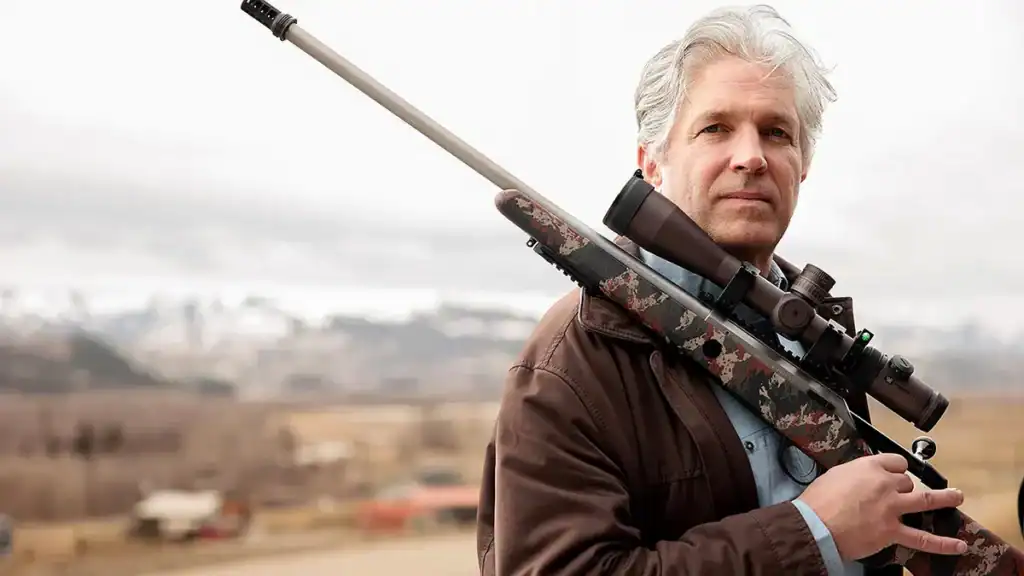
When Rep. Harriet Hageman (R., Wyo.) decided to run for Wyoming’s open Senate seat, she set off a scramble to succeed her in the House of Representatives. One of the Republicans running to succeed her is Steve Friess, who told the Washington Reporter that Hageman told him that she was “sitting in a hotel room. There’s a sheet of paper in front of me, and there’s a list of names on it of who can I get to run for the seat, and your name’s at the top of the list.’”
For his part, Friess told the Reporter that he I “took that [encouragement from Hageman] as a pretty big encouragement. If she had faith that I could represent the state well, that pushed me forward.”
Since then, for the past several months, Friess has criss-crossed Wyoming, leaning on decades of connections that he’s built in the state and in the country from his time as a funder of some of the GOP’s biggest organizations and from the lessons he learned in working to create a Christian school in Wyoming.
Alongside his father, Foster Friess, Steve noted that he built “a successful money management business, and when we sold it, we started very actively funding conservative movements, the grassroots movement in particular.”
“We helped raise the first million dollars for Tea Party Patriots, and we met Charlie Kirk when he was 18 years old, and helped him with the significant seed funding, and have continued to support Turning Point going forward,” he said. “There are some other groups that we felt were doing great work. There’s an organization called Open the Books that goes state by state to create more transparency legislation, and as the trans issue came to the forefront, when we learned about the story of Riley Gaines from our friends at Independent Women’s Forum and Independent Women’s Voice like Heather Higgins, we quickly stepped in to provide funding, which was used to help with her platforming, to get her story out, to give her media, and to help her build the skills so that she could take that message nationwide. Hers was such a spectacular story of insanity, absurdity, and injustice: a guy jumps in the pool, and he doesn’t even beat her. They tie, and they hand him the trophy, driven by this nonsensical agenda of gender confusion.”
“We had also been funding these other groups,” Friess added. “James O’Keefe is a great friend, and we have supported O’Keefe Media Group. Another is True the Vote, which has been a great friend over the years. At the same time, we were helping fund political campaigns. Well before Greg Gianforte and Pete Ricketts and Steve Daines ran for office, those gentlemen were part of a group that provided a key big push to help Tom Daschle be unseated by John Thune. I’d had some insight into both the mechanisms of politics and elections. Each of those men in particular are role models for me. I had seen them succeed in business and then take time to get active in politics after they’ve raised their family, mostly. I thought of them as guide markers on the importance of serving.”
But for Friess, serving in Congress would give him the opportunity to work even more closely with conservative movement leaders he has spent years working closely with. “While I was pondering whether to do this or not, first I got my family’s buy-in, but up on the screen, Speaker Mike Johnson was pushing hard for the SAVE America Act, and standing right behind him was Jenny Beth Martin, one of the founders of Tea Party Patriots, and I just have this feeling like the folks that I had helped to get to important positions of policy influence are there in D.C.,” he said. “I care about these people. I feel like I was coming in to join the team.”
Friess added that the murder of Charlie Kirk struck close to home for him, as someone who first identified the potential in a then-18-year-old Kirk. “The passing of Charlie Kirk really also made me feel like I had to step up,” Friess said. “I had to get engaged. We lost a person who would have been a phenomenal president of this country. When we met him when he was 18 years old, and he told us he did not want to go to college, and that he wanted to set up clubs and organizations that would teach the rising generation about the evils of socialism and the need to protect the freedoms and liberties that we enjoy, we were impressed. Knowing that he was no longer on the scene, and I’ll never be a Charlie Kirk, made me feel that much more motivated to get into the fight because we’ve got now five or more Democratic Socialists of America headed into Congress.”
From Friess’s standpoint, he said that he “always felt that the Founders never intended politics and Congress to be a lifelong career, or especially some place that people went to get rich. My thinking is that the Founders thought that it would be folks like Steve Daines who succeeded, got some life experience with raising a family, and then knew their state well, and are able to go and serve to both defend their national liberties and also to represent the state that they’re from and that they love. That’s really my template. I was thinking about those folks, those three men in particular, as I made the decision.”
Now that Friess has spent months as a candidate on the trail himself, he sees several issues that Wyoming voters care about — and almost all of them tie back to the state’s abundant energy resources.
“Everyone understands that getting more high-paying jobs into the state is essential,” Friess explained. “As I’ve traveled around the state, a couple things have really hit me. One is that so many of the folks I meet are older. Younger generations have been moving away to find better economic opportunities. One of the reasons that I moved to Wyoming was because my parents were there. They moved there in 1990, and I finally moved there in 2000, and I knew that I wanted to raise my kids near my parents because they would pass on family stories, and we’re faithful folks, and having the chance to pray together at a meal rather than just waiting for Thanksgiving and Christmas; that’s a special thing, and I’ve heard from so many families about how their kids have moved away. That’s one of the things that weighs on me, and it really drives what my priorities are for the state, which are to start getting the federal government to rethink how we’re going about our energy and rare earths and and mining strategies, when we’re up against rivals around the world that have no concern for environmental quality or the way they degrade their landscape.”
“Our miners and our oil and gas people have learned how to do things with tremendously low impact on the environment,” Friess said. “You could almost say it’s been a benefit to have the environmentalists breathing down their neck all the time because they really have learned to do things clean, safe, and in a way that preserves and protects the environment. I have to remind the environmentalists that I come across that it was Richard Nixon and the Republican Party that really launched and established the EPA, because conservatism is about conserving. It’s about taking care of the environment and keeping the air clean, but I ask you this question: If Vladimir Putin had control of Wyoming, how long would it take him to open a new coal mine? It would take as long as to diesel up the earth movers and get them to the site, and that’s the competition that we’re in. The driver of prosperity in this country, or for any country, is affordable energy, and Wyoming has vast reserves of coal”; this is something he saw firsthand on the campaign trail.
“I was out at the with Jonah Energy at the Jonah Field,” he added. “They’ve recovered 6 trillion cubic feet there, and it’s estimated there’s another 25 trillion cubic feet of natural gas. We need an LNG port on the west coast. We need to keep pushing through with President Trump’s new renewed drive to get coal exported out of Oregon. I’ve had environmentalists tell me that shipping Wyoming’s coal all the way to Taiwan or Japan and burning it there, even with the emissions of taking it there, is still cleaner than than burning the coal that they might get from other sources. Wyoming coal is some of the cleanest in the world, and we’ve got to be able to get it out there. I’m excited about getting the regulations more rationalized so that there can be great jobs for people in Wyoming, and families don’t have to split up and move away. That is the core message; I’m going to lots of parades and fairs, and when I run side to side behind my float, I tell people I’m going to start the next energy boom so that these young kids are not going to have to move away. I’ve gotten applause. The message is really clear. If we can drive the right regulatory reforms to get the red tape obstacles out of our way, we know how to get oil, gas, coal, and uranium out of the ground in a clean, efficient way. The only thing that’s standing in our way is red tape, and that’s what I’m working on.”
While Wyoming has no shortage of natural resources, Friess explained that the other 49 states are poised to benefit from it. “It is essential for the rest of America to understand that Wyoming has a huge role to play in our national security, both for lowering the cost of energy and providing it more abundantly, but also for rare earths and strategic minerals,” he explained. “Right now we’re getting all these things from China. Why should we be over the barrel with China for these things when we’ve got them right here? I understand that some of the processing methods have got to be worked out, and they’ve got to be made cleaner. But I know we’ve got the technology and the smarts to do that here, because we care about the state, we care about the country. We have different levels of drought, and this multi-state water compact on the Colorado River, which we are of course headwaters to, is under negotiation right now, and there’s a really clear answer to this: we need nuclear power. We need small modular reactors. We need Wyoming to provide the uranium, and all these states to the south can do what the Gulf states do, which is they use the cheap energy of nuclear power to desalinate water from the ocean, and they’ll have all the water they want, and instead of sending them water we don’t have to give to them, we could keep all the water here, and our ranchers and farmers would flourish.”
But Friess also sees healthcare as a key issue facing voters, and he is leaning on his years of experience fighting Obamacare in that realm. He also saw this on the campaign trail, dating back to his first event as a congressional candidate.
“The very first event that I hosted was in the city of Gillette, and it was the first time that I was walking into a room where I didn’t know anybody,” he said. “We had recruited everybody through texts and emails; I got there half an hour early to get comfortable with the space, and there was a woman there, probably in her 70s, with a 30-year-old son, who evidently had tremendous disabilities of several kinds, and I spoke with her for a moment, and she said ‘I’ve been waiting for an hour. I can’t get my son the help that he needs.’ It just hit me so hard that there are a lot of people in need. How long does it take to change a medical policy to affect a handicapped 30-year-old young man in an ice cream store? I didn’t really know what to say, but it suddenly really sharpened my antenna to the medical issues that the state is facing.”
“In one particular area, our state has a complete undersupply of OB/GYNs because a trial lawyer named Gerry Spence ran around telling everybody they had to remove the cap on either pain and suffering or on punitive damages,” Friess added. “He had them remove the cap, which means that insurance for any of these providers is so expensive that they don’t move to Wyoming. We can’t attract them. Nowadays, you’ve clearly got a system that’s not meeting everyone’s needs.”
“When I had a full on policy focus, I was an initiator of the group that launched a $30 million campaign to try to combat and prevent the passage of Obamacare,” Friess continued. “There were so many things that infuriated me about the passage, and about the dishonesty of Obamacare’s passage. For example, its very name, the Affordable Care Act, was a lie. The lies of you can keep your doctor or you can keep your plan if you like your plan if you like your doctor. Just outright lies, but one of the data points that always frustrated me was in their advocacy for the Affordable Care Act.”
Obamacare’s advocates, he said, “would talk about how all these European countries have better health outcomes than we do, and they pay so much less, and it’s just so difficult for people to be educated. How many drugs that they’re using were developed here? How many procedures are they using that were developed here? How many devices are they using that were developed here? You’re free riding on everything we’ve built and adding price controls, and probably those price limits are what are driving the providers of all these things to be jacking their prices up here. We’ve made it so expensive for a new drug to pass. The main beneficiaries of Obamacare have been insurance companies and pharmacy benefit managers. It certainly hasn’t been patients or doctors. Wyoming needs more affordable and accessible healthcare. It’s a beast to tackle. There are so many complicated layers of subsidies and programs; if you squeeze one side of the balloon, it’s going to puff up on another side. I know some of the people that have worked on some of the key health reform initiatives, like Ambassador Andrew Bremberg, who was Trump’s appointee to the ambassadorship of the UN in Geneva, and he’s been working avidly on a number of healthcare reform initiatives.”
“Knowing that I’d be alongside allies that I knew that were solving these problems, is so important,” Friess added.
Below is a transcript of our interview with Steve Friess, lightly edited for clarity.
Washington Reporter:
You were recently at a candidate forum in which you said that this race is a two man race between yourself and Chuck Gray. What is the latest with the race?
Steve Friess:
I categorically thought I would never run for public office. I didn’t really want the spotlight. I’ve been in proximity of quite a few people who were in the spotlight, and sometimes they got unwanted attention, and that was one of the reasons that I thought it never made sense for me. But as this race started shaping up, a few friends came to me, and they said ‘we asked our family if we could run.’ We just weren’t excited about the lead candidate, the Secretary of State Chuck Gray. He’s a career politician who ran for office a few years after moving to the state, and he’s been a House member, he’s now the Secretary of State, and he’s been a bit of the ringleader of a very fractious phenomenon within the state of Wyoming over the past couple years, the Wyoming Freedom Caucus. I don’t know how tightly they’re aligned with the the House Freedom Caucus, but their positions on bills and legislation haven’t been really that outside of the mainstream of normal Republican debate, but for some reason they’ve taken tactics that have been divisive and combative. There’s been name calling. There have been lifelong Republicans who’ve been excluded from meetings. Their policies haven’t been bad. It’s just they need to go to charm school. They need to be winning the argument with an eye towards building consensus rather than a ‘you’re with us or you’re a RINO’ approach, and Chuck Gray has been you know arguably one of the leaders of driving that group forward. They just did a bit of a takeover of the state GOP, and I had a long conversation with Bryan Miller, who’s the state GOP chair, and they were talking about the party wanting to be able to weigh in during primaries; they came out and endorsed Chuck Gray in a very crowded field, and that surprised me. But my experience working to establish a private Christian school, for example, helped me build a lot of relationships with state legislators. During that, some people mentioned to me that they thought I might have some skills in consensus building and persuasion, and when this race came around, and I wasn’t thrilled about the leading candidate, I threw my hat in the ring, and it’s gone very well. I’m fairly confident we’ve moved well ahead of Chuck. The controversial thing happened of the state GOP weighed in and chose Chuck out of the whole field. The Wyoming Freedom Caucus dominated that there; we just released a list of notables in the state who are backing me: that includes a former governor, former Speakers of the House, and more. We believe we’ve pulled into the lead, and what leads us to believe that is that he threw this kind of hilarious attack at me, where it’s a jet and a mansion and and velvet slippers and glasses of champagne, like I’m this elitist buying the race. I wish my house was that nice.
Washington Reporter:
Was your experience creating the Christian school part of why you wanted to run for Congress?
Steve Friess:
That was one part of it; another part was I helped my dad build a successful money management business, and when we sold it, we started very actively funding conservative movements, the grassroots movement in particular. We helped raise the first million dollars for Tea Party Patriots, and we met Charlie Kirk when he was 18 years old, and helped him with the significant seed funding, and have continued to support Turning Point going forward. There are some other groups that we felt were doing great work. There’s an organization called Open the Books that goes state by state to create more transparency legislation, and as the trans issue came to the forefront, when we learned about the story of Riley Gaines from our friends at Independent Women’s Forum and Independent Women’s Voice like Heather Higgins, we quickly stepped in to provide funding, which was used to help with her platforming, to get her story out, to give her media, and to help her build the skills so that she could take that message nationwide. Hers was such a spectacular story of insanity, absurdity, and injustice: a guy jumps in the pool, and he doesn’t even beat her. They tie, and they hand him the trophy, driven by this nonsensical agenda of gender confusion. We had also been funding these other groups; James O’Keefe is a great friend, and we have supported O’Keefe Media Group. Another is True the Vote, which has been a great friend over the years. At the same time, we were helping fund political campaigns. Well before Greg Gianforte and Pete Ricketts and Steve Daines ran for office, those gentlemen were part of a group that provided a key big push to help Tom Daschle be unseated by John Thune. I’d had some insight into both the mechanisms of politics and elections. Each of those men in particular are role models for me. I had seen them succeed in business and then take time to get active in politics after they’ve raised their family, mostly. I thought of them as guide markers on the importance of serving. I always felt that the Founders never intended politics and Congress to be a lifelong career, or especially some place that people went to get rich. My thinking is that the Founders thought that it would be folks like Steve Daines who succeeded, got some life experience with raising a family, and then knew their state well, and are able to go and serve to both defend their national liberties and also to represent the state that they’re from and that they love. That’s really my template. I was thinking about those folks, those three men in particular, as I made the decision. While I was pondering whether to do this or not, first I got my family’s buy-in, but up on the screen, Speaker Mike Johnson was pushing hard for the SAVE America Act, and standing right behind him was Jenny Beth Martin, one of the founders of Tea Party Patriots, and I just have this feeling like the folks that I had helped to get to important positions of policy influence are there in D.C. I care about these people. I feel like I was coming in to join the team, and at the same time, the passing of Charlie Kirk really also made me feel like I had to step up. I had to get engaged. We lost a person who would have been a phenomenal president of this country. When we met him when he was 18 years old, and he told us he did not want to go to college, and that he wanted to set up clubs and organizations that would teach the rising generation about the evils of socialism and the need to protect the freedoms and liberties that we enjoy, we were impressed. Knowing that he was no longer on the scene, and I’ll never be a Charlie Kirk, made me feel that much more motivated to get into the fight because we’ve got now five or more Democratic Socialists of America headed into Congress. I also called Harriet Hageman, whose seat I would be seeking to have the honor of serving in, and I said, ‘Harriet, I’m thinking of doing this.’ And honestly, I thought the phone went dead quiet for a second. She said, ‘Steve, I’m sitting in a hotel room. There’s a sheet of paper in front of me, and there’s a list of names on it of who can I get to run for the seat, and your name’s at the top of the list.’ I took that as a pretty big encouragement. If she had faith that I could represent the state well, that pushed me forward.
Washington Reporter:
What have you found to be the difference for you shifting from being a donor and a funder of these organizations to being a candidate and meeting voters across Wyoming and asking them to vote for you yourself?
Steve Friess:
The most challenging part of it is that I’d always been told that you don’t toot your own horn, you don’t talk yourself up. That was a shift, to slowly learn how to step up in front of a microphone and say ‘I want to do this, and I’ll think I’ll do a great job, and here’s why.’ That’s something to overcome. This thing that’s gone around about how you have to have 10,000 hours to be good at something is really true. We’ve only been at this for 120 days or so, so I think that’s only 1,400 hours. I’m only a tenth of the way towards towards mastery of any of this. But it’s been a lot of fun as we’ve raised the money and put up the ads and sent the mailers to people. Sometimes, I’m walking through a grocery store, and some folks come by and just fist bump me and say ‘we’re voting for you,’ and I stop to talk, and they say ‘no, no, we’re good, we’re good.’ That’s been really fun. Folks that have started early voting have been calling me or texting me to just say ‘hey, voted for you today.’ I feel like the campaign has a ton of momentum. As I’ve traveled around the state, a couple things have really hit me. One is that so many of the folks I meet are older. Younger generations have been moving away to find better economic opportunities. One of the reasons that I moved to Wyoming was because my parents were there. They moved there in 1990, and I finally moved there in 2000, and I knew that I wanted to raise my kids near my parents because they would pass on family stories, and we’re faithful folks, and having the chance to pray together at a meal rather than just waiting for Thanksgiving and Christmas; that’s a special thing, and I’ve heard from so many families about how their kids have moved away. That’s one of the things that weighs on me, and it really drives what my priorities are for the state, which are to start getting the federal government to rethink how we’re going about our energy and rare earths and and mining strategies, when we’re up against rivals around the world that have no concern for environmental quality or the way they degrade their landscape. Our miners and our oil and gas people have learned how to do things with tremendously low impact on the environment. You could almost say it’s been a benefit to have the environmentalists breathing down their neck all the time because they really have learned to do things clean, safe, and in a way that preserves and protects the environment. I have to remind the environmentalists that I come across that it was Richard Nixon and the Republican Party that really launched and established the EPA, because conservatism is about conserving. It’s about taking care of the environment and keeping the air clean, but I ask you this question: If Vladimir Putin had control of Wyoming, how long would it take him to open a new coal mine? It would take as long as to diesel up the earth movers and get them to the site, and that’s the competition that we’re in. The driver of prosperity in this country, or for any country, is affordable energy, and Wyoming has vast reserves of coal. I was out at the with Jonah Energy at the Jonah Field. They’ve recovered 6 trillion cubic feet there, and it’s estimated there’s another 25 trillion cubic feet of natural gas. We need an LNG port on the west coast. We need to keep pushing through with President Trump’s new renewed drive to get coal exported out of Oregon. I’ve had environmentalists tell me that shipping Wyoming’s coal all the way to Taiwan or Japan and burning it there, even with the emissions of taking it there, is still cleaner than than burning the coal that they might get from other sources. Wyoming coal is some of the cleanest in the world, and we’ve got to be able to get it out there. I’m excited about getting the regulations more rationalized so that there can be great jobs for people in Wyoming, and families don’t have to split up and move away. That is the core message; I’m going to lots of parades and fairs, and when I run side to side behind my float, I tell people I’m going to start the next energy boom so that these young kids are not going to have to move away. I’ve gotten applause. The message is really clear. If we can drive the right regulatory reforms to get the red tape obstacles out of our way, we know how to get oil, gas, coal, and uranium out of the ground in a clean, efficient way. The only thing that’s standing in our way is red tape, and that’s what I’m working on.
Washington Reporter:
Other than energy, what are the other top issues that you hear about from voters in the state?
Steve Friess:
Everyone understands that getting more high-paying jobs into the state is essential. But I will tell you, the very first event that I hosted was in the city of Gillette, and it was the first time that I was walking into a room where I didn’t know anybody. We had recruited everybody through texts and emails; I got there half an hour early to get comfortable with the space, and there was a woman there, probably in her 70s, with a 30-year-old son, who evidently had tremendous disabilities of several kinds, and I spoke with her for a moment, and she said ‘I’ve been waiting for an hour. I can’t get my son the help that he needs.’ It just hit me so hard that there are a lot of people in need. How long does it take to change a medical policy to affect a handicapped 30-year-old young man in an ice cream store? I didn’t really know what to say, but it suddenly really sharpened my antenna to the medical issues that the state is facing. In one particular area, our state has a complete undersupply of OB/GYNs because a trial lawyer named Gerry Spence ran around telling everybody they had to remove the cap on either pain and suffering or on punitive damages. He had them remove the cap, which means that insurance for any of these providers is so expensive that they don’t move to Wyoming. We can’t attract them. Nowadays, you’ve clearly got a system that’s not meeting everyone’s needs. When I had a full on policy focus, I was an initiator of the group that launched a $30 million campaign to try to combat and prevent the passage of Obamacare. There were so many things that infuriated me about the passage, and about the dishonesty of Obamacare’s passage. For example, its very name, the Affordable Care Act, was a lie. The lies of you can keep your doctor or you can keep your plan if you like your plan if you like your doctor. Just outright lies, but one of the data points that always frustrated me was in their advocacy for the Affordable Care Act. They would talk about how all these European countries have better health outcomes than we do, and they pay so much less, and it’s just so difficult for people to be educated. How many drugs that they’re using were developed here? How many procedures are they using that were developed here? How many devices are they using that were developed here? You’re free riding on everything we’ve built and adding price controls, and probably those price limits are what are driving the providers of all these things to be jacking their prices up here. We’ve made it so expensive for a new drug to pass. The main beneficiaries of Obamacare have been insurance companies and pharmacy benefit managers. It certainly hasn’t been patients or doctors. Wyoming needs more affordable and accessible healthcare. It’s a beast to tackle. There are so many complicated layers of subsidies and programs; if you squeeze one side of the balloon, it’s going to puff up on another side. I know some of the people that have worked on some of the key health reform initiatives, like Ambassador Andrew Bremberg, who was Trump’s appointee to the ambassadorship of the UN in Geneva, and he’s been working avidly on a number of healthcare reform initiatives. Knowing that I’d be alongside allies that I knew that were solving these problems, is so important. Back in 2011, I remember people talking about energy independence, and I always thought that was such a wimpy phrase. I loved the idea of energy dominance because we should be energy dominant, and I’m excited to advance that agenda.
Washington Reporter:
You were mentioning an interesting point about what if Vladimir Putin had access to Wyoming’s coal reserves? How long would it take for him to build the plant? Can you talk about the connection between energy security, energy independence, energy dominance, and national security, and why it is important for people in the other 49 states of America for Wyoming to be able to unlock that potential?
Steve Friess:
You’re absolutely right. You could almost just flip your question into the statement, and I’ll thumbs up that as a quote. It is essential for the rest of America to understand that Wyoming has a huge role to play in our national security, both for lowering the cost of energy and providing it more abundantly, but also for rare earths and strategic minerals. Right now we’re getting all these things from China. Why should we be over the barrel with China for these things when we’ve got them right here? I understand that some of the processing methods have got to be worked out, and they’ve got to be made cleaner. But I know we’ve got the technology and the smarts to do that here, because we care about the state, we care about the country. We have different levels of drought, and this multi-state water compact on the Colorado River, which we are of course headwaters to, is under negotiation right now, and there’s a really clear answer to this: we need nuclear power. We need small modular reactors. We need Wyoming to provide the uranium, and all these states to the south can do what the Gulf states do, which is they use the cheap energy of nuclear power to desalinate water from the ocean, and they’ll have all the water they want, and instead of sending them water we don’t have to give to them, we could keep all the water here, and our ranchers and farmers would flourish.
Washington Reporter:
Steve, thanks so much for your time.