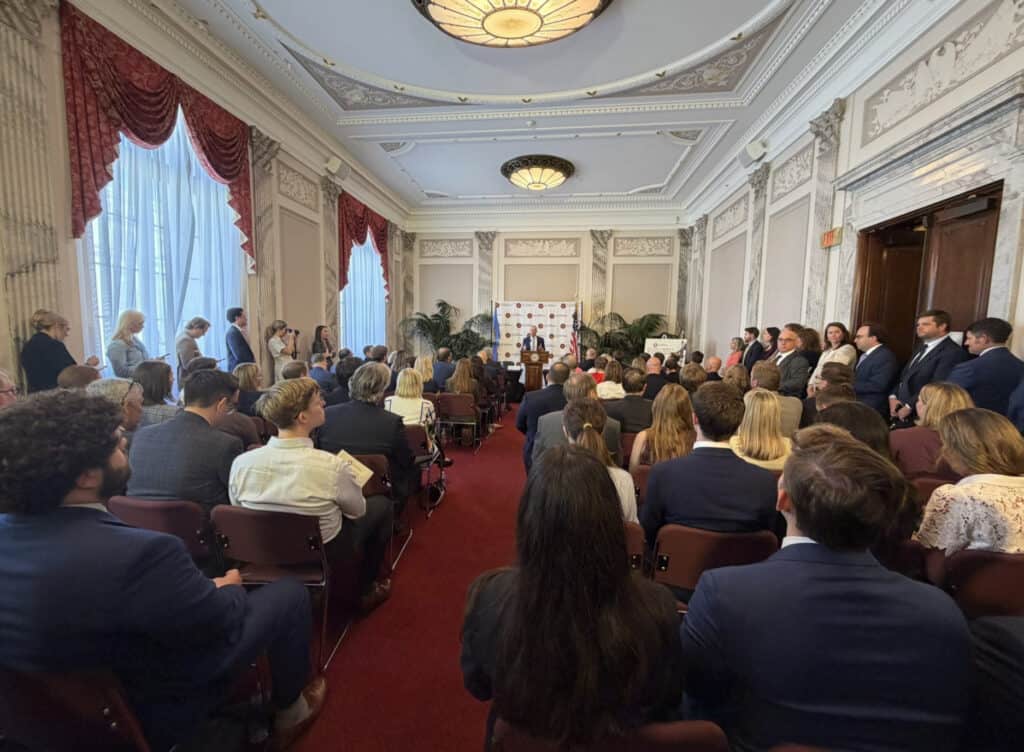
The newest member of the Senate — someone most political insiders had never heard of three months ago — flexed his industry clout with a full house on Capitol Hill for an in-depth discussion on energy security and the urgent need for permitting reform.
Just months ago, now-Sen. Alan Armstrong (R., Okla.), was the CEO of the Williams Companies. But, he found himself serving as America’s newest senator following then-Sen. Markwayne Mullin’s (R., Okla.) ascension to serve as the new Secretary of Homeland Security. Throughout his event, he showed that he knows what he’s talking about when it comes to oil and gas. Armstrong spent nearly 40 years at Williams, starting as an engineer building pipelines in the 1980s, before spending the past 13 years as CEO.
That industry expertise sets Armstrong apart from all of his colleagues. What’s remarkable is how he’s used that firsthand knowledge in his new role as Oklahoma’s junior senator with a single-track focus on passing permitting reform to help not only the oil and gas industry he came from, but also the entire energy sector and critical infrastructure buildouts.
Sen. John Barrasso (R., Wyo.), the Senate’s Majority Whip, said at Armstrong’s event that he is “focused like a laser beam. Most senators are focused like a disco ball, shining all over the place.”
His event on Capitol Hill today that his commitment is paying off. Armstrong referred to it as a “pep rally for permitting reform” with a lineup of familiar faces, including one of his Democratic colleagues.
Joining Armstrong and Barrasso were Sens. Senator Peter Welch (D., Vt.), Cynthia Lummis (R., Wyo.), Lisa Murkowski (R., Alaska), Steve Daines (R., Mont.), Jon Husted (R., Ohio), Gov. Kevin Stitt (R., Okla.), and Reps. Mike Collins (R., Ga.), Mariannette Miller-Meeks (R., Iowa), Troy Balderson (R., Ohio), and Pete Stauber (R., Minn.).
Armstrong’s unrelenting attention on energy and mineral infrastructure is an impressive accomplishment on Capitol Hill, where the constantly-evolving news cycle has trained politicians to jump from topic to topic at a moment’s notice. His unique position as a senator with an abbreviated term and no reelection gives him the freedom to pursue this passion project with few distractions. Oklahoma law prohibits appointed senators from running for reelection.
It was standing-room-only for Armstrong’s bipartisan lineup of legislative heavy-hitters, and the energy in the room matched Armstrong’s use of the phrase “pep rally” for a topic that frequently emerges as a rare consensus mission for the House and Senate this year. Attendees seemed fired up at the prospect of finally passing a bill to address the obstacles faced by seemingly anyone trying to build infrastructure in this country.
“China now generates more than twice as much electricity as the United States,” Armstrong emphasized. “They are building infrastructure at a pace that allows them to scale industries, deploy technology, and strengthen their economic influence. Meanwhile, America has thousands of miles of energy infrastructure stalled by delay and uncertainty.”
For his part, Stauber highlighted a project in his district that has been stalled for 20 years thanks to permitting delays and frivolous lawsuits. “Without permitting reform, we can’t build the critical infrastructure necessary to restore American energy and mineral dominance, which is essential to lowering energy costs,” he said.
There was a consensus from the elected leaders that now is the time for permitting reform. Murkowski remarked, “We have a great but closing window to get this done and need to make it our top priority.”
Armstrong used his time at the mic to rally the cross-sector industry troops in the audience — and also to make a surprise announcement: he’s introducing the American Energy and Mineral Infrastructure Act in conjunction with this event to put the priorities his colleagues discussed on paper.
“We can have strong environmental protections and a permitting system that actually works,” he said. “America’s future depends on our ability to build.”
The industry panel featured a surprising show of unity across sectors, with traditional energy industry veterans sitting next to renewables, all in agreement on the issue at hand: America needs to build again.
The participants, which included executives from the American Gas Association, ACORE, the Steel Manufacturers Association, and the Solar Energy Manufacturers for America (SEMA) Coalition, shared a common theme of their industries needing predictability and consistency in order to grow.
While most freshman senators — Armstrong included — toil in low-tier committees, Armstrong is not letting committee jurisdiction box him out of the energy portfolio. With existing relationships across the energy industry and on both sides of the aisle, he sees himself as a coalition builder and catalyst for action.
Armstrong acknowledged the wide range of industry leaders in the room, saying that “the fact that so many different voices have come together around this issue speaks to something important: permitting reform is no longer a niche policy discussion. It is increasingly recognized as one of the central economic and competitiveness challenges facing our nation.”
Governor Stitt’s presence was a reminder of who put this whole plan in motion. When President Donald Trump nominated Mullin to be the next Secretary of Homeland Security, Stitt saw a rare opportunity to use what could have been a largely symbolic, short-term appointment to the Senate as an adrenaline shot to revive the fight to pass a permitting reform bill into law.
“What we all want is a fair, predictable technology-neutral process that lets every legitimate project compete on a level playing field,” Stitt said. “States are ready — we’ll compete for projects. We’ll drive innovation, We’ll keep energy affordable. And we’ll make sure that ‘Getting America Building Again’ is more than a slogan.”
It’s clear that Armstrong is taking that mandate seriously, and industry leaders are too.
Miller-Meeks summed the mood up by nothing that “there was an Armstrong who was the first man to walk on the moon, and I think it’s gonna be another Armstrong that finally gets permitting reform done here in Washington, D.C.”