The European Union’s (EU) decision to apply its Digital Markets Act (DMA) to American companies like Microsoft and Amazon was quickly met with derision by President Donald Trump, national security experts, and consumer advocates, who view the move as yet another anti-American regulatory move from the EU that targets American companies.
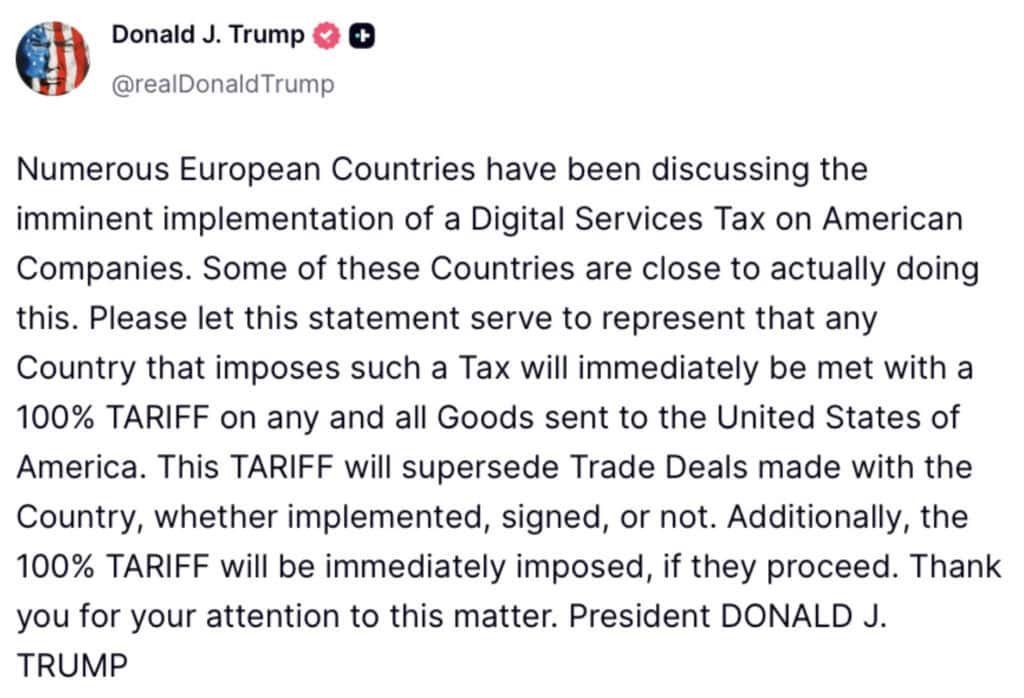
Following the decision, Trump announced that “any Country that imposes such a Tax will immediately be met with a 100% TARIFF on any and all Goods sent to the United States of America…This TARIFF will supersede Trade Deals made with the Country, whether implemented, signed, or not.”
Among the possible beneficiaries of the move that targets American tech companies is China, one expert is cautioning. Michael Lucci, the founder and CEO of State Armor, called the move “the worst time for Europe to pick yet another unnecessary fight with the U.S.”
The EU’s decision comes as “America is slashing the usage of Chinese technology at both the state and national level,” he explained. “Meanwhile, the EU appears to be taking a step in the opposite direction even though China is about to broaden its ongoing trade war against Europe. By unfairly targeting and ultimately alienating U.S. technology providers, European policymakers risk creating conditions that increase dependence on Chinese alternatives, potentially exposing critical systems to greater espionage and sabotage risks.”
Lucci, one of America’s leading China hawks, added that the regulatory expansion follows a pattern of EU regulations. “The EU’s latest crackdown on American cloud providers continues this pattern and could undermine data security, weaken intelligence-sharing relationships, and strain broader economic ties between Europe and the United States in favor of Communist China.”
The EU’s expansion of DMA is the latest in what critics view as a series of moves designed to expressly make it harder for American tech and telecommunications companies to operate in Europe. European officials have said these rules and regulations are designed for American companies to “[feel] the pain.”
Among the groups praising Trump’s move is Public Policy Solutions (PPS) praised Trump for delivering “a strong counterstrike.” PPS said Trump’s move sends “a strong message to the EU: Stop your assault on American companies or face unyielding retaliation. For too long, Europe has targeted our tech companies with digital services taxes and punitive fines.”
Trump alums, like Joe Grogan, explained that “the EU’s so-called digital sovereignty scheme is little more than a half-baked ploy to target American companies. They have no way to fund this plan and their draconian regulatory regime has prevented them from developing their own domestic champions capable of supplying the infrastructure for AI and cloud services.”
Grogan, the co-founder of PPS, added that “pursuing a policy agenda focused primarily on hindering U.S. tech leadership will hurt the EU in the long term and weaken our relationship as the Trump administration works to find a path forward to resolve the ongoing trade dispute.”