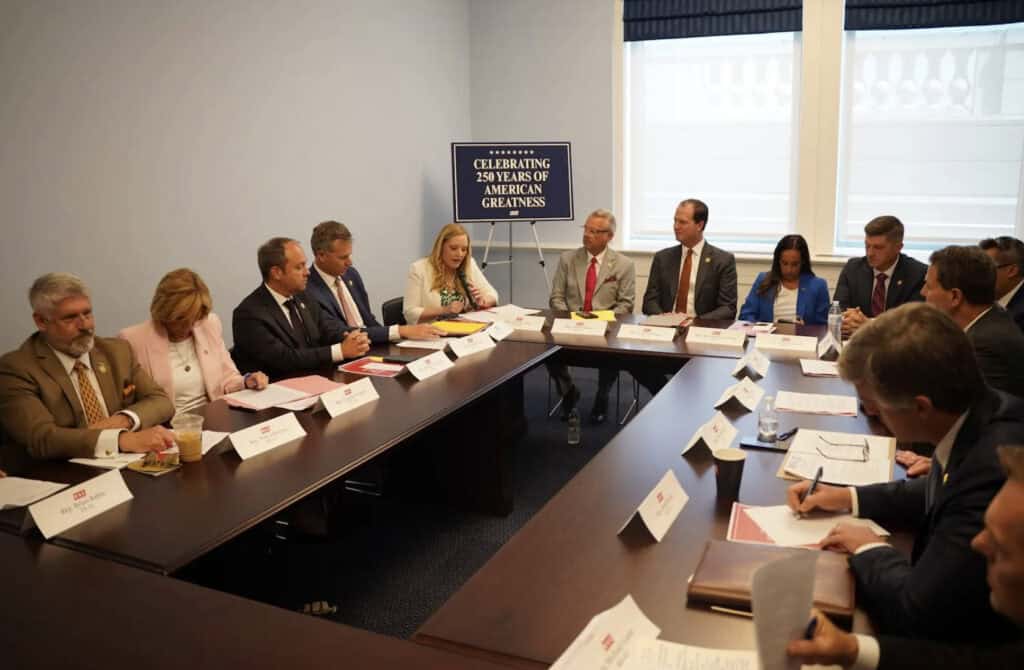
As Americans gear up to celebrate America’s 250th birthday, Republicans in the conservative Republican Study Committee (RSC) joined forces to share what they think makes America special — and to tell the Washington Reporter what they would put in a time capsule for America’s 500th birthday.
Rep. August Pfluger (R., Texas) led a roundtable of RSC members who discussed how everything from Indiana limestone to religious liberty have formed the cornerstones — literally and metaphorically — of so much of America’s history. Pfluger and his colleagues laid out their visions to “secur[e] generational wins to lock in another 250 years of American dominance.”
“The American Dream is alive and well,” Rep. Mike Kennedy (R., Utah) said.
“250 years ago, this country began as one of the boldest experiments in world history,” Rep. Mark Alford (R., Mo.) explained. “In 1776, ordinary people — farmers, craftsmen, small business owners, stood up to the most powerful empire in the world…declaring that our rights don’t come from government, they come from God almighty. They took a risk on an idea that people could actually govern themselves, and guess what? 250 years later, it’s working.”
Rep. Claudia Tenney (R., N.Y.) gave attendees an overview of how even states like New York, which played a critical role in the “heroic age” of America’s founding can lose their way. “When we think of our Founders, yes, they’re heroic and incredible, but we’ve kept up that tradition…[but now] communism is on the rise, Marxism, anti-Semitism…now it’s more important than ever for us to renew our faith in our Founders and in our self-governance.”
“Nothing in the history of humanity, no rules, no laws, no systems of man have done more to improve the human condition than free market capitalism and the type of government we have here,” Rep. Troy Downing (R., Mont.) said, noting that it is important to continue those policies moving forward.
Throughout the roundtable discussion, lawmakers touted everything from Trump Accounts — with Rep. Blake Moore (R., Utah) lauding them — to how Republican governance can help football teams like the Chicago Bears relocate a few miles over to Indiana; Rep. Marlin Stutzman (R., Ind.) in particular sounded eager about that possibility.
Rep. Pete Stauber (R., Minn.) homed in on the fraud in his home state of Minnesota and noted that it was Republican lawmakers who have helped shine a light on it. “This president, this administration, is stopping it.” Rep. Brad Finstad (R., Minn.) added that he has seen firsthand that “fraud is real…fraudsters are taking the money” that should be going to American taxpayers. “It is common sense versus crazy,” he added.
Rep. Vince Fong (R., Calif.) was another lawmaker who noted that many of the GOP’s wins came despite opposition from Democrats, like his home state’s governor, Gavin Newsom (D., Calif.). “As a Californian, it was extremely important” that they secured the border in the bill.
Rep. Michael Cloud (R., Miss.) read a letter from one of his constituents who thanked him and his colleagues for the tax relief that the Working Families Tax Cuts (WFTC) brought to seniors. “It was only $103, but it sure beat paying additional money after paying in thousands during the year,” his constituent wrote. Rep. Brad Knott (R., N.C.) was another who noted that the WFTC also helped to secure America’s border.
Rep. Adrian Smith (R., Neb.) was another voice who helped shepherd the WFTC into law, and he spoke about how its policies, like no taxes on tips, were essential for American workers. “My priority of school choice [was] included in the bill” too, he added.
While America’s 250th birthday is an opportunity for reflecting, lawmakers like Rep. Brian Babin (R., Texas), the Chair of the House’s Science, Space, and Technology Committee, were eager to celebrate the “cutting-edge technologies” that will allow America to “usher in a new Golden Age” in the future. That type of innovation, Rep. Mike Haridopolos (R., Fla.) cautioned, almost vanished when President Barack Obama was in charge.
Rep. Jeff Crank (R., Colo.) said added that America’s “best days lie ahead.”
Rep. Erin Houchin (R., Ind.), who recently put a piece of Indiana limestone and a photograph of Indiana’s national championship football team in a time capsule that will be opened on July 4th, 2276, explained that the former lies at the foundation of everything from the Pentagon to the Empire State Building, and beyond.
The Reporter asked the RSC members what they too would put in the time capsule. “I’d put in a can of Spam,” Finstad said. “We know it’ll last another 250 years…it signals the importance of agriculture to this country,” and it comes from the heart of his district.
“We’re the food production capital of California, we’re the agriculture capital of California, and we’re the aerospace capital of California,” Fong said of his district. “I’d put in some agriculture products, a barrel of oil, and Chuck Yeager broke the sound barrier in my district,” so he’d add something to commemorate that as well.
Downing would want to “put a big ol’ silver belt buckle, made in Montana, to represent the west,” he said. Crank would put the “green flag that I was able to wave last week at the 103rd running of the Pike’s Peak International Hill Climb,” he said.
“I’d like to have people come visit,” Haridopolos said. Tourists who come to his district for more than three days will see space launches. “I would say a tobacco leaf,” Knott said. “In North Carolina, we were growing tobacco before we were a state.”
Alford, who initially said he would put Kansas City barbecue in before realizing that it might not last for 250 years, revised his answer to be a Hallmark card. Stauber, who represents northern Minnesota, did put a picture of Lake Superior and an ore carrier in an America 500 time capsule. Guest said that he would put recordings of the visitors to the World Cup. “It is truly amazing to see people from across the globe who have never set foot in our country coming and seeing the greatness of America.”