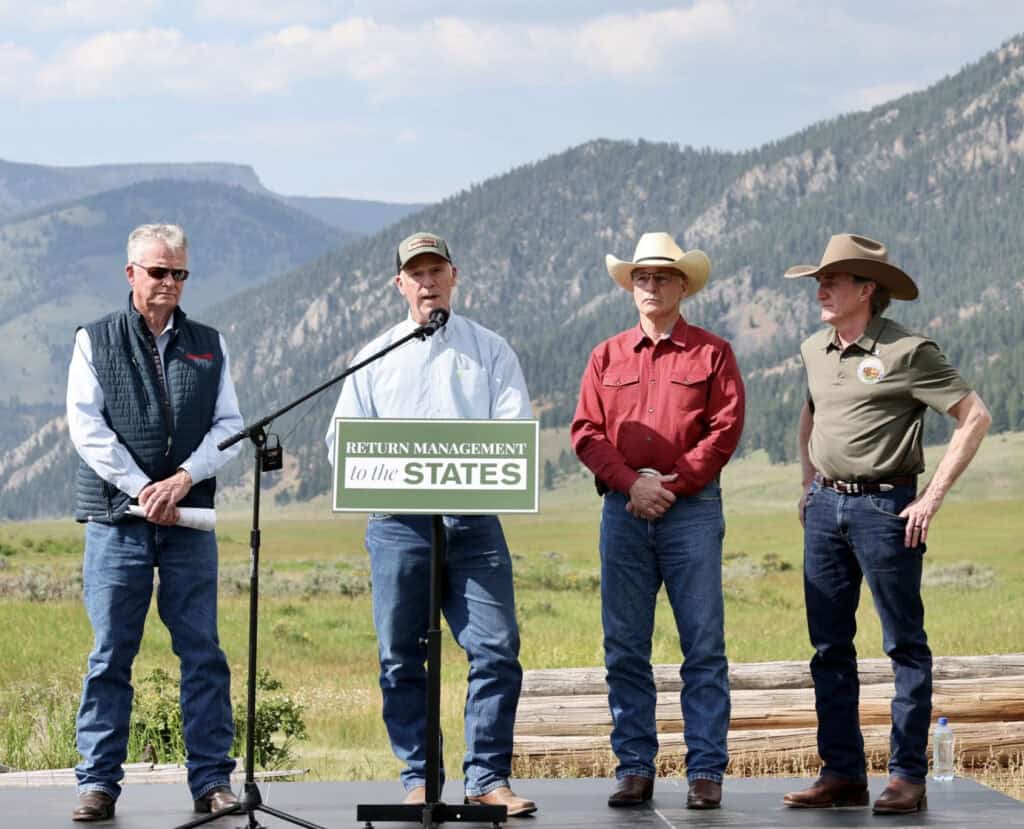
Interior Secretary Doug Burgum and a trio of GOP governors celebrated moves from the Trump administration that Gov. Greg Gianforte (R., Mont.) said will give states much-needed flexibility to manage the growing grizzly bear populations across Montana, Wyoming, and Idaho.
Burgum, Gianforte, and Govs. Brad Little (R., Idaho) and Mark Gordon (R., Wyo.) convened in Montana to discuss America’s success in rehabilitating grizzly bear populations, and what comes next for the cherished animal.
“Thanks to the work of Montana Fish, Wildlife, and Parks, the U.S. Fish and Wildlife Service, and many Montanans over decades, the grizzly bear recovery story is one of America’s great conservation successes,” Gianforte said. “With this success has come a challenge — bears have expanded into new areas and conflicts have increased with farmers, ranchers, recreationists, and residents. Returning management to the states is a welcome change and Montana is ready to lead to balance conservation and the safety of our communities.”
Burgum, himself a former governor, explained that “the science is more than clear,” and that “grizzly bears have recovered and far exceeded every federal recovery benchmarks.” Consequently, the former North Dakota Governor announced that the Interior Department is “returning conservation leadership to the Western states instead of Washington bureaucrats. Under the leadership of President [Donald] Trump, we’re following the science, upholding the law and ending politics masquerading as conservation.”
These rules are expected to give states increased flexibility in how to manage grizzly bear populations in areas where the grizzly population has either met or exceeded the benchmarks set by the federal government, while also preserving protections under legislation like the Endangered Species Act (ESA), which listed grizzlies as a “threatened” special in 1975; at that time, there were only several hundred grizzlies left in the continental United States. Now, estimates put their number at over 2,000.
The proposed rule change under Burgum is the first major reform to grizzly management since the species was listed; if enacted, the rule would allow states like Montana to increase their ability to manage grizzly populations in areas where the species is thriving.
For years, Gianforte has petitioned administrations of both parties, asking for increased flexibility for how to handle grizzly populations. Now, he may get it. “With a statewide management plan in place and our decades of on-the-ground experience, Montana is ready to take over management of grizzly bears,” Christy Clark, the Director of Montana’s Fish, Wildlife, and Parks (FWP), said. “Our specialists follow the best available science and utilize existing relationships with ranchers, landowners, and recreationalists to maintain conservation efforts while supporting the communities that call grizzly bear country home.”
Burgum’s moves were quickly praised by Montana’s congressional delegation, including Sens. Steve Daines (R., Mont.) and Tim Sheehy (R., Mont.). “It’s long past time to delist the grizzly bear,” Daines said. “I commend Secretary Burgum and his team for recognizing this and taking a good first step in the process by expanding state management of the grizzly.”
Sheehy added that Burgum’s announcement “marks an important step towards returning management of grizzly populations to the state level where it belongs. I look forward to working with the Trump Administration going forward to delist the grizzly bear and support the needs of local communities.”
Both Reps. Troy Downing (R., Mont.) and Ryan Zinke (R., Mont.) — who previously held Burgum’s job — back the move as well. “Montanans understand the importance of localized wildlife management for our landscapes and communities better than anyone,” Downing said. “This proposed rule is a commonsense step that empowers states to manage their respective grizzly bears populations in an evidence-based manner while maintaining federal protections. Local experts need the ability to respond to conditions on the ground, especially when public safety and conservation are both at stake.”
Zinke added that “this announcement is a long time coming and very good news for many communities and the wildlife within the Yellowstone ecosystem and across bear country. Like the bald eagle before it, the recovery of the grizzly stands as one of America’s great conservation success stories — the culmination of decades of hard work and dedication on the part of state, tribal, federal, and private partners.”
On a federal level, Brian Nesvik, the U.S. Fish and Wildlife Director, said that “grizzly bear conservation has steadily advanced over the decades in many portions of the species’ range. This proposal recognizes these successes and right-sizes management where the greatest conservation success has taken place. This action would support the administration’s priority of easing regulatory burdens through common sense flexibilities in management.”
Gianforte has much to celebrate in recent weeks; the Montana governor also announced that his state is in the top ten for job growth.
“Montana continues to rank as one of the best states to start or grow a business, earn a competitive wage, and secure a good-paying job,” he noted. “As we continue to reform our regulatory environment to support job creators and cut taxes to give money back to the hardworking Montanans who earned it, we see the results of conservative policies at work as the Treasure State ranks in the top ten states with the strongest job growth.”