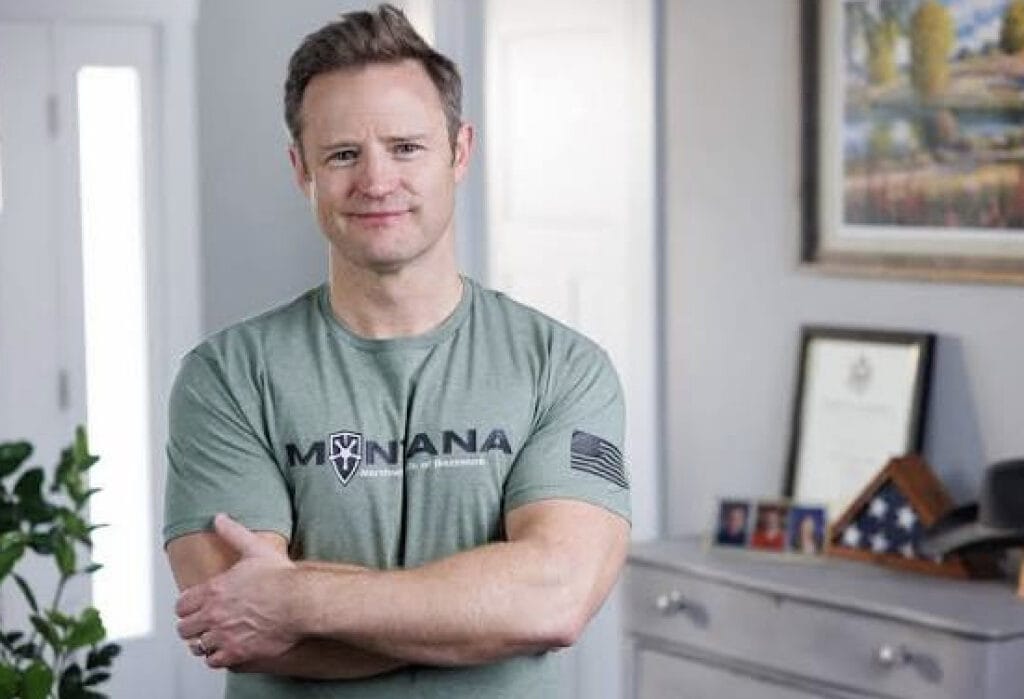
BUTTE, Montana —
For over 20 years, Aaron Flint served in the U.S. Army — like many 90s kids, the September 11th terrorist attacks changed his life forever. On that day, he was working in Washington, D.C. for one of Montana’s senators, but he knew in that moment that he wanted to join the Army.
In the decades since that attack, Flint has had a distinguished career in and out of the military — for years, he’s been Montana’s top conservative radio host, and now he’s running for Congress to succeed another military veteran, Rep. Ryan Zinke (R., Mont.).
In an interview with the Washington Reporter from Shawn O’Donnell’s Irish Pub, Flint explained why he’s making his first run for office since his successful campaign to be president of the University of Montana’s student government.
“It’s not just the importance of this seat,” Flint explained. “I truly believe that this House seat here in Western Montana could determine control of the U.S. House of Representatives the way the margins are right now.”
While the stakes are national in this race, which Democrats are heavily contesting, Flint emphasized that there are major local issues at stake as well. “But even put all that aside, we have to keep this seat here in Western Montana. We actually have the opportunity to get some things done right now. When Zinke got a hold of me back in late January and told me ‘after 35 years of government service, I am looking to retire.’ After 23 years as a Navy SEAL, as a legislator, in Congress, as Interior Secretary, and as Congress again, it was time for him to retire. Ryan Zinke held this seat when we thought it might fall to the Democrats, and Zinke came to me and he said ‘look, Aaron, there are some folks who can win the primary, but they’ll lose the general. There are some folks who can win a general, but they can’t get through the primary. You’re the guy who can do both.’”
“I understand how important this seat is, not only to control of the U.S. House of Representatives, but also to the future direction of Western Montana,” Flint said. “If we allow these guys to take over, these are not your old school Blue Dog Democrats anymore. They’re just all about the crazy stuff right now, and they want to turn Western Montana into Portland. They want to turn Western Montana into these failed West Coast cities, and we’ve got to keep the crazy out of Montana. We also have to make it to where we have opportunities for my kids and eventually my grandkids to be able to stay and live and work here in Western Montana, because over the past few decades we’ve had these far-left groups come in here with these far-left judges and they’ve destroyed opportunities for everyday Montanans.”
Flint described the Montana Republican Party’s entire ticket as one of “common sense,” in contrast with the “crazy” of the Montana Democrats. “They killed our timber industry, which has destroyed our forests,” he said. “They blocked mining opportunities, and now we’ve got some rural communities here in Montana that are struggling. It’s not really one thing, as you can tell. It’s the importance of the race on a national level, the importance of the race here for Western Montana, and then also opportunities for our young kids moving forward.”
Flint’s Democratic opponent, Sam Forstag, is one of many Democrats running in red-leaning districts around the country who Republicans argue are wolves in sheep’s clothing.
“Look at this race for Congress, the Working Families Tax Cuts, is a huge tax break with no tax on Social Security, and my opponent already said he would have voted against that,” Flint explained. “My opponent would have voted to keep taxing Social Security, my opponent would have kept taxing tips. My mom was a single mom who worked as a waitress. I worked as a waiter and a busboy through high school and college, and my opponent would have voted to keep taxing tips. Yet he pretends to be the working class candidate. It’s absurd.”
The contrast between Flint and Forstag, and between what Republicans and Democrats are pushing for across the nation, has helped Flint score several critical union endorsements during his campaign to keep Zinke’s seat red.
“I’m sure my opponent is a nice enough guy, but he’s a far-left lobbyist from Portland who literally lobbied for sanctuary cities, for illegal aliens, for men in girls bathrooms, for men in girls sports, and he worked for an outfit that wants to defund the police,” Flint said. “This is the craziest of the crazy, and that’s why I think a lot of old school Democrats or Democrat-leaning groups like the trades unions are going to say ‘enough of this craziness. We can’t even vote for that,’ and they know that I’m a guy who’s been fighting for working families here in Montana for decades.”
That distinction is important, because Flint noted that affordability issues are at the front and center of his race, as they are with so many across America. But he blamed President Joe Biden and former Sen. Jon Tester (D., Mont.) for many of those problems.
“People need any kind of relief they can get right now,” Flint explained. “You’ve got single moms who have kids playing sports that have to buy new running shoes that have to travel long distances to take their kid to a volleyball tournament or things like that. Every single dollar we can allow them to keep in their pocket is a huge difference for these working families out here right now, especially after what we saw during the Joe Biden, Jon Tester years, where we saw a 31 percent increase in energy inflation alone. Restaurant inflation was over a 20 percent increase. A lot of people just stopped going out to eat, and so whatever we can do to allow people to keep more of what they earn makes a big difference in a place like Montana, where frankly most people are living paycheck to paycheck.”
For Flint, his years in the military and in the media are assets that he’s leaning heavily on to make his case to voters.
When it comes to his military service, he pointed back to how former Speaker of the House Newt Gingrich pinned his Airborne wings on him while he was at Fort Benning, Georgia.
While that moment was remarkable for that alone, Flint said that it also inspires how he looks at politics.
“I was a kid in the ’90s, and I know that ’90s music is coming back again,” Flint explained. “But I want to bring back the ’90s balanced budgets. Bill Clinton and Newt Gingrich, Democrats and Republicans, we can dissect that however we want, but they actually balanced the budget. We need to get back to that again here in America. I was actually talking about this with the Carpenters Union guys at the Union Hall, about bringing the 90s back and bringing back balanced budgets. In Helena, Montana, whether you’re a Democratic governor or a Republican governor, you have to balance the budget. It’s a requirement. We need to have a balanced budget requirement in Washington D.C.”
But that is not enough, he added. “I also think it’s also why we need to ban congressional stock trading. I think part of the reason why we have $40 trillion in debt is because we’ve got a bunch of politicians back in Washington, D.C. who are getting rich off the backs of taxpayers, while we sit back here and barely get ahead or fall behind,” he said. “If we ban congressional stock trading, I think some of these clowns that have been basically making money off the backs of taxpayers that have been sitting back there for 40 years-plus will finally pack their bags and leave, and I think that will help us balance the budget as well. We also have to make it so that if they can’t pass a budget, they shouldn’t get paid. If they can’t do their job, they shouldn’t get paid.”
Flint’s candidacy is unique, because while he is a first-time candidate for Congress, he knows the Hill better than most first-timers, having worked for then-Sen. Conrad Burns (R., Mont.).
Flint told the Reporter that, if he has his druthers, he’d like to serve on both Appropriations and on Energy and Commerce, should he win in November.
“Appropriations, specifically Interior Appropriations, is huge,” he explained. “We’ve got such a high percentage of federal land here in this western district. We’ve got to keep public lands in public hands, but we’ve also got to have better management of our federal lands as well. Through the Interior Appropriations Committee, you’ve got your hand on some levers to not only really make sure that rural Montana is not forgotten, but you’ve also got some levers where you can have a little bit more influence over these federal land management agencies as well. The other one would be Energy and Commerce. Troy Downing, our Eastern District Congressman, is on the Natural Resources Committee. I’ve always enjoyed energy policy ever since I was working on energy policies as a young staffer and as a broadcaster. And then there are some incredible veteran entrepreneurs. Tim Sheehy is an example of that. These incredible veterans who started these incredible businesses right here in Montana. That’s why Energy and Commerce would be an incredible opportunity as well.”
Flint believes that his time working on the Hill as a staffer would allow him to be a “mustang” in Congress. In the military, he explained, “the mustangs were the men and women who had served as enlisted soldiers, and then they became officers, so they knew the hard work that it took to get the job done. So when they’re in that decision-making capacity, they know the hard work that it takes to get that legislation across the finish line. They also know the work and communication that it takes to communicate with folks back home to ensure that this legislation is going to be what the people back home need and want.” Flint believes that Rep. Richard Hudson (R., N.C.), the chair of the National Republican Congressional Committee (NRCC), embodies those mustang traits.
Flint, who has lived all over Montana, said that he hasn’t visited many new places in his state during his campaign, in part because he’s traversed so much of Montana. However, he has met many new people, including many who had only heard his voice on the radio in the past.
In one instance, he said, “I was at the Rocking R Bar in Bozeman during my campaign, and this was one of my favorite experiences. This lady loved listening to my show. She was the same age as my grandma, class of 1955. She comes to our event at the Rocking R Bar, and I shake her hand, and she holds onto my hand like this for five minutes while we’re talking, and we’re talking about everything. Well, after that, her daughter came up to me, and she said, ‘my mom never goes to bars, she’s never been to the Rocking R Bar, but she came here to see you’ for one of our meet and greets, and so that was a really cool event. This lady is one of my grandma’s friends, and now she’s coming up to talk to me at an event for my campaign.”
Below is a transcript of our interview with Aaron Flint, lightly edited for clarity.
Washington Reporter:
When Congressman Ryan Zinke announced that he was retiring, what made you want to run for this office?
Aaron Flint:
It’s not just the importance of this seat. I truly believe that this House seat here in Western Montana could determine control of the U.S. House of Representatives the way the margins are right now. But even put all that aside, we have to keep this seat here in Western Montana. We actually have the opportunity to get some things done right now. When Zinke got a hold of me back in late January and told me ‘after 35 years of government service, I am looking to retire.’ After 23 years as a Navy SEAL, as a legislator, in Congress, as Interior Secretary, and as Congress again, it was time for him to retire. Ryan Zinke held this seat when we thought it might fall to the Democrats, and Zinke came to me and he said ‘look, Aaron, there are some folks who can win the primary, but they’ll lose the general. There are some folks who can win a general, but they can’t get through the primary. You’re the guy who can do both.’ I understand how important this seat is, not only to control of the U.S. House of Representatives, but also to the future direction of Western Montana. If we allow these guys to take over, these are not your old school Blue Dog Democrats anymore. They’re just all about the crazy stuff right now, and they want to turn Western Montana into Portland. They want to turn Western Montana into these failed West Coast cities, and we’ve got to keep the crazy out of Montana. We also have to make it to where we have opportunities for my kids and eventually my grandkids to be able to stay and live and work here in Western Montana, because over the past few decades we’ve had these far-left groups come in here with these far-left judges and they’ve destroyed opportunities for everyday Montanans. They killed our timber industry, which has destroyed our forests. They blocked mining opportunities, and now we’ve got some rural communities here in Montana that are struggling. It’s not really one thing, as you can tell. It’s the importance of the race on a national level, the importance of the race here for Western Montana, and then also opportunities for our young kids moving forward.
Washington Reporter:
This sounds similar to when you decided to run for president of University of Montana. You weren’t looking at it, and then you threw your hat in the ring. Was that a thought in your mind, or were these two totally separate thought processes?
Aaron Flint:
They were two totally separate thought processes. I got back from Afghanistan in 2009, and that’s when I first started in statewide talk radio. It’s what I’ve always wanted to do. I love doing it. I love every day getting to talk to people all across the state, taking phone calls from anybody. I had the ability to basically reach out and talk to anybody I wanted to talk to. I could always get great guests on the show. I could have an impact, but still be on a pontoon later that afternoon if I wanted to. I had people for several years encourage me to run for an office like this because I’m on the radio, I’m a combat veteran, and because people know what I stand for. But I didn’t want some stupid title. I didn’t want to go back to Washington, D.C. And why would I go back there? Just to bang my head against the wall and get nothing done? But I think right now we actually have the opportunity to get some things done, and I think that Tim Sheehy is a great example of that. Being a fellow veteran, my wife and I knew him and Carmen before anybody finally smartly convinced him to run for office, but he’s proven that as a freshman senator, you can actually get some things done, and you can actually work with the other side without compromising your principles. He’s doing that on wildland firefighting policy right now.
Washington Reporter:
When you’re on your own radio show, you’re not limited to a 10 second soundbite, but when you’re a candidate, you don’t get the airtime that you have when you’re running a show. How do you distill everything that you would talk about for years on the radio into that 30-second TV ad, into that two sentences in the newspaper, in order to get that message across to people who haven’t heard you in the past?
Aaron Flint:
That’s a good point. It’s almost like when you’re going to a commercial break and you can hear the music running, and you’re trying to communicate a thought, but you have to spit it out quick. But sometimes that’s when your best thoughts come out, when you just put it in plain language. You just say what you really think, and I think that’s what I really love about getting out and talking to people. Here in Butte at the Union Hall just a few minutes ago, I didn’t have to stick with some scripted speech, I can just say what I really believe and say what I really feel. Sometimes my team will joke ‘we know you’ve got all these great stories because you’ve been talking to folks all across Montana all these years. But get to the point right away, and then get into story time.’
Washington Reporter:
How would you prep for your radio show versus a day in the life of a campaigner? Were you one of the guys on radio who needed a script and you would mostly ignore it, like Trump with his speeches? Or would you wing it the whole show?
Aaron Flint:
I would pretty much wing it the whole show. I would wake up at 3:30 in the morning and consume every source I possibly could consume. I’d grab as many audio highlights that I could possibly grab, because then once the show started at 6:06 in the morning, it was game on for the next four hours, and I really only had time to go get coffee during the commercial break. When I first started in talk radio, I tried to script it because I worked in TV, and finally I just realized you can’t script this stuff. You’ve just got to throw it out. You’ve just got to talk to people, and I feel like it’s the same way. So many of these these politicians have been so scripted for so long, and they forget that you just have got to get out and talk to people. And what I also found, because I take phone calls from people all morning long, and anybody could call in. I found that if you listen long enough, eventually you can find a point of agreement with anybody if you just listen long enough. That was a key thing. What I learned in the radio show is that sometimes what you think is news, the big news story of the day, or sometimes what everybody else thinks is the big news of the day, may not be the biggest story of the day that gets everybody talking. I remember when Biden was president, they announced they were going to start banning gas stoves and gas appliances, and it was a quick news story that came on at the top of the hour. I was planning to talk about five or six different things. The moment our listeners heard that Democrats wanted to ban gas stoves and gas furnaces, I had plumbers calling in saying how stupid of an idea that was. I had people who loved to cook with a gas stove instead of electric stove. That was the topic for the next two hours. It didn’t matter how many other big news stories there were. That’s what people wanted to sound off and talk about. That’s what you learn when you go out and talk to people. You find out what really matters.
Washington Reporter:
How has what you’ve been hearing from Montanans changed or stayed the same from when you were taking their calls as a radio host to now knocking on doors as a candidate for Congress?
Aaron Flint:
I think it’s the same. I don’t think it’s changed. When you’re behind a microphone sitting in a studio, people will call in and there might be some people who are concerned about one thing, but there might be a whole bunch of people who aren’t concerned about that. But when you get out and you go talk to people, that’s when you find out what people are really fired up about and what people are really concerned about. And that’s why I’ve loved this whole process, to be honest. Because when I go and have meet and greets, or I’m at a parade, or I’m just out talking to people, the same issues that I heard about on my radio show that were of concern to Montanans, it’s reinforced every time I get out on the campaign trail and talk to people in person. For example, if somebody was to ask me, what’s the biggest complaint you heard? What the one thing that stood out through all your years on the radio? It’s taxing Social Security benefits, and it’s been one of the biggest complaints. Every time I get a state legislative leader on the show, every time I get a governor, the biggest complaint our listeners have had, especially the older generations, is ‘I’ve been paying taxes on my Social Security my entire life, and now they’re taxing me again.’ Look at this race for Congress, the Working Families Tax Cuts, is a huge tax break with no tax on Social Security, and my opponent already said he would have voted against that. My opponent would have voted to keep taxing Social Security, my opponent would have kept taxing tips. My mom was a single mom who worked as a waitress. I worked as a waiter and a busboy through high school and college, and my opponent would have voted to keep taxing tips. Yet he pretends to be the working class candidate. It’s absurd.
Washington Reporter:
We’re at an Irish bar that you’ve been coming to for a long time. What has no tax on tips meant for restaurants and servers and bartenders here in Montana?
Aaron Flint:
People need any kind of relief they can get right now. You’ve got single moms who have kids playing sports that have to buy new running shoes that have to travel long distances to take their kid to a volleyball tournament or things like that. Every single dollar we can allow them to keep in their pocket is a huge difference for these working families out here right now, especially after what we saw during the Joe Biden, Jon Tester years, where we saw a 31 percent increase in energy inflation alone. Restaurant inflation was over a 20 percent increase. A lot of people just stopped going out to eat, and so whatever we can do to allow people to keep more of what they earn makes a big difference in a place like Montana, where frankly most people are living paycheck to paycheck.
Washington Reporter:
You’re running for the U.S. House of Representatives now. On September 11th, you were working in the Senate for one of Montana’s senators, and that day changed the trajectory of your life completely. Following those attacks, you were in the military for over two decades. How does that inform your desire to continue serving?
Aaron Flint:
The knee-jerk reaction right now is that there are a lot of military families that just look at what’s been happening in Washington D.C. over the past two-plus decades as just a massive slap in the face to families who sacrificed so much. They see all this money going to all these other countries, and we saw it when we were overseas, and we see the American people getting ripped off by this money going to these other countries, and then we come home, and we get ripped off again, and we see all of our money going to all these other people from all these other countries who came here illegally, and now they’re ripping us off again, and giving free healthcare to illegal aliens when we can barely afford to have health insurance. I just think we’ve seen this repeated slap in the face to the American people, and I think we owe it to all these families that have sacrificed so much to fix this shit, pardon my French. Now, we’ve actually got the opportunity to do it. Now we’ve got people who can step up. People are just sick and tired of what’s happened to our country and what people are doing to our country, even still! After the 2024 election, you think they would have gotten the hint. We don’t want illegal aliens getting all this free shit while the rest of us work our asses off. And the radical left still hasn’t gotten the hint. They think they’re going to get away with it again, which is why we have to stop them this election.
Washington Reporter:
You’re a little bit removed from your time working as a staffer in the Capitol, but what lessons did you take from that time that you want to bring as a legislator?
Aaron Flint:
I had the honor of spending some time with NRCC Chairman Richard Hudson, and he was a former Hill staffer. He was a chief of staff, so he really had experience. I look at guys like that — we would call them mustangs in the military. The mustangs were the men and women who had served as enlisted soldiers, and then they became officers, so they knew the hard work that it took to get the job done. So when they’re in that decision-making capacity, they know the hard work that it takes to get that legislation across the finish line. They also know the work and communication that it takes to communicate with folks back home to ensure that this legislation is going to be what the people back home need and want. I look at the folks who’ve had some legislative experience on Capitol Hill. They’re like a Mustang in the military, they know a little bit about the work that it takes to really get these things across the finish line. I also think you come in with your eyes a little more wide open about the realities of Washington, D.C. and you realize if somebody’s sucking up to you, you should probably be a little skeptical about that. I also think you get these people, and we’re in an Irish pub, so again, pardon my French, but they go to Washington, their eyes gloss over at the experience of the Capitol and all that goes with it, and then they get all these people kissing their ass, and they forget why they were sent there in the first place. If you can go there eyes wide open about the reality, it allows you to be more grounded so that you can focus on getting the job done, and really being somebody who can fight like a team back there too, and work with your caucus, work with your fellow delegation members, and also at times work with the other side without without abandoning your principles as well.
Washington Reporter:
You recently rolled out endorsements from private sector unions. Between now and November, what is the path for you to win to keep both the traditional Republican coalition together and also to reach out to some of those newer communities?
Aaron Flint:
What this shows with this major union endorsement, is that it shows that we are the ticket that is fighting for the working people here in Montana. Whether it’s union jobs at the coal mine in Colstrip, or at the power plant, or union jobs at the Stillwater Mine, or jobs in the timber industry, or mining jobs here in Western Montana, my opponent and his far-left AOC-style socialists are the ones who’ve been killing all those jobs, who’ve been attacking all those jobs. We are the team that’s going to fight for the working people of Montana, and I think these trade unions are recognizing that this is common sense versus crazy, and we’re the ticket that’s common sense. I didn’t just start fighting for working people today because it’s some campaign slogan. I’ve been in this fight, fighting for our timber industry, fighting for mining opportunities here in America, and standing up for these union jobs that frankly, some of these other far-left unions have been the ones attacking. They’ve been killing these jobs. That’s where the common ground is at right now.
Washington Reporter:
You’re describing yourself as running on a ticket of common sense versus a ticket of crazy. What is going on in the Senate race, and how is that impacting your race? Yours is a traditional head-to-head. Your Senate race is anything but traditional.
Aaron Flint:
It’s been crazy watching that Senate race. It just shows what a train wreck the Montana Democratic Party is right now. I’ll tell you what. If you’re looking at what a train wreck the Montana Democratic Party is right now, why would you send a dime to them? The Democrats are probably going to give up on the Senate race now, and they’re going to go out and they’re going to beg all their out-of-state donors to help plow money into the congressional race here in Montana. They’re such a train wreck. Look at what they just did in the Senate race. Why would you even trust these guys with a dime of your money towards a House race? I’m sure my opponent is a nice enough guy, but he’s a far-left lobbyist from Portland who literally lobbied for sanctuary cities, for illegal aliens, for men in girls bathrooms, for men in girls sports, and he worked for an outfit that wants to defund the police. This is the craziest of the crazy, and that’s why I think a lot of old school Democrats or Democrat-leaning groups like the trades unions are going to say ‘enough of this craziness. We can’t even vote for that,’ and they know that I’m a guy who’s been fighting for working families here in Montana for decades.
Washington Reporter:
To put the cart before the horse a little bit, because you’ve already worked on the Hill, are there legislators who you saw when you previously worked there, or who you’ve interviewed on your radio show, who you look at as examples for whom you want to model your time in Congress after, should you win in November?
Aaron Flint:
Well, it was kind of funny. I was in Fort Benning, Georgia, for Airborne school in the Army, and it just so happened that former Speaker of the House Newt Gingrich was there that day, so I got my jump wings pinned on me by Newt Gingrich, which was pretty cool. I say that to say, I was a kid in the ’90s, and I know that ’90s music is coming back again. But I want to bring back the ’90s balanced budgets. Bill Clinton and Newt Gingrich, Democrats and Republicans, we can dissect that however we want, but they actually balanced the budget. We need to get back to that again here in America. I was actually talking about this with the Carpenters Union guys at the Union Hall, about bringing the 90s back and bringing back balanced budgets. In Helena, Montana, whether you’re a Democratic governor or a Republican governor, you have to balance the budget. It’s a requirement. We need to have a balanced budget requirement in Washington D.C. But I also think it’s also why we need to ban congressional stock trading. I think part of the reason why we have $40 trillion in debt is because we’ve got a bunch of politicians back in Washington, D.C. who are getting rich off the backs of taxpayers, while we sit back here and barely get ahead or fall behind. If we ban congressional stock trading, I think some of these clowns that have been basically making money off the backs of taxpayers that have been sitting back there for 40 years-plus will finally pack their bags and leave, and I think that will help us balance the budget as well. We also have to make it so that if they can’t pass a budget, they shouldn’t get paid. If they can’t do their job, they shouldn’t get paid.
Washington Reporter:
I noticed as soon as I landed in Montana, forestry is an incredibly important issue here. What committees would you be interested on, based on both your personal experience and on the issues of importance to your constituents?
Aaron Flint:
Appropriations, specifically Interior Appropriations, is huge. We’ve got such a high percentage of federal land here in this western district. We’ve got to keep public lands in public hands, but we’ve also got to have better management of our federal lands as well. Through the Interior Appropriations Committee, you’ve got your hand on some levers to not only really make sure that rural Montana is not forgotten, but you’ve also got some levers where you can have a little bit more influence over these federal land management agencies as well. The other one would be Energy and Commerce. Troy Downing, our Eastern District Congressman, is on the Natural Resources Committee. I’ve always enjoyed energy policy ever since I was working on energy policies as a young staffer and as a broadcaster. And then there are some incredible veteran entrepreneurs. Tim Sheehy is an example of that. These incredible veterans who started these incredible businesses right here in Montana. That’s why Energy and Commerce would be an incredible opportunity as well.
Washington Reporter:
You’ve been all over Montana. You’ve lived all over Montana. But what is one place that or one person you’ve met on this campaign in particular that sticks in your mind?
Aaron Flint:
It’s not so much places that I never been to, because I don’t know if I’ve been anywhere new, because I traveled a lot for my show, and I grew up here. But one example is that we did a fundraiser in Florence, Montana. And I actually drove past the road to turn in to the fundraiser because I was too busy marveling at this old homestead ranch. I was marveling at it and then I realized that that’s where our fundraiser is. Now, I have the excuse to pop into any town in Montana and go meet people. I was at the Rocking R Bar in Bozeman during my campaign, and this was one of my favorite experiences. This lady loved listening to my show. She was the same age as my grandma, class of 1955. She comes to our event at the Rocking R Bar, and I shake her hand, and she holds onto my hand like this for five minutes while we’re talking, and we’re talking about everything. Well, after that, her daughter came up to me, and she said, ‘my mom never goes to bars, she’s never been to the Rocking R Bar, but she came here to see you’ for one of our meet and greets, and so that was a really cool event. This lady is one of my grandma’s friends, and now she’s coming up to talk to me at an event for my campaign.
Washington Reporter:
Aaron, thanks so much for chatting.