While Jennifer Davis was growing up on a farm, running for office was the furthest thing from her mind. “I always joke that my brothers made sure I didn’t even win a popularity contest when we were growing up,” she told the Washington Reporter in an interview. “I have five brothers who kept me very humble on my farm in Wisconsin.”
But, after 35 years as a small business owner and as a youth sports coach in Illinois’s 8th District, Davis felt that it was time for a change. After Rep. Raja Krishnamoorthi (D., Ill.) vacated the seat for a long-anticipated campaign to succeed retiring Sen. Dick Durbin (D., Ill.), Davis threw her hat in the race.
“Something like 95 percent of incumbents win,” she explained. “I would not have run for this seat unless I had a pathway to victory that was robust and that was real. Look, I spent 35 years up to my eyeballs in data, and we spent a lot of time to make sure that our pathways to victory were strong and that they were real. Once I knew that it was a real and winnable seat, then I started carving out what those pathways are, and it really comes to being a grassroots candidate. I’ve probably coached over 1,000 kids in this district. All of those kids have two parents; having been on the ground for 35 years with my ten kids, I have had a lot of exposure to a lot of different circumstances, and it gives me the opportunity to be a real representative of the people.”
Two of the reasons that Davis is optimistic that she can flip a blue seat in November are that the Democratic Party has yet to rally around her opponent and because voters in the district she is running in are opposed to both Gov. JB Pritzker (D., Ill.) and Chicago Mayor Brandon Johnson.
“JB Pritzker is usually the tagline for a lot of negativity,” she said. “He isn’t quite upside down in his polling. I don’t know how that’s possible, however, because when you walk down the street, it’s hard to find somebody who has had a positive interaction or a positive opinion on him. On our marketing, whenever Pritzker or Brandon Johnson is in our marketing, it all skyrockets.”
While Pritzker is expected to win handily in November, Davis has a warning for Americans in the other 49 states about his record as governor, should he decide to run for president: “You really just need to look at what has happened in our state,” she said. “He brags about a balanced budget, but our budget is balanced with tax dollars that are uncollectible. They’re new taxes. He has increased the quantity of taxes. The budget has skyrocketed, and we don’t have the income to support it. We lost almost 800,000 people during COVID, and they were replaced by non-voting residents. If you just look at the actual results that have come out of the state of Illinois, I don’t know how anyone would elect him to be president.”
Davis is also working to leverage a fractured Democratic Party in her own race; her opponnet, former Rep. Melissa Bean (D., Ill.), she said, “is not a popular candidate. I have personally knocked on over 4,000 doors. I have made over 7,000 phone calls. She is not a popular candidate.”
Illinois’s primaries were much earlier in the cycle than elsewhere; Bean narrowly prevailed over a Democratic Socialists of America-aligned (DSA) opponent, and Davis said that those wounds have yet to heal for the Democrats in Illinois’s 8th District.
“The people who are energized on the Democratic side are energized to the DSA,” she said. “Those are the ones who are energized, and I think the rest are kind of asleep at the wheel, maybe disenfranchised with their own party. I also outraised her significantly, so that also is a representation both of the seriousness that people are taking this race with, and the seriousness that she’s taking the race with. She’s been virtually MIA, the excitement about her in the political circles isn’t there. So it could be assumed that since her fundraising has been relatively dismal and her spending has been high that there is a high probability that she doesn’t have the grassroots support or excitement around her campaign that we do.”
“I’m a farm girl from Wisconsin,” Davis said. “I’m going to outhustle anyone. I will run circles around her, and that’s what I plan to do when I get there. Continuing to bring that mission and demonstrating it with something more than a talk track is really important to the people whose doors I’m knocking on. We have done dozens and dozens of parades, and I have to tell you the excitement around us being there is unparalleled, and we’ve heard this from people who have run parades for decades.”
Should Davis upset Bean, she wants to bring her decades of small business experience to Congress. “Small business is the backbone of our country, and families are it,” she said. “What I always tell people is that this campaign is all about supporting strong families, and those strong families can build strong family businesses. Strong family businesses are what actually build a strong state, and strong states build a strong nation, and it can’t happen in the opposite order.”
Despite Davis being a first time candidate, she spoke about her success in winning over locally elected officials to her cause. “One of the things that was really important to me was to partner with all of the mayors in the district,” she said. “I made a conscientious effort to call each and every one of the 44 mayors in the district. We met with over 30 of them and we have gotten significant quantity of endorsements out of that group, and I am really working together with the mayors. The mayors are where the people are. Most of the mayors are in nonpartisan seats, so they are there working on behalf of the people, not a party, and not for a label, not for a brand, just for the people. It was important to me when I decided to run that I was making sure that I was gluing myself to the people who knew the most about the people.”
During her months on the trail as a candidate, she said that she’s noticed “that the crossover of what I did in business to politics is really not that much different.”
“The only difference between the two is that there’s a finite deadline and there’s a single day when the transaction takes place in politics,” she said. “Beyond that, it’s being financially prudent. It’s being strategic in what you’re doing. It’s using data to the best of your abilities. References are the best way to build a business. So why wouldn’t it be the same in politics? Marketing matters. Your logo matters, and unfortunately, so often the people within your own party can be your biggest opposition. Sometimes I say that Republicans like to attack each other far more than they like to attack Democrats. In my case, I like to tell people, ‘be worried less about the letter behind my name and more about the content of my character and what I can actually do to do the job.’ I don’t need to play partisan games. I’m not a part of their system. I’m not a part of any big money. I just want to get things done, and that’s how you run a business.”
“I would also say that I’m also the mom to ten kids,” Davis added. “Running a household with ten kids means that you have to handle ten different personalities. You are negotiating from the minute you open your eyes until you close your eyes. We as a country are so divided, and if we can just focus on the things that we agree on, we can make progress, instead of being frozen in this conundrum that we’re in right now.”
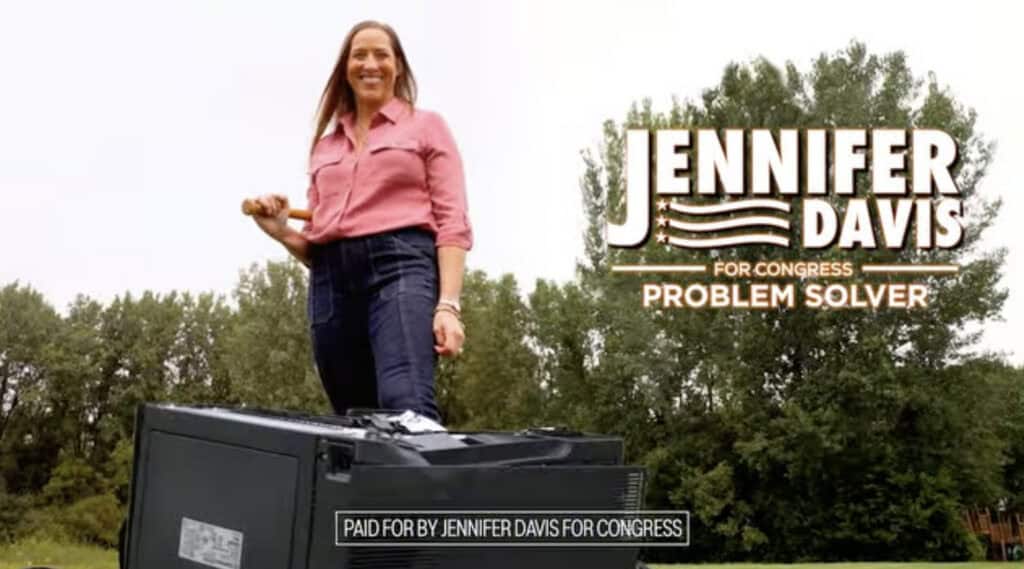
Voters in Illinois’s 8th District have seen Davis on their TVs in recent weeks with her first general election ad, which is a clear homage to Office Space. However, Davis herself has never seen the movie, because “funnily enough, I have never watched TV, so I had to go back and somebody had to show me that show to see what it was related to.”
“However,” she said of her ad, in which she smashes a printer to bits, “I think every single person who has ever printed something in their entire lives can relate to the experience.”
“As it turns out, that printer is really heavy, and when you have to redo that take ten or 12 times, the gasping for air at the end of the video is 100 percent real; I was dying.” she added. “But, its goal is really to demonstrate what we would like to do to the printer and to every printer in our life is is not actually what’s going to get something done. I like to laugh; I like to laugh at myself. We just need to be a whole lot more lighthearted, and people just need to be a little less cynical and a lot less sure about their opinions and more about seeking facts and seeking just getting involved. It was a way to hopefully attract a different audience.”
“I have never been involved in politics, and I often now reflect back and wonder who in the world I thought was doing the work while I was on the sidelines,” Davis said. “I don’t know, but it wasn’t me. If I can attract more people like myself into the political arena, it will open the opportunity up for better politics. People get the representation they ask for because nobody votes, and if we can get people to engage, we will have a very, very different America.”
For years, Illinois has led America in out-migration, and Davis pointed to the 800,000 residents who left the state during the coronavirus pandemic as an exacerbating factor to many of the state’s economic woes. One of the reasons she wants to serve in Congress is so she can keep her family closer to home.
“We have to protect Social Security and Medicare for our seniors, but we have to create a situation where our children aren’t paying for the debt that we are accumulating, and I think we can do that by protecting Main Street America and by making sure that other grandmas like me don’t have to be an O’Hare grandma and go to O’Hare to see our kids,” she said. “If we keep people here, that will help drive the innovation and drive the prosperity of our state.”
Below is a transcript of our interview with Jennifer Davis, lightly edited for clarity.
Washington Reporter:
Jennifer, as you are running for Congress in Illinois, JB Pritzker is running for re-election as governor at the top of your ticket. How has he been doing, and how do you think that he’s viewed by voters in Illinois’s 8th District?
Jennifer Davis:
JB Pritzker is usually the tagline for a lot of negativity. He isn’t quite upside down in his polling. I don’t know how that’s possible, however, because when you walk down the street, it’s hard to find somebody who has had a positive interaction or a positive opinion on him.
Washington Reporter:
Is that true in the 8th District specifically?
Jennifer Davis:
Absolutely; on our marketing, whenever Pritzker or Brandon Johnson is in our marketing, it all skyrockets.
Washington Reporter:
As you’ve been campaigning, what are you hearing as the top issues in this district for voters?
Jennifer Davis:
The biggest things that people are worried about today are all of the kitchen table issues: the cost of living, housing being unaffordable, taxes being unaffordable, and the one-party state that our state is. Those are the things that people don’t feel like their voice is heard on, and they just don’t know how much more our state can take. They’ve watched all their friends and relatives leave. They watched their kids leave, and there are people who feel like they’re stuck here because of their business, but they would otherwise be looking for ways to leave.
Washington Reporter:
Pritzker is looking to run for president; what would you tell people in the other 49 states about his track record?
Jennifer Davis:
You really just need to look at what has happened in our state. He brags about a balanced budget, but our budget is balanced with tax dollars that are uncollectible. They’re new taxes. He has increased the quantity of taxes. The budget has skyrocketed, and we don’t have the income to support it. We lost almost 800,000 people during COVID, and they were replaced by non-voting residents. If you just look at the actual results that have come out of the state of Illinois, I don’t know how anyone would elect him to be president.
Washington Reporter:
In Illinois’s 8th District, this is an open seat because Raja Krishnamoorthi decided to run for Senate. What made you want to throw your hat in the ring?
Jennifer Davis:
I am a complete political outsider. I have never had any desire to get involved in politics, but being a mom in this state and watching all of my friends leave, and watching eight of my ten kids leave the state because it’s an unaffordable state has left me no choice; that requires somebody to get involved, and a federal seat means you’re a representative of the district. For me to be able to represent the people who actually live here is really important. My background is such that I’ve never been involved in politics. I’ve done nothing other than vote because I didn’t understand the urgency of what needed to happen for the citizens, so I want to take my expertise of having spent 35 years in the district coaching kids’ sports teams and running our business that was a software company here in in the district itself. I was signing the front of the paycheck, not just the back, and it gave me a good perspective to really represent the people who actually live here.
Washington Reporter:
How does it being an open seat impact your plan for the final weeks in order to win?
Jennifer Davis:
Something like 95 percent of incumbents win; I would not have run for this seat unless I had a pathway to victory that was robust and that was real. Look, I spent 35 years up to my eyeballs in data, and we spent a lot of time to make sure that our pathways to victory were strong and that they were real. Once I knew that it was a real and winnable seat, then I started carving out what those pathways are, and it really comes to being a grassroots candidate. I’ve probably coached over 1,000 kids in this district. All of those kids have two parents; having been on the ground for 35 years with my ten kids, I have had a lot of exposure to a lot of different circumstances, and it gives me the opportunity to be a real representative of the people.
Washington Reporter:
Based on your background in small business, how would you want to approach your role in Congress?
Jennifer Davis:
Small business is the backbone of our country, and families are it. What I always tell people is that this campaign is all about supporting strong families, and those strong families can build strong family businesses. Strong family businesses are what actually build a strong state, and strong states build a strong nation, and it can’t happen in the opposite order. One of the things that was really important to me was to partner with all of the mayors in the district. I made a conscientious effort to call each and every one of the 44 mayors in the district. We met with over 30 of them and we have gotten significant quantity of endorsements out of that group, and I am really working together with the mayors. The mayors are where the people are. Most of the mayors are in nonpartisan seats, so they are there working on behalf of the people, not a party, and not for a label, not for a brand, just for the people. It was important to me when I decided to run that I was making sure that I was gluing myself to the people who knew the most about the people.
Washington Reporter:
This is your first time running for office. What surprised you? What did you learn? What lessons did you take from that experience?
Jennifer Davis:
Ours was a four-way primary. I won 51 percent of the vote. I have never run for anything in my life. I always joke that my brothers made sure I didn’t even win a popularity contest when we were growing up. I have five brothers who kept me very humble on my farm in Wisconsin. It was really important to me when I was running my campaign to make sure that I was speaking the language of the audiences who were there. I learned a tremendous amount. I’ve said this whole experience has been like drinking from a fire hose, and my favorite phrase is, ‘I was today years old when I learned this.’ What I’ve really learned is that the crossover of what I did in business to politics is really not that much different. The only difference between the two is that there’s a finite deadline and there’s a single day when the transaction takes place in politics. Beyond that, it’s being financially prudent. It’s being strategic in what you’re doing. It’s using data to the best of your abilities. References are the best way to build a business. So why wouldn’t it be the same in politics? Marketing matters. Your logo matters, and unfortunately, so often the people within your own party can be your biggest opposition. Sometimes I say that Republicans like to attack each other far more than they like to attack Democrats. In my case, I like to tell people, ‘be worried less about the letter behind my name and more about the content of my character and what I can actually do to do the job.’ I don’t need to play partisan games. I’m not a part of their system. I’m not a part of any big money. I just want to get things done, and that’s how you run a business. That background is helpful. I would also say that I’m also the mom to ten kids. Running a household with ten kids means that you have to handle ten different personalities. You are negotiating from the minute you open your eyes until you close your eyes. We as a country are so divided, and if we can just focus on the things that we agree on, we can make progress, instead of being frozen in this conundrum that we’re in right now.
Washington Reporter:
You recently released your first general election ad is an homage to Office Space. Tell me about that and how much fun it was to smash up that printer at the end of it.
Jennifer Davis:
Funnily enough, I have never watched TV, so I had to go back and somebody had to show me that show to see what it was related to. However, I think every single person who has ever printed something in their entire lives can relate to the experience. As it turns out, that printer is really heavy, and when you have to redo that take ten or 12 times, the gasping for air at the end of the video is 100 percent real; I was dying. But, its goal is really to demonstrate what we would like to do to the printer and to every printer in our life is is not actually what’s going to get something done. I like to laugh; I like to laugh at myself. We just need to be a whole lot more lighthearted, and people just need to be a little less cynical and a lot less sure about their opinions and more about seeking facts and seeking just getting involved. It was a way to hopefully attract a different audience. I have never been involved in politics, and I often now reflect back and wonder who in the world I thought was doing the work while I was on the sidelines. I don’t know, but it wasn’t me. If I can attract more people like myself into the political arena, it will open the opportunity up for better politics. People get the representation they ask for because nobody votes, and if we can get people to engage, we will have a very, very different America.
Washington Reporter:
You’re new to politics; Illinois has these really early primaries, and Melissa Bean narrowly won. She did not win the majority that you did, and she was up against a field filled with DSA candidates. In my assessment, if the primary had been later, there might have been even more money poured in there. Where is the energy in the Democratic Party in your district and in the rest of Illinois right now? Is it with the more establishment Democrats? Or is it with the more DSA-aligned candidates as we head into November?
Jennifer Davis:
It’s very interesting. She is not a popular candidate. I have personally knocked on over 4,000 doors. I have made over 7,000 phone calls. She is not a popular candidate. The people who are energized on the Democratic side are energized to the DSA. Those are the ones who are energized, and I think the rest are kind of asleep at the wheel, maybe disenfranchised with their own party. I also outraised her significantly, so that also is a representation both of the seriousness that people are taking this race with, and the seriousness that she’s taking the race with. She’s been virtually MIA, the excitement about her in the political circles isn’t there. So it could be assumed that since her fundraising has been relatively dismal and her spending has been high that there is a high probability that she doesn’t have the grassroots support or excitement around her campaign that we do.
Washington Reporter:
As you’re looking towards the home stretch, how does that manifest for you on trail? How do you pick up voters of either Democrats or Independents who are disaffected with with Melissa Bean, who had been in Congress for a long time?
Jennifer Davis:
We are really focused on our own game and making sure that we are fixated on the people who can help us win. One of the data strategies that we put together is that we are fixating on the people who are soft Democrats, Independents, and new voters, and soft Republicans, and those are the only houses right now that we are hitting between now and the election. We are depending upon our party to pull our base vote out, and I spend every single minute I can in rooms of people that I disagree with on topics that aren’t in my talk track about content that really makes a difference in this district, and really connecting to the people in every single way. Look, I’m a farm girl from Wisconsin. I’m going to outhustle anyone. I will run circles around her, and that’s what I plan to do when I get there. Continuing to bring that mission and demonstrating it with something more than a talk track is really important to the people whose doors I’m knocking on. We have done dozens and dozens of parades, and I have to tell you the excitement around us being there is unparalleled, and we’ve heard this from people who have run parades for decades. We are grassroots. We have over 500 volunteers who have raised their hand; these are people who have never been engaged in politics. My mission has been to engage and to inspire people like me to get involved in politics, and we’re doing just that. Everything that I am doing is about being results-driven and making sure that we’re delivering results. I had to deliver results to my clients, and people in Congress and especially people in federal politics don’t feel that they have any need to deliver something that’s tangible to their constituency and that’s really what’s important. We have to protect Social Security and Medicare for our seniors, but we have to create a situation where our children aren’t paying for the debt that we are accumulating, and I think we can do that by protecting Main Street America and by making sure that other grandmas like me don’t have to be an O’Hare grandma and go to O’Hare to see our kids. If we keep people here, that will help drive the innovation and drive the prosperity of our state.