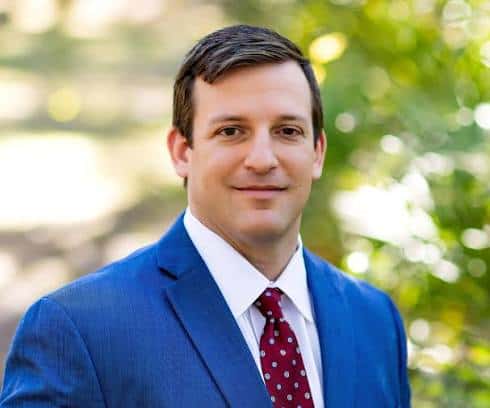
After three terms in the Florida House of Representatives, Mike Beltran hung up his cleats and “went back to private practice and was spending time with my family, and frankly, I was enjoying that.”
But, earlier this year, his former colleagues in Tallahassee “drew me and Congresswoman [Kathy] Castor into the same district,” he told the Washington Reporter in an interview. “When I was a bachelor, I moved to South Tampa about 17 years ago, and she was my congresswoman, and I didn’t like it. After a couple of years, I moved to the suburbs and raised my family and ran for office. But I didn’t want to be represented by her again. She doesn’t share our values. I don’t think that people in East Hillsborough County, or in South Tampa, for that matter, ought to be represented by someone who aligns so closely with the radicals in the Democratic Party.”
Now, Beltran is running against an incumbent who “suddenly discovered bipartisanship a couple of weeks ago”; that is a contrast he welcomes.
“I’ve always represented the people,” he explained. “I’ve always represented my district. I voted against my party. I voted against special interests. I voted against Governor Ron DeSantis when I had to. I voted against the presiding officers in the House; I voted against several different Speakers. In fact, every Speaker, I voted against. I voted against insurance companies, trial lawyers, home builders, landlords, car companies.”
“You name it, I voted against that special interest at some point or another because it was necessary to do so to protect my constituents,” Beltran continued. “I broke with my party in order to ensure that there was an armed law enforcement officer in every school. I voted against provisions to dilute child labor protections. I’m going to be bipartisan. I’m going to vote my district. I’m going to do what’s right for my constituents. I’m going to speak my mind and vote my conscience. I don’t think my opponent can say the same thing, given her 20-year track record of voting party line.”
Beltran’s top priority in Congress, should he oust the longtime incumbent, Rep. Kathy Castor (D., Fla.), is “being a good fiscal steward, making sure we’re spending every dollar wisely.”
“In six years in the Florida House, I never voted for an unbalanced budget,” Beltran said. “In 20 years in Congress, my opponent has never voted for a balanced budget. That’s really key. That’s what’s driving all of our inflation: the out of control spending from Washington. Those deficits are inflationary. They’re continuing to cause problems, and that’s what we need to address.”
Beltran tied his priority to both his time in the Florida legislature and to the affordability issues that he said dominate voters’ concerns in Florida’s 14th District. “We’ve been good fiscal stewards here in Florida,” he said, pointing to his time in Tallahassee. “We actually spend about half what they spend per capita up north in states like New York. Some states up north have less than half the population and double the budget that we do here in Florida. When we received monies from Washington that we had to spend, we did our best to pay down debt and to put money into our reserves and to invest in durable infrastructure so that we would have something to show for in coming years.”
“By contrast,” Beltran added, “the liberal governments up north have squandered money, and they continue to tax their citizens at a very high rate. I always want to make sure that we spend every dollar wisely, and that’s an approach that I want to take to Washington. We’re spending $2 trillion more than we take in every year. Half of that deficit is interest on previously accrued debt, so it’s actually a compounding problem that is feeding upon itself, and it needs to be addressed.”
In the Tampa-area district he’s running in, he said that “there are a lot of people who are concerned about affordability, and the discussions I’ve had have been along the lines of what we’ve talked about. Those are mainly the issues that people are discussing at the federal level. At the state level, people are talking about development and our property tax cuts, and different things like roads, for example; our interstates and our local roads here in Hillsborough need a lot of attention, and certainly as to the interstates, that’s something I will be advocating for in Washington.”
In order to advance those priorities, Beltran first has to beat Castor, who’s been in office for decades. However, a new map advanced by Gov. Ron DeSantis (R., Fla.) put Castor in a district that voted for President Donald Trump by double digits in 2024, and Beltran is using the Florida Democratic Party’s ongoing implosion to counter any potential midterm bump that could benefit Castor.
Beltran was quick to note that the Democrats’ Senate nominee, Angie Nixon, will be an albatross around Castor’s neck. Nixon, a Democrat closely aligned with the Democratic Socialists of America (DSA), “has disrupted proceedings on the floor of the House. She was allotted very generous speaking time, and when that wasn’t sufficient she went into the well and shouted at the top of her lungs for two hours. Eventually we just had to pass legislation while she was shouting because she would just not stop, and because the sergeant at arms did not want to physically remove her from the chamber. A couple years later, that wasn’t enough; she came and she used a megaphone on the floor of the House. That’s the type of conduct I would expect would get you physically removed, but the sergeant at arms showed her a lot of quarter.”
“When it comes to my race, remember that Kathy Castor called Nixon a ‘hustler,’” Beltran said. “She said that she wanted to welcome her into a big tent. She’s very loud, she’s very obnoxious and disruptive. I wouldn’t want to be in any kind of tent, metaphorical or physical, with her, of any size, whether big, small, or otherwise.”
While Castor is viewed by some groups, like the pro-Israel Democratic Majority for Israel (DMFI) as one of the few remaining pro-Israel Democrats in Congress, Beltran said that his opponent has changed with her party.
“I was recently debating her, and she was very critical of the Israeli government and of Prime Minister Benjamin Netanyahu,” he said. “I was actually surprised to see her say that, given how much money she’s taken from AIPAC. But that’s what she said. Those are the words that came out of her mouth. It’s at minute 47 to 49 of the recording of the debate, if anyone wants to listen to it. She’ll take money and say one thing, and then when she needs to say something else, she’ll say something else. She’s really not the friend of Israel that she pretends to be.”
Beltran also argued that, even in Castor were moderate, a win by her would “enable[] socialists” in Washington, D.C.
“She is poised to elect Hakeem Jeffries as Speaker of the House,” he explained. “That will result in Chairwoman Ilhan Omar, Chairwoman Alexandria Ocasio-Cortez, Chairman Jamie Raskin, and so forth. These people are known radicals. They’re anti-Israel. They’re socialists, avowed socialists in some cases. And she has voted with her party’s leadership over 90 percent of the time; she suddenly discovered bipartisanship a couple of weeks ago when she voted against a proclamation about communism. But the fact remains is she’s embraced Cuba’s socialist dictatorship. She has done pro-Cuba legislation before. She voted for the Unaffordable Care Act, and she votes in line with her party. She voted to allow men in women’s sports. She voted for trans surgeries for children, and she voted against the Working Families Tax Cut. She’s done a number of very radical things in line with her party, but out of line with the values of Tampa Bay families.”
Closer to home, Beltran also argued that Castor has failed Floridians by voting to shut down FEMA during hurricane season.
“It’s appalling,” he said of her votes to defund FEMA, “especially because the old configuration of her district had even more coastal areas than it does now; it included South Tampa and St. Petersburg and Pinellas County, which are two areas that get hit the hardest with flooding. She wasn’t even voting her district.”
“If she was in Colorado or something and she votes against hurricane funding, it would be one thing,” he said. “But here in South Tampa and St. Petersburg, those are two peninsulas in the middle of the Gulf of Mexico that just got hit with hurricanes, and she voted against FEMA funding as recently as 2026, earlier this year. She’s not voting her district. She’s not being being fair to the people of Florida. It’s atrocious. She also voted against no tax on Social Security. There are a lot of seniors here in District 14, especially in the eastern parts of the district that I’ve represented. She voted against no tax on overtime. She voted against no tax on tips. These are working class tax cuts, along the lines of the other things she voted against; she’s got a very poor voting record.”
Below is a transcript of our interview with Mike Beltran, lightly edited for clarity.
Washington Reporter:
Florida is an interesting state this cycle for a lot of reasons this cycle, in part because of what’s going on at the top of the ticket, where both sides of the Democratic Party are represented, with an open DSA member running for Senate in Angie Nixon and a former Republican congressman, David Jolly, running for governor. How does that play out statewide? And how does that impact things on the ground in the 14th District?
Mike Beltran:
What these Democrats really lack, which everyone seems to lack, is any Democrat who approaches common sense. We have David Jolly, who started off, frankly, as kind of a RINO, then he went off and started his own party. Now, all of a sudden, he’s masquerading as a progressive Democrat all of a sudden; he doesn’t believe in the 2nd Amendment any more, even though he swore an oath to uphold it as a congressman and in various other capacities as well, and then you’ve got Angie Nixon. At least she’s consistently radical. Angie Nixon has disrupted proceedings on the floor of the House. She was allotted very generous speaking time, and when that wasn’t sufficient she went into the well and shouted at the top of her lungs for two hours. Eventually we just had to pass legislation while she was shouting because she would just not stop, and because the sergeant at arms did not want to physically remove her from the chamber. A couple years later, that wasn’t enough; she came and she used a megaphone on the floor of the House. That’s the type of conduct I would expect would get you physically removed, but the sergeant at arms showed her a lot of quarter. When it comes to my race, remember that Kathy Castor called Nixon a “hustler.” She said that she wanted to welcome her into a big tent. She’s very loud, she’s very obnoxious and disruptive. I wouldn’t want to be in any kind of tent, metaphorical or physical, with her, of any size, whether big, small, or otherwise.
Washington Reporter:
You’re now running in the newly redrawn Florida’s 14th district. How has Castor been situating herself? She’s called Angie Nixon a “hustler,” but how do you see this race in the final month playing out?
Mike Beltran:
Castor has been a mainline Democrat for a long time, but she has enabled socialists. She is poised to elect Hakeem Jeffries as Speaker of the House. That will result in Chairwoman Ilhan Omar, Chairwoman Alexandria Ocasio-Cortez, Chairman Jamie Raskin, and so forth. These people are known radicals. They’re anti-Israel. They’re socialists, avowed socialists in some cases. And she has voted with her party’s leadership over 90 percent of the time; she suddenly discovered bipartisanship a couple of weeks ago when she voted against a proclamation about communism. But the fact remains is she’s embraced Cuba’s socialist dictatorship. She has done pro-Cuba legislation before. She voted for the Unaffordable Care Act, and she votes in line with her party. She voted to allow men in women’s sports. She voted for trans surgeries for children, and she voted against the Working Families Tax Cut. She’s done a number of very radical things in line with her party, but out of line with the values of Tampa Bay families.
Washington Reporter:
Where do you see yourself on these foreign policy issues? You were just mentioning Cuba and Israel, but what about Venezuela as well? How are Trump’s policies, as well as those of Secretary of State Marco Rubio, being received in the Tampa area?
Mike Beltran:
I’m gratified that we have improved the situation in Venezuela. It’s probably not perfect, but anyone’s better than Castro, and anyone’s better than Maduro, and we see an improvement there. We’re going to have a lot more petroleum production coming online in the coming years, to the tune of millions of barrels a day from Venezuela, where we’ve seen a dictator who was not only oppressing his own people, but trafficking narcotics to the United States, taken out. He’s been taken into custody and brought to justice. That’s a very good situation there. It’s good for our economy. It’s good for the people of Venezuela. It’s good for the entire hemisphere.
Washington Reporter:
Looking outside of our hemisphere to Israel, Castor is viewed by organizations like the Democratic Majority for Israel as one of the increasingly few reliably pro-Israel Democrats in Congress. They’ve endorsed her. Is that something that they’re missing the mark on?
Mike Beltran:
I think it is. I was recently debating her, and she was very critical of the Israeli government and of Prime Minister Benjamin Netanyahu. I was actually surprised to see her say that, given how much money she’s taken from AIPAC. But that’s what she said. Those are the words that came out of her mouth. It’s at minute 47 to 49 of the recording of the debate, if anyone wants to listen to it. She’ll take money and say one thing, and then when she needs to say something else, she’ll say something else. She’s really not the friend of Israel that she pretends to be.
Washington Reporter:
How do you see yourself on issues with Israel and with Trump’s policy there?
Mike Beltran:
I believe Israel has the right to defend themselves. We sold them weapons for a long time, and rightly so. They’ve been one of the largest purchasers of American defense manufacturers, and that’s good for our economy. It’s good for Israel. They’ve also developed some innovative technologies in the areas of counterterrorism and asymmetric warfare, which, frankly, the United States can benefit from as well. We’ve purchased and adopted some of their technologies as well, so that’s an alliance that I think both parties have received some benefit from.
Washington Reporter:
When you were in the Florida legislature, one of your signature achievements was passing the largest tax cut in Florida’s history. In D.C., every Democrat voted to sign off on what would have been the largest tax hike on Americans in history. How is that something that voters are looking at in your race for Congress?
Mike Beltran:
We’ve been good fiscal stewards here in Florida. We actually spend about half what they spend per capita up north in states like New York. Some states up north have less than half the population and double the budget that we do here in Florida. When we received monies from Washington that we had to spend, we did our best to pay down debt and to put money into our reserves and to invest in durable infrastructure so that we would have something to show for in coming years. By contrast, the liberal governments up north have squandered money, and they continue to tax their citizens at a very high rate. I always want to make sure that we spend every dollar wisely, and that’s an approach that I want to take to Washington. We’re spending $2 trillion more than we take in every year. Half of that deficit is interest on previously accrued debt, so it’s actually a compounding problem that is feeding upon itself, and it needs to be addressed.
Washington Reporter:
What would your priorities in Congress be? Should you win, what do you want to focus on for Floridians?
Mike Beltran:
The first thing is being a good fiscal steward, making sure we’re spending every dollar wisely. In six years in the Florida House, I never voted for an unbalanced budget. In 20 years in Congress, my opponent has never voted for a balanced budget. That’s really key. That’s what’s driving all of our inflation: the out of control spending from Washington. Those deficits are inflationary. They’re continuing to cause problems, and that’s what we need to address.
Washington Reporter:
What do you hear from voters as you’re campaigning about what their top priorities are for this election?
Mike Beltran:
There are a lot of people who are concerned about affordability, and the discussions I’ve had have been along the lines of what we’ve talked about. Those are mainly the issues that people are discussing at the federal level. At the state level, people are talking about development and our property tax cuts, and different things like roads, for example; our interstates and our local roads here in Hillsborough need a lot of attention, and certainly as to the interstates, that’s something I will be advocating for in Washington.
Washington Reporter:
One of the Trump policies that could be very interesting for Florida, in particular, is how we have seen Trump talk about indexing capital gains sales for homes to inflation. Is that something that you’ve looked at? Do you think would be beneficial to Florida home buyers and home sellers?
Mike Beltran:
I do. You already have the $500,000 deduction for capital gains on homes. So, unless you have a very expensive home or you’ve lived in it for a really long time or you made a really awesome investment, you’re hopefully not getting taxed on capital gains from your home — at least not if you have a good accountant. That also refreshes every five years, so you’ve got a pretty good exemption there. But certainly, I’m not opposed to indexing things for inflation. Obviously, the capital gains rates are a little bit lower than the income tax rates, and that kind of accounts for a little bit of of inflation there. Some of the investment returns are really just keeping pace with inflation and the increased costs of living. But all that said, I think most people probably aren’t getting hit with that capital gains tax on a primary home sale.
Washington Reporter:
You are also campaigning on healthcare, which is not necessarily common for Republicans. You’ve talked about your work in the state legislature on cutting bureaucratic red tape to help new healthcare clinics open, expand telehealth, make affordable healthcare available to more families, and to seniors. What made you decide to lean in on that issue?
Mike Beltran:
Expansion of scope is another issue that we worked on. My wife is a nurse practitioner, so she was doing primary care, and you had physicians who were supposedly having to supervise the nurse practitioners. The regulation was just enough that it was costing money to the providers, and it was an expense and a cost of doing business, but there wasn’t really a whole lot of good supervision that was being provided. So it was really just a way for folks to make money without actually adding value. So we expanded scope, and that makes it more possible to get affordable and easy access to routine care. We also did work in order to ensure that big pharma is not price gouging American consumers. We pay for R&D here in the United States through grants to universities and NIH funding and so forth, and then we have a very rigorous intellectual property regime in the United States and our federal courts, so we give a lot of benefits to big pharma, and yet big pharma charges Americans up to ten times the foreign price for life-saving medicines. I don’t think that’s right, after the United States provides an environment where big pharma can do business, where a lot of these big pharma companies are headquartered or perform R&D here. We’re working to ensure that people can import medicine from Canada, and that Floridians can do so, just like people in border states are able to drive across the border. We should be allowed to import medicine by mail from Canada if the American price is not fair; big pharma has been fighting us on that, both at the state level and at the federal level. I’ve also done some work in the courts in my litigation practice on that, and I’m going to take that issue to Washington, and hopefully big pharma will stop price gouging and just charge fair prices, and that’ll be that.
Washington Reporter:
Is Trump Rx something that you’ve seen already helping Floridians with healthcare costs?
Mike Beltran:
Trump Rx works along the same lines of holding the big pharma companies accountable. Everyone’s allowed, obviously, to make a profit, and we want companies to continue to do that R&D and so forth. But for these companies to come to the government on the one hand and ask for patent and trademark protections, and then claim full free market reign to price gouge as much as they want and engage in international price discrimination, I think that’s wrong. You’re not in a free market if you’re doing pharmaceutical sales in the United States; you have IP protection, which is obviously creating a monopoly, and then in a lot of cases you’re selling to the government, so that’s not really a free market either.
Washington Reporter:
Why, given what you’ve laid out, did you decide to run for Congress instead of running for state office again?
Mike Beltran:
I retired from the state legislature in 2024. I thought a lot of my work was complete, and we’d advanced the ball on these key issues as much as possible. I went back to private practice and was spending time with my family, and frankly, I was enjoying that, until they drew me and Congresswoman Castor into the same district. When I was a bachelor, I moved to South Tampa about 17 years ago, and she was my congresswoman, and I didn’t like it. After a couple of years, I moved to the suburbs and raised my family and ran for office. But I didn’t want to be represented by her again. She doesn’t share our values. I don’t think that people in East Hillsborough County, or in South Tampa, for that matter, ought to be represented by someone who aligns so closely with the radicals in the Democratic Party.
Washington Reporter:
A lot of your endorsers in D.C., like Congressman Jim Jordan, were spied on by the Biden administration via Jack Smith, via Arctic Frost. There was a piece of legislation that you may not even have seen. It did not get much coverage outside of our news outlet, called the NDO Fairness Act, which Congresswoman Castor and everyone else in the House of Representatives voted for. The theory behind this, and the reason that Republicans were so supportive of it, is that it would prevent future Jack Smiths as special counsels from being able to access lawmaker records improperly. Is something like that legislation that you could see yourself supporting if it’s voted on again in a future Congress?
Mike Beltran:
I believe in separation of powers and checks and balances, and obviously we have checks and balances. Nobody’s above the law; if a congressman engages in criminal or otherwise unlawful conduct, they should be investigated. But they should be investigated consistent with the Constitution, just like any other American. Everyone’s entitled to Fourth and Fifth Amendment protection, and to Sixth Amendment protections. No warrants shall issue, but upon probable cause, and you can’t have warrantless surveillance and searches that are unreasonable. What was done in those cases was improper, and they were being targeted because of their politics and so forth; that was improper. I would support legislation that aims to rein in a rogue Justice Department.
Washington Reporter:
You were just talking about how you believe that Castor has been out of step with the community you’re running to represent for the 17 years that you’ve lived in this area. One of the other things I noticed with her voting record is that she had voted against funding FEMA during hurricane season. I live in Maryland. Fortunately, we don’t have to deal with hurricanes that much, if ever. How is that something that is viewed by people in the 14th District?
Mike Beltran:
It’s appalling, especially because the old configuration of her district had even more coastal areas than it does now; it included South Tampa and St. Petersburg and Pinellas County, which are two areas that get hit the hardest with flooding. She wasn’t even voting her district. If she was in Colorado or something and she votes against hurricane funding, it would be one thing. But here in South Tampa and St. Petersburg, those are two peninsulas in the middle of the Gulf of Mexico that just got hit with hurricanes, and she voted against FEMA funding as recently as 2026, earlier this year. She’s not voting her district. She’s not being being fair to the people of Florida. It’s atrocious. She also voted against no tax on Social Security. There are a lot of seniors here in District 14, especially in the eastern parts of the district that I’ve represented. She voted against no tax on overtime. She voted against no tax on tips. These are working class tax cuts, along the lines of the other things she voted against; she’s got a very poor voting record, in addition to the things we’ve already discussed,
Washington Reporter:
You’re in the final month of an incredibly expensive and contentious election. What is the most important thing for voters to know about you, and for them to know about Kathy Castor as they head to the polls?
Mike Beltran:
Kathy Castor’s voted with Nancy Pelosi over 90 percent of the time, and now she’s suddenly discovered bipartisanship when she’s in a tough election. I’ve always represented the people. I’ve always represented my district. I voted against my party. I voted against special interests. I voted against Governor Ron DeSantis when I had to. I voted against the presiding officers in the House; I voted against several different Speakers. In fact, every Speaker, I voted against. I voted against insurance companies, trial lawyers, home builders, landlords, car companies. You name it, I voted against that special interest at some point or another because it was necessary to do so to protect my constituents. I broke with my party in order to ensure that there was an armed law enforcement officer in every school. I voted against provisions to dilute child labor protections. I’m going to be bipartisan. I’m going to vote my district. I’m going to do what’s right for my constituents. I’m going to speak my mind and vote my conscience. I don’t think my opponent can say the same thing, given her 20-year track record of voting party line.
Washington Reporter:
Mike, thanks for your time.