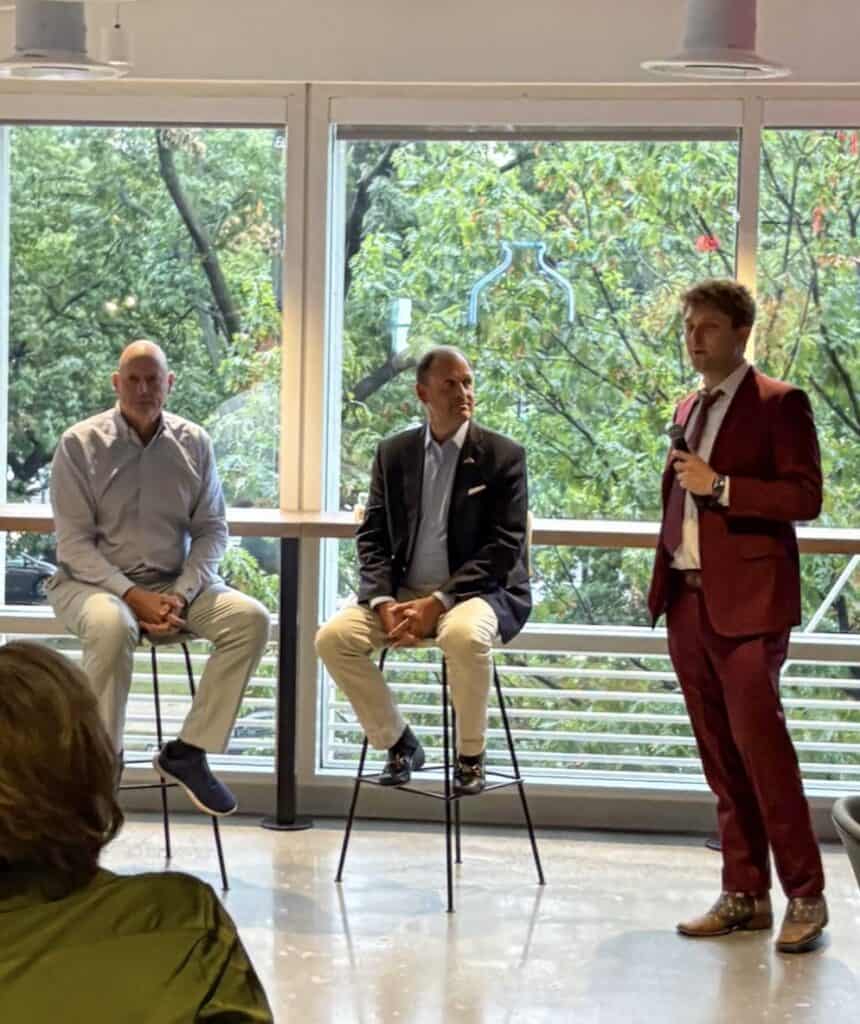
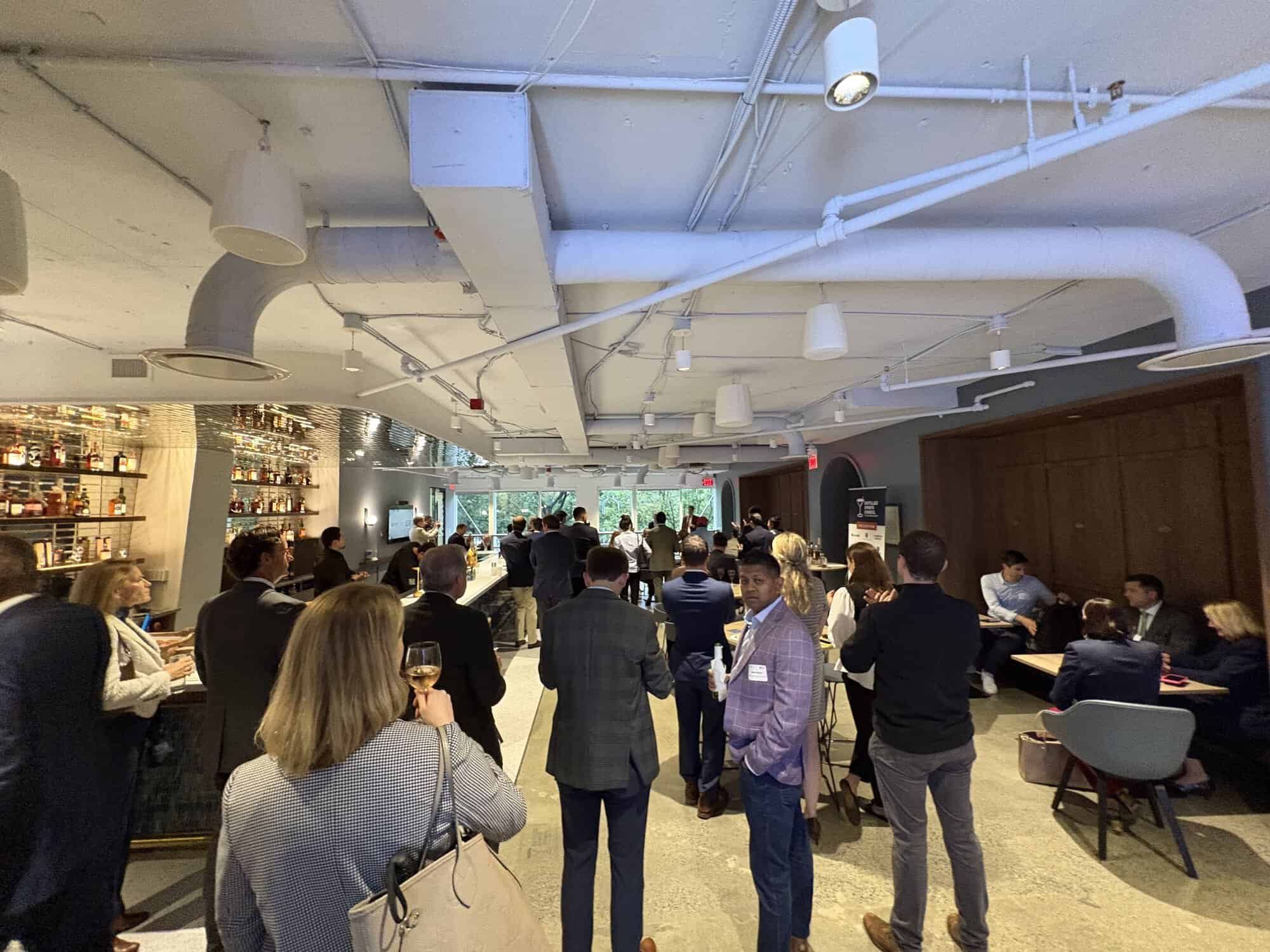
Over 100 people joined the Washington Reporter, alongside Rep. Andy Barr (R., Ky.) and the Electronic Payments Coalition (EPC) for the Reporter’s discussion about Kentucky bourbon, banking, and Barr’s agenda.
The Reporter’s CEO, Brian Colas, kicked the event off by announcing the latest step in the Reporter’s growth: a new podcast, which Colas said will heavily feature video content. “If you’re interested in getting your message out, we would love to work with you,” Colas told those assembled.

Colas then turned the mic over to Foldi, who introduced both Barr and Richard Hunt, EPC’s executive chairman. Foldi told the audience that Hunt is effective because he is both “sharp and funny,” and said that the Reporter finds EPC to be “one of the savviest and most effective operators in the space that we all inhabit…if you’ve heard about the Credit Card Competition Act, you’ve probably heard about it from [EPC], whether it’s Richard calling it ‘draconian’ [in an interview with me” or from their litany of campaigns against it.
Foldi also praised Barr for being “one of the most effective members of the House of Representatives”; he added that the Reporter is “very excited that…he will be one of the most effective members of the United States Senate starting next year.” He added that Barr is a “champion for Kentucky bourbon and for Kentucky horse racing…he’s a statesman, he’s a smart guy, he’s very funny, and he’s very enjoyable to have some bourbon with.”
During the event, Hunt homed in on his organization’s priority: its opposition “to all things government mandates by [Dick] Durbin and [Roger] Marshall.” Hunt acknowledged that Marshall is in a tough race by remarking that both Durbin, who is retiring, and Marshall, who is in a fierce reelection bid, “may take care of themselves; we don’t know.”
Hunt asked the audience what it uses credit card rewards points for: miles or cash back. He then pressed Barr on how many credit cards he has, noting that the average American has five credit cards.
“If you do not count my campaign card, I have three.” Barr, who prefers cash back to miles, noted that he recently checked, and his “credit score went down just a little bit. The one that I use the most is the one that my wife shares with me. I look at that balance. It’s due in four days. I got to call her and say, ‘what the heck is going on there?’ That’s the one I use the most. I have one that’s that I use that that I use a little less frequently, but it’s only mine. And then there’s one that’s been dormant for a little while.”
Hunt noted that “some 100,000 people fly in and out of Kentucky using airline points to do that.” While the Reporter’s audience seemed to prefer miles to cash back, Hunt explained that “the more popular option is actually cash back.”
For Barr, cash back is the law of the land: “II just saw my balance from the one that I share with my wife. I think she’s been buying some clothes for my kids. Cash back this month for sure. I used to be a debit guy. That was what I did, and then when we got the shared credit card and I saw the the volume of usage from my wife, I realized I was missing out on cash back. So we actually now put most of our transactions on credit.”
Hunt used that opportunity to make the case of one of EPC’s top priorities: stopping the Durbin-Marshall Credit Card Competition Act. “You mentioned debit,” he told Barr. “Remember what happened in 2010 with the Durbin Amendment. You used to get miles on the debit card, but when they changed that through the amendment and they reduced the amount we could charge to make sure your debit cards were safe and secure, people moved over to credit cards to have the miles.”
Barr called that a “great point. It’s an admonition of the intended or unintended negative consequences of the Credit Card Competition Act. The Americans do not want to lose their points. They do not want to lose their cash back, and that is at risk with the with the ‘misguided’ Credit Card Competition Act.”
Hunt noted that the opposition to the bill is broad and bipartisan. “We’re attracting a lot of Democrats too, especially in tourism states like Nevada, Colorado, California, because people know how important it is for the tourism industry.”
Hunt also had to speak with about one of Kentucky’s biggest exports: bourbon. Barr then impressed attendees with his granular knowledge of the drink. “It is hard to make good bourbon, and we’re experts in that,” Barr explained. “All bourbon is whiskey. But, not all whiskey is bourbon. Bourbon represents about 1/5 of the market share of global whiskey sales and consumption. 95 percent of all bourbon is made in Kentucky. 5 percent is counterfeit and is made outside of Kentucky. But all bourbon is made in the United States. It’s by law a distinctively American spirit…It has to be 51 percent corn in a virgin new white oak barrel, charred typically, and there’s a proof requirement for it. But good bourbon needs to be at least straight bourbon, two years in the barrel. Oftentimes, it’s age greater to six, eight, ten, or twelve, years.”
Barr added that there are a couple of attributes of bourbon that make it distinctively ‘Kentucky.’ One is our mineral-rich water, which is very key ingredient. Obviously, we’ve developed a workforce ecosystem and concentrated talent in terms of distillers and master distillers who understand how to make it, and who know what kind of ingredients and composition, and then also the aging process is a craft. It’s a skill, and we are very good at the natural aging process, because Kentucky has four distinct seasons…You’ve got cold, cold winters. You’ve got temperate and rainy, sometimes humid, springs and very hot, humid summers. That is conducive to the distillate going in and out of the barrels and getting all those rich notes from the oak. So that’s how you make bourbon.”
The Kentucky lawmaker even positioned bourbon in an international affairs context, telling the audience that Kentucky bourbon reminds him of a conversation with one of his favorite ambassadors: Lithuania’s Gediminas Varvuolis.
Varvuolis told Barr, Barr recounted, that “Lithuania and Kentucky are very similar. We both like basketball. We both have drinking cultures. You drink bourbon, we drink vodka. We have similar populations — four and a half million people — and we’re both anti-communist. We love freedom. But I’ve learned something since learning about you and Kentucky. Vodka is the drink of the occupier, and bourbon is the drink of freedom.”
Hunt then asked Barr about why Barr decided to give politics another try after he narrowly lost his first race for Congress. Barr explained that he came back for a rematch because he and his family “put a lot into that first race, and we lost by 647 votes out of 242,000 votes. It was pretty crushing and heartbreaking, but at the same time, I started with no name ID, no money. I was outspent three to one. We really acquitted ourselves quite well in that in the course of that campaign, and we proved what people said we couldn’t do, which was make that a competitive race and make it a competitive district. Speaker Boehner called me, urged me to run again. A lot of future colleagues really encouraged me to keep at it. Pete Sessions at the NRCC said ‘we’re going to help you,’ and so we kept at it.”
But, Kentucky Democrats “redistricted [the district] to try to to save the incumbent, but despite the district deteriorating and getting harder, we won the second time around. And when I tell schoolchildren across Kentucky today, that perseverance is the most important quality you can have. Calvin Coolidge said it the best. He said nothing in this world can take the place of persistence. Talent will not. Genius will not. Education will not…Persistence and determination alone are omnipotent. The slogan ‘Press On’ always has and always will solve the problems of the human race. I tell those students ‘don’t ever give up. That 2010 campaign for me was not a defeat. It was not a loss. It was phase one of a two-phase victory. Never give up, persevere. That’s the American way,’” Barr said to applause.
While Barr is expected to easily prevail over Democrat Charles Booker in Kentucky’s Senate race in November, he reflected on one of the pieces of legislation that he is already most proud of: the CAROL Act, which he pushed for to honor his late wife.
But following her unexpected passing, “we passed a bill that was bipartisan; I worked with my colleagues, in the House and Senate, Democrat and Republican, and we passed the Cardiovascular Advances and Research and Opportunities Legacy Act, the Carol Act, named for my late wife, and I am told by cardiologists and researchers across the country that since that law came into effect, we are making really important strides in cardiovascular, valvular heart disease research, making a difference, saving lives, and channeling my grief into something that is really, really, making a difference.”
Even though Barr is favored to be Kentucky’s next senator, he insisted that he will remain a “man of the House.” That is explained in part because his best friends in Congress, in both parties, are in the lower chamber.
“I have two best friends” in Congress, Barr said. “One is a former member. One is a current member. Both of these gentlemen are dear personal friends, in addition to being great lawmakers, and they are both the godfathers of my new two-and-a-half year old son Hale: Brad Wenstrup of Ohio, and Bill Huizenga of Michigan.” Barr noted that his favorite Democrat is Rep. Jimmy Panetta (D., Calif.). “We get along really well, and we’ve traded off going to each other’s districts, and we’ve had a lot of fun together.”
Hunt then pressed Barr to continue that spirit of honesty to then answer who his favorite child is. Barr conceded that his daughter, Mary Clay Barr, is in the lead because she starred in one of his viral campaign ads, in which she pitched her father as being the best man to represent Kentucky in Congress.
Barr gave the audience a history lesson about “Henry Clay, my predecessor, the former Speaker of the House.”
Clay, Barr noted, “was elected Speaker of the House the very first day he was sworn in as a new congressman. Now, how does that happen? That happened once, and it will never happen again. It happened because he was a U.S. senator who decided… that it would be much more prestigious to be elected by the people, so he moved from the Senate to the House. That doesn’t happen as much anymore. But I will always be a man of the House, and I will take my experience from the House, and it gives me an opportunity, as I say to my constituents, and my hopefully-future constituents, I am ready on day one.”
“My experience in the House makes me prepared to deliver for Kentucky in the Senate,” Barr continued. “I have big shoes to fill with Senator Mitch McConnell. I can’t fill those shoes. I’m going to be my own man, but what I would say is this: It has been a privilege of a lifetime to get a chance to represent the people of Central Kentucky in Congress. It would be an even greater privilege to represent the entirety of the best state out of 50, the Commonwealth of Kentucky, and all of Kentucky. That’s why I wanted to represent it.”
While Barr weathered an at-times difficult and contentious primary, he ultimately prevailed easily, with the help of President Donald Trump’s endorsement. But, he said, he “take[s] nothing for granted” heading into November’s showdown with Booker. “I think we win,” he said, however.
“This is a challenging environment,” Barr cautioned. “Kentucky is a Republican state. It’s a state that Trump won by 30 points in 2024, and yet there’s a lot of political diversity in Kentucky. Look at Ed Gallrein and Thomas Massie. Look at Rand Paul and Mitch McConnell. You also have a Democratic governor in Kentucky.”
“Democrats can win statewide in Kentucky,” Barr noted. “My opponent highlights that I say that a lot, but I say that in all earnestness because you have to earn it, and I have to earn it. I’m in the middle of a job interview, and I need to earn the job offer, and I intend to do so. This race is going to be about common sense versus crazy. I represent common sense, and that includes not just Republicans, but common sense independents and Democrats. We are not socialists in Kentucky, and we’re going to hold this seat for Republicans and keep the majority in the United States Senate.”
Hunt noted that Barr is running in an environment in which “voter intensity among Democrats is a 12 out of 10, and that you’re worried about Republican turnout.” Barr said that turnout and intensity for Republicans “always gets better as you get closer to the election, and people start tuning in and start recognizing what the stakes actually are, and when they see, hopefully, as time goes on… is that it is a choice between common sense and climate alarmism, anti-Semitism, socialism, and the only thing the other guy wants to do is impeach the president; that’s not going to help the people of Kentucky.”
“We obviously have to motivate those common sense voters, Republican and Democrat alike, that the stakes are high. We also have to just broaden my appeal beyond the primary electorate. Make sure people understand that I actually am ready on day one, and that I can deliver for Kentucky. Whether it’s the horse industry, the bourbon industry, auto manufacturing, farmers, the coal industry. We’re going to deliver for Kentucky every single day, 24/7.”
Barr concluded the event by reminding those present that “a lot is on the line in this upcoming election. Kentucky is a Republican state. If we lose a U.S. Senate seat in Kentucky, we lose the Senate. If we lose the Senate, we can lose the country. What is at stake is common sense versus crazy, free enterprise versus socialism. Count me in for the American Dream. Count me in for what makes this country great, and that is the idea that with hard work, determination, persistence, you can get ahead in America. That only happens if we prevent socialism from coming to our shores. That’s what I’m all about. I believe in free enterprise. I love this country. I want to keep this country great.”
Foldi noted to the Reporter that “Andy Barr is just the best. Throughout his contentious primary, he worked closely with us to explain the important work he has been doing for Kentucky’s 6th District in Congress, and what his vision for all of Kentucky is. His team is the best in the business, and we can’t wait to keep working with them all after he prevails in November.”
Following the event, Hunt told the Reporter that “it was great to hear Congressman Barr talk about his vision for the country, why community banks and credit unions are essential for strong local economies, and the secret to making a great bourbon. He’s been a strong leader in the House with a record of getting things done, and he’ll bring that same leadership to the Senate.”
Colas added to the Reporter that “Andy Barr is the star of this cycle. We were thrilled to host him alongside the Electronic Payments Coalition — the leading voice against harmful government mandates. Richard Hunt led a great conversation for a packed house, and we have more major Washington Reporter events coming soon.”
Among those in attendance were Mary Rosado, Jessica Carter, Tyler Grassmeyer, Alex Bellizzi, Kendyl Parker, Grace Newton, Erika Bone, Mark Fraenkel, Doug Hochberg, Nick Ballas, Jim Bognet, Andrew Langer, Cassie Scher, Brenna Jeffries, Nihal Krishan, Brett O’Donnell, Gage Raley, Alex Butterworth, Ewan Moran, Sarah Hooton, Cori Willson, Sarah Frances Morris, Paul Foldi, Bonnie Glick, Miranda Dabney, Will Ambruzs, Ninio Fetalvo, Jahan Wilcox, Carly Moran, Patrick McCann, and Micah Rea.