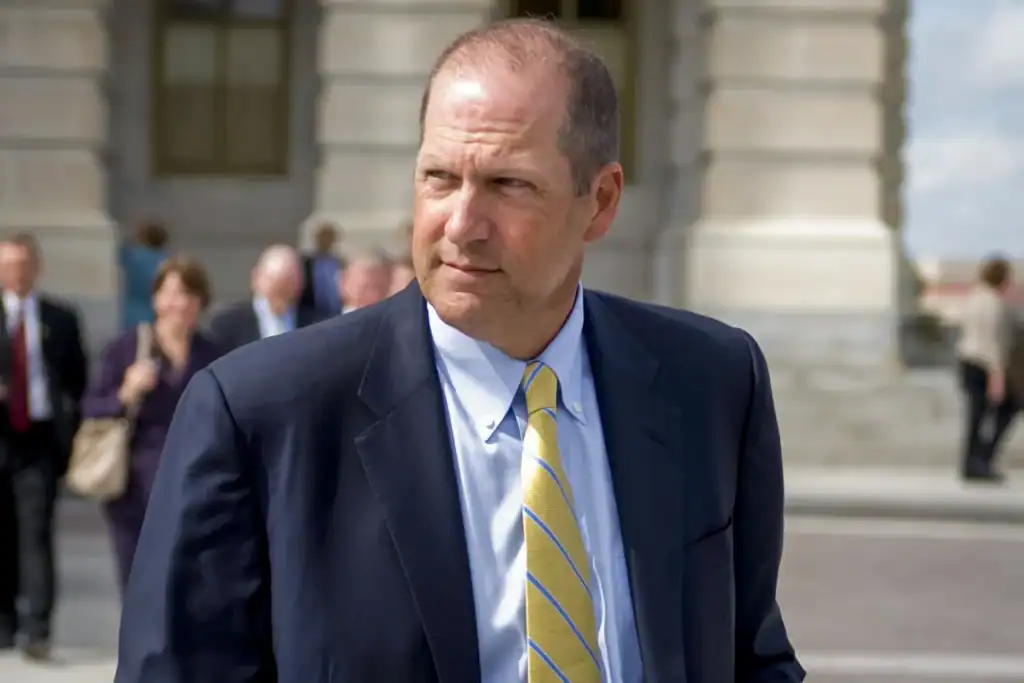
When former Sen. John E. Sununu (R., N.H.) announced his bid for reelection more than 15 years after he left office, he acknowledged his return to politics was a bit unconventional.
“Maybe you’re surprised to hear that I’m running for the Senate again. I’m a bit surprised myself,” Sununu said in his announcement.
Now, Sununu is working on a last-minute surge against Rep. Chris Pappas (D., N.H.) in one of the nation’s most competitive Senate races this year; Sununu is aided by his legendary last name in the Granite State, and by the state’s popular governor, Kelly Ayotte (R., N.H.), who is expected to win her reelection bid handily.
On September 15, Cook Political Report changed its prediction from “Lean Democrat” to “Toss Up,” and a September 14 poll from co/efficent found the race between Pappas and Sununu tied at 46 percent in a race that Pappas once led by seven points.
Sununu’s return to politics comes after representing the Granite State first in the House and later in the Senate.
An engineer and manufacturing executive, Sununu had never held office when he first ran for U.S. House in 1996 at age 32. He won the crowded seven-candidate Republican primary and later the general election. Six years later in 2002, Sununu ran for Senate and defeated both incumbent Sen. Bob Smith (R., N.H.) in the primary and sitting Gov. Jeanne Shaheen (D., N.H.) in the general election, becoming the youngest member of the Senate at the time at age 38. Now, he is running to succeed the seat that Shaheen is vacating.
Sununu’s name was familiar to New Hampshire voters when he first ran for office, as his father John H. Sununu served as New Hampshire’s governor from 1983 to 1989. His brother Chris later served as the state’s popular governor from 2017 to 2025. But it was John Sununu’s message about work that earned him the seat in his first run for office.
Before running for office, Sununu earned his bachelor’s and master’s degrees in mechanical engineering from MIT and an MBA from Harvard. He then built a career in engineering and served as chief financial officer and operations director at a Manchester control company.
As senator, Sununu was a pragmatic fiscal conservative, known for his unique approach to issues, his independence, and his ability to work across party lines to solve tough problems.
He supported the 2001-2002 tax cuts that reduced income tax rates and removed the estate tax, and also opposed ending the federal assault-weapons ban. Sununu voted in favor of confirming John Roberts and Samuel Alito to the Supreme Court, and opposed the 2007 immigration bill which would have provided amnesty for roughly 12 million illegal immigrants.
Sununu led the charge to permanently ban the internet tax while in office. Just before the federal ban was set to expire in 2007, Sununu worked to provide a lengthy extension of the ban before pressing Congress on the issue and ultimately making the ban permanent.
“We’ve got an obligation to make sure the Internet is not taxed,” Sununu said in 2007.
Yet Sununu was also known for his independence. He bucked President George W. Bush and Republican leadership to join three other Republican senators in voting to block reauthorization of the PATRIOT Act until Congress added stronger civil-liberties protections in December 2005. He helped negotiate changes to the bill with the White House and eventually voted for the revised legislation.
“John E. Sununu is a trusted leader who delivers for Granite Staters when it matters most,” Senate Leadership Fund’s (SLF) Communications Director Chris Gustafson told the Washington Reporter.
But, Gustafson said, throughout Pappas’s two decades in office, the Democrat has merely been a party shill.
“Chris Pappas meanwhile is a corrupt Washington insider who’s in the pocket of D.C. lobbyists and his liberal donors,” Gustafson said. “The choice this November couldn’t be more clear.”
Sununu’s record of working across party lines puts him more in line with the independence New Hampshire is known for.
On the flip side, “John Sununu will be an independent voice who will always put New Hampshire first,” Sununu spokesperson Mike Schrimpf told the Reporter. “Chris Pappas always puts Democrat party politics first. He voted with Nancy Pelosi 222 out of 223 possible times and voted to raise taxes 68 times. New Hampshire literally can’t afford Chris Pappas.”
Pappas has held state and federal offices for more than twenty years and has consistently voted with his party, choosing party allegiance over loyalty to voters. Across his legislative career, Pappas voted to raise taxes 68 out of 68 times, the Reporter found.
“New Hampshire voters prize independence, and Chris Pappas went to Washington and just does whatever the House leadership tells him to do,” a GOP operative told the Reporter. “The guy has zero backbone and zero independence.”
A Reporter review of Pappas’s record found he supported several of the Biden administration’s largest COVID-era economic packages, including the “Build Back Better” bill which would have placed $100 billion in taxes on American energy providers. In another vote for the Democrats, Pappas voted against securing the southern border and instead voted to protect sanctuary cities.
“John Sununu is winning the Senate race because Granite Staters know he will be an independent voice who will stand up for New Hampshire every single day,” New Hampshire GOP Chairman, Scott Maltzie, explained. “Chris Pappas is just the opposite. He voted with Nancy Pelosi 222 out of 223 times and would do the exact same thing for Chuck Schumer in the Senate.”
Earlier this year, Pappas flip-flopped on a vote on transportation legislation. He ultimately voted in favor of a provision advocated for by his husband’s employer, Uber, the Reporter previously reported.
“The only thing Chris Pappas has done in Washington is vote to raise taxes and marry a lobbyist,” National Republican Senatorial Committee (NRSC) Regional Press Secretary Samantha Cantrell said. “Granite Staters know that Pappas is part of the failed status quo and that John Sununu is the only candidate with a record of delivering for New Hampshire.”
As the race has grown more competitive, Pappas’s record has faced increased scrutiny and become a prominent liability for his campaign.
“Voters can sense that Pappas is weak,” a GOP strategist told the Reporter. “If he hasn’t been strong enough to stand up to the left wing of his party in the House he definitely won’t be able to when the spotlight is brighter in the Senate.”
Patrick Hynes, president of Novus Public Affairs, told the Reporter that Pappas’s legislative history could be difficult for him to justify come November.
“He’s finally going to have to defend that record because he’s got a competitive opponent, and it’s a general election that people are going to be watching,” Hynes told the Reporter. “I think people are going to be scratching their chins, saying, ‘Well, why did you vote to ladle all of these taxes on hardworking families and their employers when we’re facing record inflation, difficult economic times, uncertain economic times?’ Really, you should have done more to help working families and not burden them with excessive taxes.”
New Hampshire currently has a Republican governor, and Republicans have the majority in the state House, state Senate, and on the state’s executive council. But both the state’s senators and its two representatives in Congress are Democrats, making it one of the Northeast’s most politically competitive states. Hynes said recent polling showing the race neck-and-neck as Election Day approaches is an unusual development.
“The totality of these polls show this race is a dead heat, and that’s a rare thing in a Northeastern state that has not sent a Republican to Washington in a very, very long time,” Hynes said. “There’s no other state other than Maine, where obviously there’s a competitive Senate race, where we’re seeing a competitive federal race.”
Pappas has wildly outspent Sununu, with his campaign reporting having raised $15.38 million and spending $11.54 million through Aug. 19. Meanwhile, Sununu’s campaign reported raising $4.18 and spending $1.11 million.
“This race is a toss-up primarily because Chris Pappas is incredibly weak,” a Republican strategist said. “He had to spend almost $12 million to win his primary against a no-namer, and just sadly begs Chuck Schumer to raise more for him.”
As Sununu eyes a return to Washington, D.C. after nearly two decades in the private sector, he looks to bring common-sense policies that put Granite Staters first on Capitol Hill.
“He would be a strong, independent voice for the Granite State,” Hynes told the Reporter. “Clearly, he would be a conservative, but he would be a conservative who thinks of New Hampshire first, and I think he’s done that in the past. I think he’ll do it again.”