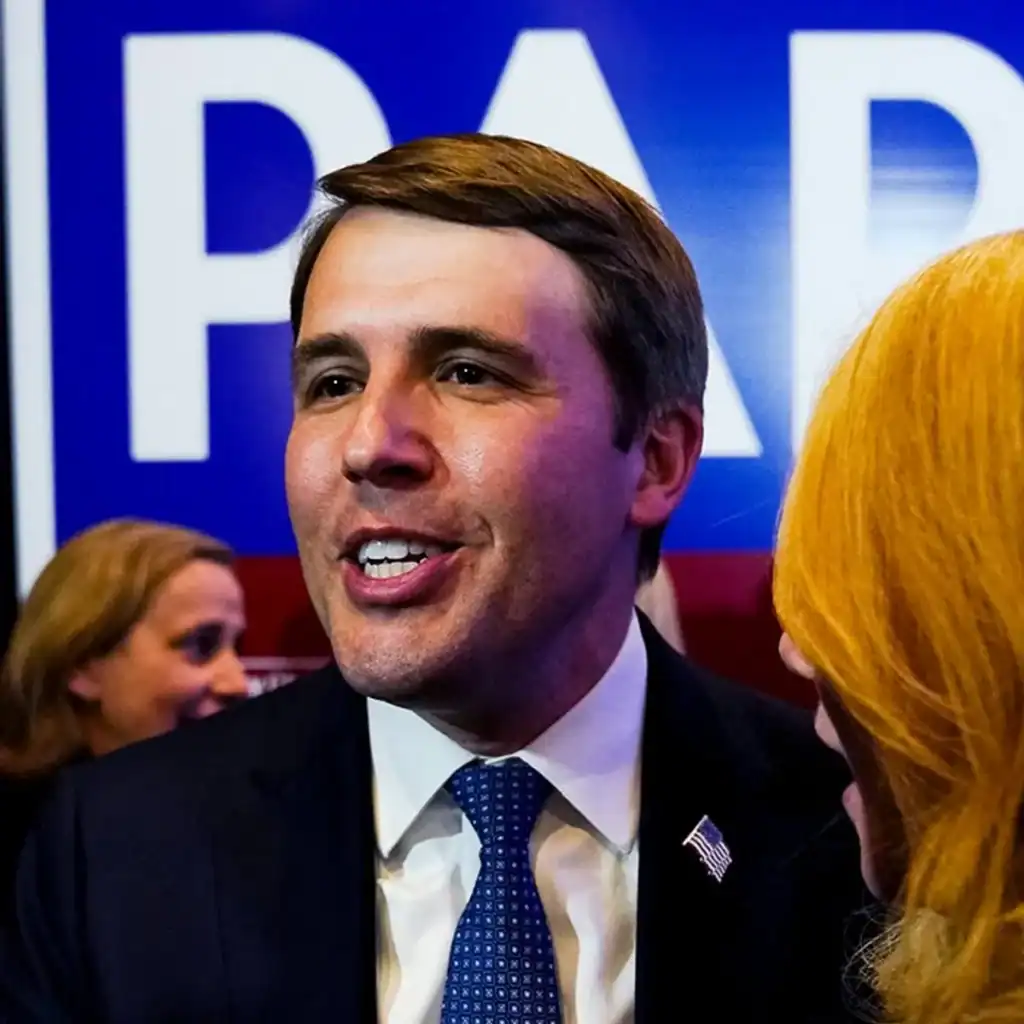
As Rep. Chris Pappas (D., N.H.) campaigns for Senate on tackling “skyrocketing” everyday costs, a review of his two-decade voting record found he has repeatedly backed legislation containing tax increases while opposing efforts to lower taxes.
Throughout his 24-year career in Congress and in the New Hampshire state legislature, Pappas supported legislation containing tax increases or opposed legislation containing tax cuts 68 times, according to a Washington Reporter analysis.
Most recently, Pappas voted against the 2025 Working Families Tax Cuts (WFTC), which extended provisions of President Donald Trump’s 2017 tax cuts and included new tax relief for tips, overtime, and Social Security.
Pappas voted against four motions to advance the legislation in May 2025, and when the House considered the final version in July, again voted against the bill. He voted several times against advancing the bill to a final vote and voted to recommit the bill, which could have delayed or derailed its passage.
The law included no tax on tips, overtime, and Social Security measures, which saved New Hampshire taxpayers an average of $4,649 in 2026, according to a Tax Foundation analysis.
Pappas also opposed the budget resolution used to set up the larger bill earlier in 2025, voting against the measure in February and April, as well as other procedural votes used to advance it.
These votes came after Pappas supported several of the Biden administration’s largest COVID-era economic packages, which contained substantial tax increases and minimal relief for working Americans.
In 2021 Pappas voted in favor of the Infrastructure Investment and Jobs Act, which repealed a tax credit that aided businesses in retaining employees during COVID. Pappas also supported a Senate amendment to the bill which CBO projected would add $256 billion to projected deficits over a decade.
Later, in 2022, Pappas supported the Inflation Reduction Act, legislation that CBO estimated would cost workers earning less than $400,000 approximately $20 billion more in taxes over a decade.
Pappas also supported the House version of President Joe Biden’s Build Back Better Act, along with several procedural measures that allowed Democrats to advance the legislation.
The House’s Build Back Better Act could have implemented $530 billion in tax hikes on working Americans, along with $470 billion in tax hikes on corporations, according to a Tax Foundation estimate. A Committee for a Responsible Federal Budget analysis suggested some of the burden of corporate taxes would also fall on workers.
In 2023, Pappas voted against the Limit, Save, Grow Act that would have repealed the federal methane charge and blocked other proposed tax increases in the gas and oil industry. But in his current bid for Senate, he campaigns on suspending the federal gas tax.
In 2020, Pappas also voted in favor of the Democrats’ COVID relief package, the HEROES Act, which repealed more than $250 billion in tax benefits for American businesses and workers.
“While families worry about inflation affecting every part of their household budget, liberal politicians like Chris Pappas would certainly cause more pain with plans to increase taxes across the board,” a GOP strategist told the Reporter. “He’s never seen a tax he didn’t want to impose on the working class.”
Previous reporting from the Washington Reporter found Pappas voted in favor of a transportation bill that would shield rideshare companies from liability when drivers harm riders. The bill benefits companies including Pappas’ husband’s employer, Uber.
Pappas’s record of increasing taxes for working Americans even spans back to the early 2000s, in his early days in the New Hampshire legislature as a young lawmaker.
In 2004, Pappas supported a proposal to establish a new state estate tax, which would have implemented a 4 percent tax on certain estates. The legislation was estimated to raise roughly $15 million annually to replace what the state was losing as federal estate-tax per year.
The year before, Pappas opposed legislation aimed at reducing New Hampshire’s education property-tax rate. The proposal would have lowered the rate from $5.80 per $1,000 of property value to $4.92 in 2004 and $4.72 in 2005. A later version of the bill ultimately became law and lowered the rate to $3.24.
Across two decades, both in Concord and in Washington, D.C., Pappas has remained consistent in supporting bills that raise taxes on Americans and opposing those who seek to lower them. Yet, a GOP strategist told the Reporter, he campaigns on a promise to lower costs for working Americans despite the obvious incongruencies with his voting record.
Pappas blames the Trump administration and Republicans for the rising costs across the nation and campaigns on fixing the issue. But his own record shows that when given the chance, he repeatedly chose to raise taxes and would likely do it again.
Pappas will face Democrat Socialist of America candidate Karishma Manzur in New Hampshire’s Senate primary on Sept. 8 before facing either John Sununu or Scott Brown in November’s election. Sununu is favored to win the GOP primary, and a recent poll found Sununu leading Pappas by two points.