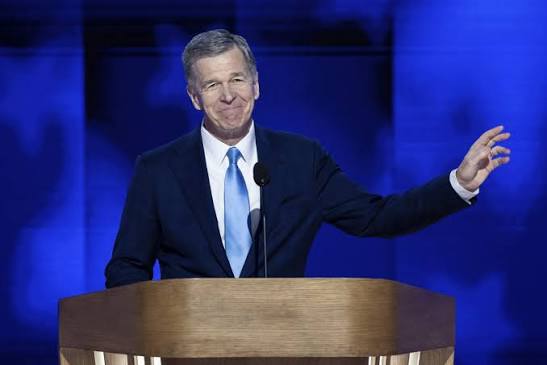
As former Gov. Roy Cooper (D., N.C.) is campaigning for Senate on a promise to “make stuff cost less” for Americans, his own Democratic successor in North Carolina is noting that he made life more expensive in the state, bringing his previous actions as governor of North Carolina under renewed scrutiny.
North Carolina’s electricity prices rose faster than any other state in the Southeast between 2017 and 2024, according to a state task force report — a period spanning most of Cooper’s tenure as governor.
On the campaign trail, Cooper admitted that “electricity costs are skyrocketing” but he promises that he has “plans to make it better.”
But during Cooper’s tenure from 2017 to 2025, North Carolinians saw an increase in just about every industry. Housing under Cooper rose by 85 percent, and North Carolina became the most expensive state for healthcare. Grocery bills grew by $125 per month, and electricity costs only increased during Cooper’s administration.
Gov. Josh Stein (D., N.C.), the current Governor of North Carolina, recently admitted as much — causing Cooper political problems, with his fellow Democrat taking him to task for an affordability crisis that he oversaw.
In August 2025, Stein created the North Carolina Energy Policy Task Force. The group’s 2026 report, which Stein signed off on, noted energy prices rose nearly 30 percent between 2017 and 2024, — the largest price increase in the Southeast.
In the same time frame, North Carolina’s bordering states saw significantly less increase in energy prices. Virginia’s electricity prices rose 19 percent and Tennessee’s rose 16%, while South Carolinians saw only a 6 percent increase in average monthly electricity bills.
Stein blames “rising and volatile natural gas prices” for the increase in costs, but many believe that Cooper’s energy policies as governor are the real reason for the spike.
For example, Cooper praised the Biden-Harris administration’s Inflation Reduction Act, which caused record levels of inflation from 2021-2023, with inflation reaching 9.1 percent during Biden’s presidency. Meanwhile, Cooper declined to sign a permit for the Atlantic Coast Pipeline, which prevented access to a dependable energy supply and impeded on lower energy costs for the state. Instead, he pushed for Green New Deal policies, such as a 70 percent carbon emissions reduction by 2030, which resulted in increased energy costs.
Cooper’s campaign website acknowledges the increase in energy prices in the state, saying that “electricity bills in North Carolina have risen 22 percent since 2020 with further increases on the horizon.” Cooper promises to target data centers and tech companies to combat the costs and “protect families from being ripped off.”
“Throughout this campaign season Democrats across the country, including Roy Cooper, have not offered any viable ideas to lower costs,” GOP strategist Mark Bednar told the Washington Reporter. “To the contrary, if you look at their policies, they actually want to raise taxes, restrict energy production, and reintroduce smothering regulations on businesses. Voters should take note of these economy-killing plans from Democrats ahead of November.”
In 2019, Cooper released a “Clean Energy Plan” that promoted green energy sources while opposing both natural gas and nuclear power. These policies would have cost North Carolina households more than $400 annually.
Cooper has criticized Duke Energy’s rising costs, arguing that as costs rise in the state, the “last thing [North Carolinians] need is another Duke Energy rate hike.”
But it was North Carolina’s Utilities Commission — whose members were chosen by Cooper — that in 2023 approved multi-year rate hikes for Duke Energy through 2026, causing the increase in energy prices that Cooper is now complaining about.
And recent reports show that as Cooper steered the state away from natural gas and nuclear power, he moved toward solar energy policies that directly benefited his family.
During his time as governor, Cooper oversaw an agreement between Duke Energy and several solar companies, brokering a deal that prompted Duke Energy to purchase more solar power. One company involved in the deal — Strata Solar — eventually leased land from Cooper and his brother, who had inherited 40 acres prior to the deal.
The long-term lease reportedly brings in $1 million each year for the family, and although Cooper has said he does not directly manage the property anymore, the policies he enacted as governor made it possible for his family to profit off the deal.
Cooper’s record on this issue could be a problem in November, as Republican Michael Whatley homes in on Cooper’s costly actions, noting the energy policies that cost North Carolinians while Cooper and his family benefited.
“Not only does Roy Cooper own Duke Energy stock,” Whatley recent noted. “Not only has Cooper taken over $440,000 in campaign contributions from Duke Energy over the last 40 years. Not only did Cooper employ a Duke Energy lobbyist on his staff in the Governor’s Mansion. Not only did Cooper reject a natural gas pipeline which would have lowered energy costs.”
“But Cooper also appointed the commission that oversaw a 30% increase in energy prices for NC families,” Whatley added. “All while his family has been making over $1 million a year on a sweetheart solar deal. Cooper doesn’t care how much your family suffers, he is just in it for himself.”
And yet, even as Cooper profits from the price gouge, he campaigns on reducing costs for everyday Americans without a clear plan to achieve those lower prices.