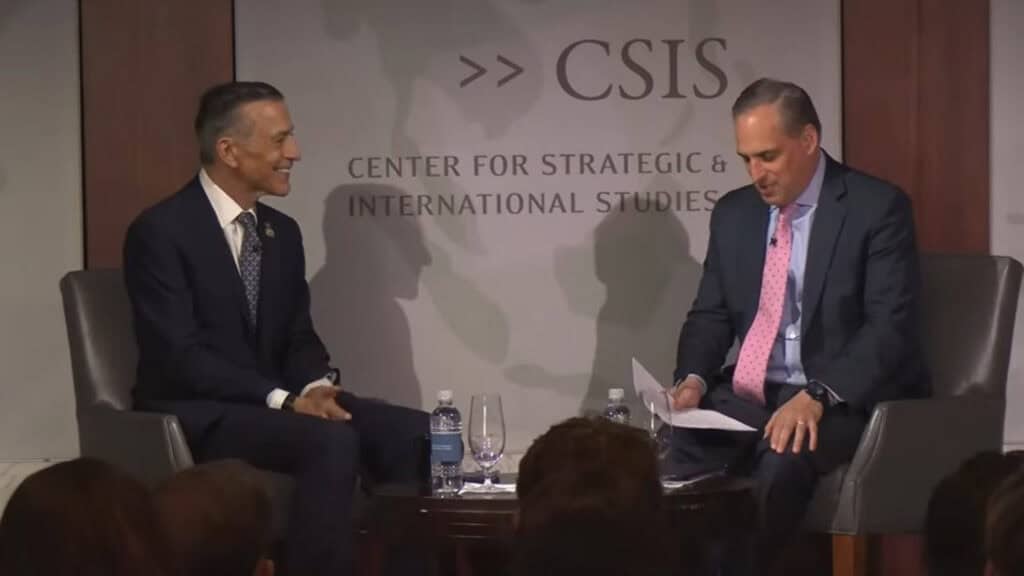
Rep. Darrell Issa (R., Calif.), the Vice Chair of the House Foreign Affairs Committee (HFAC), delivered a blunt warning about the future of American power: the United States is entering an era where military strength will be determined less by legacy systems and more by industrial speed, technological adaptability, and political will.
Issa’s analysis came at a recent discussion hosted by the Center for Strategic and International Studies (CSIS) and Dr. Seth Jones; their global conversation ranged from China and Iran to drone warfare, domestic polarization, and the future of America’s defense industrial base. But one theme tied everything together: America is no longer competing in a world where it can afford to move slowly.
“We haven’t been in my lifetime in a situation where we’re reshuffling who’s with us, who’s against us, and who pretends to be on both sides more than today,” Issa noted. That reshuffling, he argued, is reshaping the international order. Countries once firmly aligned with Washington are hedging. Rivals are coordinating more closely. Strategic ambiguity has replaced Cold War certainty.
Issa took the audience around the world in 60 seconds: Pakistan is “trying to be relevant”; India is playing both sides of Operation Epic Fury by buying oil that funds Russia and China, because in reality “there’s no such thing as non-aligned” South Korea’s “current government is one that is cozying to North Korea,” friendly with China, and hostile to American businesses; Qatar has “always been one of those in-betweeners”; and China is the only country that could ostensibly destroy America.
With Iran, Trump has shifted from “bombing the shit” out of them “to strangling them economically.” That tactic, Issa said, “should be applauded by the Europeans as ‘let’s do it quickly, let’s get it done.’”
While Issa criticized trade agreements like North American Free Trade Agreement (NAFTA) as being imperfect, he said that “you never get to 100 percent compliance” with allies; he suggested using President Ronald Reagan’s 80-20 rule.
There remain problems to be solved, he added. “We’ve been trying to get India to respect intellectual property, they’re trying to feed their people…they’re a major polluter. What can we do about it? Help them not be so poor.” Other problems remain, including Australia’s taxes on streaming platforms and European Union (EU) regulations on American tech companies.
But those problems are dwarfed by those of America’s adversaries. Issa pointed specifically to the growing relationship between Xi Jinping and Vladimir Putin, describing it as a convergence of economic and military power that poses a long-term challenge to the West. “They may not like each other,” he said. “But they in fact will come together for the foreseeable future, and it is an existential threat to the rest of the free world.”
But the congressman’s sharpest warnings were not about diplomacy during the talk. They were about manufacturing in part because, he explained, “in war, everything is dual use.”
Drawing heavily from lessons emerging out of Ukraine, Issa argued that modern warfare is exposing a dangerous weakness in the American system: the United States can build advanced platforms, but it struggles to build affordable systems at scale.
“You have visited a large drone facility,” Issa noted. “But most of the deaths in Ukraine are dropping less than 100 pounds… commercially available, inexpensive, $100-$200 drones. Substantially made in China.”
That reality, he said, should alarm Washington.
The future battlefield is increasingly defined by swarms of cheap autonomous systems, rapidly manufactured electronics, and commercial off-the-shelf technology. America’s procurement system, by contrast, remains optimized for expensive, long-cycle defense programs.
“We can make expensive programs. We can make state-of-the-art programs,” he said. “But we cannot make swarming vast amounts of weapons.” Again and again, the discussion returned to one concept: speed.
Issa described what he called the “18-month problem” — whether the United States could
truly surge industrial production in the event of a major war. Could factories be built fast enough? Could permits be approved? Could supply chains scale?
His answer was sobering: “If you go to get a permit in California, you’re not even going to get through the environmental portion of it in 18 months,” he remarked.
Instead, Issa pointed to companies like SpaceX as the model government should study. Elon Musk won virtually unlimited money, but not without some crashes, Issa said. However, that model was fast.
He contrasted the rapid pace of private-sector innovation with the slow movement of traditional federal procurement systems.
“How is it you were building your rocket boosters at the same time as you were putting up your building?” Issa recalled asking SpaceX leaders. The answer, he said, was simple: urgency.
That same urgency, he argued, is missing inside government. “Our greatest military asset today might be Starlink…we didn’t pay for that.”
At one point, Issa distilled the challenge into a single line that captured the mood of the entire discussion: “speed is probably the one thing that needs to be put into the system.”
The congressman was also critical of the Pentagon’s tendency to overcomplicate procurement, while adversaries adapt in real time. In Ukraine and the Middle East, low-cost commercial technologies are being weaponized immediately, while the United States often spends years refining requirements.
Secretary of War Pete Hegseth has made massive strides to remedy the procurement process, but there is more work to be done, Issa explained. “If you plan for the future far enough in advance,” he warned, “then in fact it’ll never be ready when you need it now.”
Despite the grim warnings, Issa ended on an optimistic note. What gives him hope, he said, is the next generation of Americans entering military service, engineering, and technology.
“They’re thinking, ‘Why is it not working on my phone?’” he said, laughing. “Why does my communication not work anywhere, anytime, in a secured way?”
To Issa, that mindset matters. The next generation expects systems to work faster, smarter, and more seamlessly than the institutions currently running them. “The next generation is ready,” he concluded. “They just need somebody to tell them they have the right solution.”
Attendees told the Washington Reporter that Issa’s remarks showcased why he’s long been one of the GOP’s top foreign policy minds. “Issa demonstrated once again that his business background means he understands better than most in Congress the need for US defense firms to have clear guidance and consistent funding to realistically ramp up production of the new weapons our military needs to address the changes they have hopefully learned from the conflicts in Ukraine and Iran,” JIB Solutions’s Paul Foldi said.