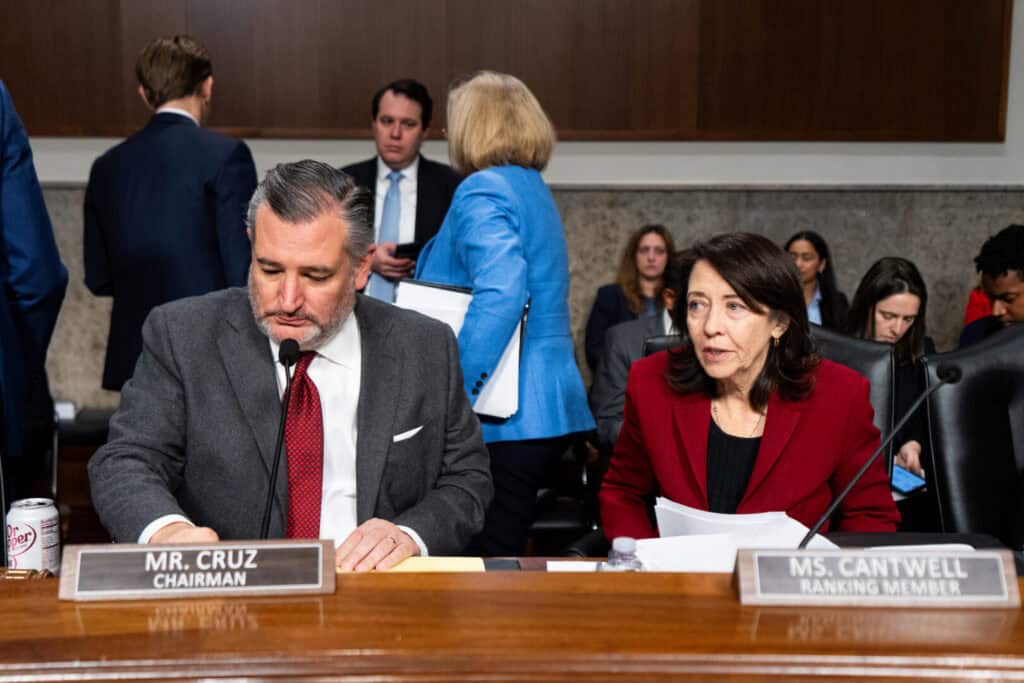
Sen. Ted Cruz (R., Texas) and the Senate Commerce Committee are in the middle of one of the Trump administration’s biggest antitrust fights, which is pitting President Donald Trump against one of his allies in conservative media.
During a hearing on “Media Ownership in the Digital Age,” Cruz welcomed in “my friend Chris Ruddy,” the CEO of Newsmax, who made the case against a Trump-backed planned merger of Nexstar and Tegna, which Trump wants the Federal Communications Commission (FCC) to green light.
“The Nexstar deal works for Wall Street but it doesn’t work for Main Street,” Ruddy told lawmakers. The Washington Reporter previously covered a Public Opinion Strategies poll which showed that an overwhelming majority of Republican voters side with Ruddy and oppose a potential merger.
Ruddy also received bipartisan support from lawmakers on the Commerce Committee when he noted that the 39 percent audience reach limit for national television ownership was set by Congress and cannot be unilaterally rewritten by the FCC. That audience reach would be directly impacted by Nexstar’s proposed $6 billion acquisition of Tegna.
“If the Nexstar-Tegna deal goes through, a single company will control 265 stations capable of reaching 80 percent of all households — more than double the current cap,” Sen. Maria Cantwell (D., Wash.), said. “For nearly half of their audience — 100 million people — Nexstar would own two or more stations in a media market. Now that concerns me.”
Curtis LeGeyt, the president and CEO of the National Association of Broadcasters (NAB), told the committee that consolidation allows for more investment in local journalism. “Some argue that allowing broadcasters to achieve greater scale would reduce local news,” he said. “The data shows just the opposite. Over the past decade, as broadcasters gained modest additional scale, the number of local news telecasts and hours of locally produced news increased substantially.”
In the past, Ruddy has made a pro-Trump argument against raising the ownership cap. “If the FCC had lifted this TV cap ten years ago, Donald Trump would never have won the presidency,” he said. That warning was posted over Capitol Hill in a media campaign by the Keep it Local Media Coalition, as the Reporter previously noted.
Nevertheless, Ruddy found plenty of common cause with Democrats. “Believe it or not, I’m going to agree with you in a minute,” Cantwell — the committee’s top Democrat — told him at one point. Another Ruddy ally was Sen. Ed Markey (D., Mass.), who said during the hearing that “localism is essential to our democracy, and when ownership is local, journalism is local.” Markey has been “skeptical” of consolidation of media throughout his career, he said.
Ruddy, however, mostly noted that conservative organizations, like the Conservative Political Action Committee (CPAC), One America News Network (OANN), and the Zionist Organization of America (ZOA) side with him in opposition to lifting the ownership cap.
He also addressed issues of both fairness and affordability in making the case against lifting the ownership cap. “Last year, Newsmax delivered five times the rating of NewsNation,” he said. NewsNation is owned by Nexstar. “Clearly Nexstar’s market leverage…suppresses competition and harms consumers,” he added, because Nexstar requires NewsNation to be carried in areas where it has ownership.
“With the collapse of newspapers, television stands alone” as the way to inform people across the country, he added, because “Big Tech does hardly any local news reporting…Raising the cap means that two or three corporations” will “control almost all local news.”
That ties directly into affordability issues, he added. “Consolidation is also about big money.” Reduced competition at local level means increased fees for advertisers. “The affordability crisis? This is a contributor…just look at radio consolidation.”
While the witnesses differed on the merits of a potential Nexstar-Tegna merger, there was almost complete agreement that the FCC or Congress should decide whether to raise the national ownership cap. “Congress set the cap and only Congress can change it,” Ruddy said.