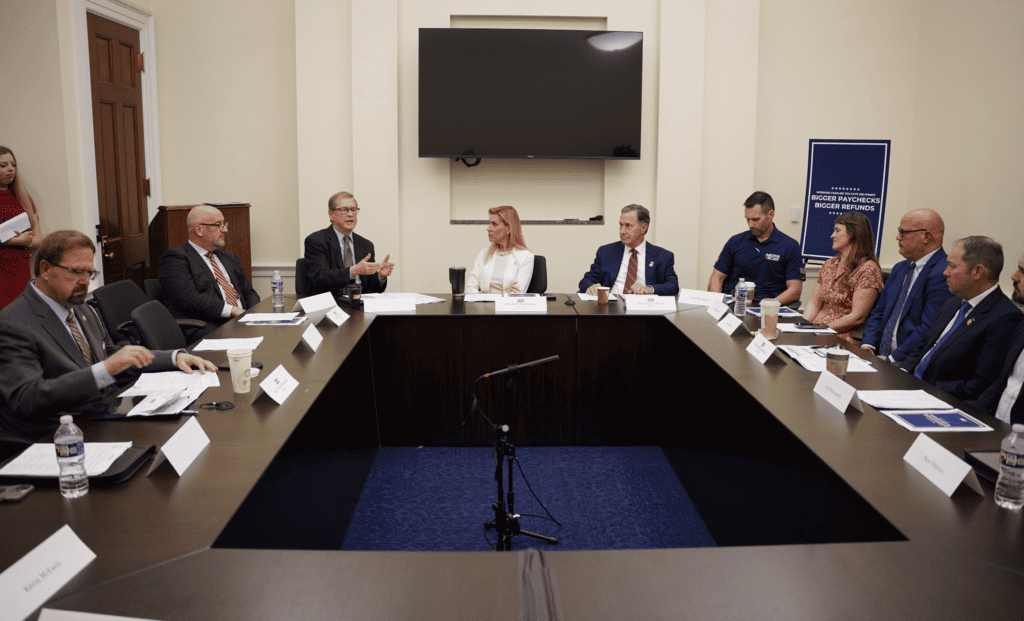
Republican lawmakers in the Republican Study Committee (RSC) kicked off Tax Day by celebrating the successes of what one business owner called the “greatest bill to hit the floor in ages.”
Rep. Beth Van Duyne (R., Texas), one of the GOP’s go-to tax experts, convened a group of lawmakers, business owners, and independent contractors to discuss the real-world impacts of the Working Families Tax Cuts (WFTC).
The business-minded guests came from across America, and they explained how the increased money in their pockets has translated to expanded hiring, thousands of additional dollars in their pockets, and savings for their children. The RSC, led by Rep. August Pfluger (R., Texas), is the largest House GOP caucus, and has led the way in messaging on legislation like the WFTC. The group was also joined by America’s leading tax cut activist, Americans for Tax Reform’s (ATR) Grover Norquist.
Among the WFTC’s most popular policies, the group explained, were no taxes on tips, no taxes on overtime, and no taxes on Social Security. But one business owner explained that making the tax cuts permanent also helped give him the certainty to plan for years ahead.
Even the lawmakers, like Rep. Tom Tiffany (R., Wis.), noted that they wished the WFTC had been in place when they were at the height of their small business careers. From Appleton to Wausau, Tiffany said that farmers in particular benefitted from the bonus depreciation provisions.
Tiffany, who is now running for governor, criticized D.C. Democrats and his governor, Tony Evers (D., Wis.), for uniformly opposing the WFTC and for vetoing a no tax on tips bill, respectively.
Lawmakers explained how they’ve already seen the benefits of the bill in their own back yard. “I haven’t seen this much building in Northern Indiana” in years, Rep. Marlin Stutzman (R., Ind.) said. He noted that this construction boom is happening in part despite tariffs. “Building cars in the United States is a big deal,” he added, noting that the auto industry faces significant external pressures that this bill helps offset.
One of the familiar faces among the invited guests was Alex Butterworth, who cofounded the eponymous Butterworth’s restaurant near Capitol Hill. Van Duyne noted that she is a frequent visitor of his restaurant, and he told the lawmakers that policies like no taxes on tips is one of the only reliefs that he’s seen from government policies.
“What you do is not just about tax policy,” one of the business owners explained. “It’s about dignity, it’s about economic relief.”
Lyndsey Fifield also noted that the Trump Accounts, which were created in the WFTC, will give American children a “life-changing” amount of money as they mature.
“We have a purpose,” Will McLoughlin, the co-founder of Ameri-CANS, said. His veteran-founded company employs people with “blue collar mentality” who clean toilets across the country. The WFTC helps him take the money that he saves, and invest it back into his business, which has helped Gold Star children attend college and helped veterans struggling with mental health problems.
“We want to keep growing,” he said, “because that’s our therapy.” His business now employs over 200 people, he noted.
Rep. Gary Palmer (R., Ala.) said that the “trickle down” impacts of the bill have led directly to a surge in spending at restaurants, helping DoorDash drivers as well.
Van Duyne regularly notes that the WFTC is so big that many of its individual provisions get lost. Several of her colleagues told the Washington Reporter what some of their favorite provisions are.
“There’s $50 billion in the bill for rural health care,” Palmer told the Reporter.
Additional policies that make America an “energy powerhouse” in the bill, Stutzman told the Reporter, include a massive expansion of domestic energy exploration in places like Alaska that will help lower energy costs that he said have risen since the conflict with Iran began.
Rep. Chuck Edwards (R., N.C.) added to the Reporter that another under-the-radar provision of the bill was the modernization of America’s air traffic control systems.
Edwards also addressed one of the Democrats’ main talking points about the WFTC — that it is for billionaires.
“I don’t know a billionaire,” he said. “How many billionaires do folks know who are working for tips?”
“How many billionaires are in this room?” Edwards asked.
“In my heart,” one attendee said.