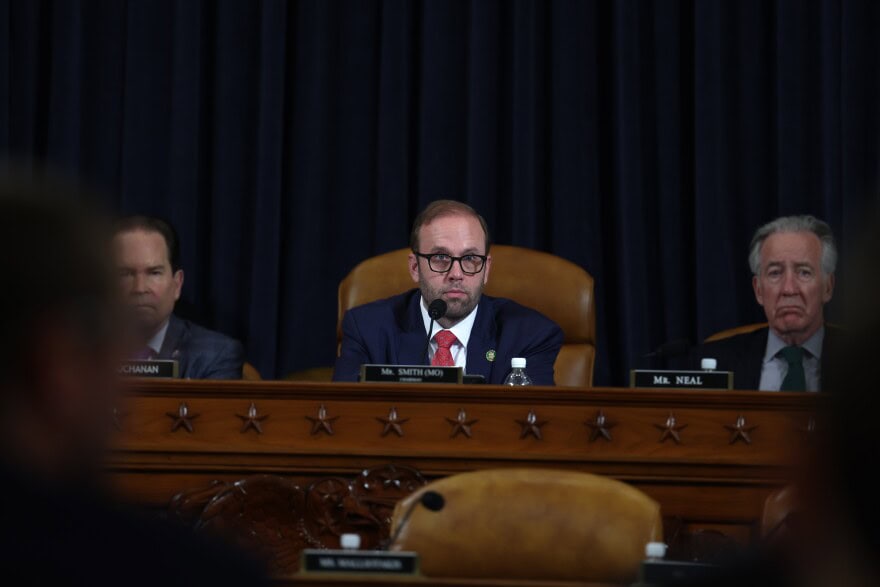
A House Ways and Means Committee hearing with health system CEOs put major hospital chains on the hot seat, as lawmakers scrutinized rising prices, taxpayer subsidies, nonprofit hospital abuse, and whether large health systems are actually delivering affordable care to patients.
Rep. Jason Smith (R., Mo.), the committee’s chairman, used the hearing to argue that sophisticated hospital systems have turned federal programs and tax benefits into a business model that rewards consolidation, higher prices, and less accountability.
“Open-ended taxpayer subsidies — manipulated by sophisticated hospitals — have become a key part of a business model that fuels ever-larger systems, eliminates competition, and drives higher prices,” Smith said. This hearing is the latest push by the Smith-led Ways and Means Committee to hold what Smith calls “health care empires” accountable for both rising costs and lack of access to health care.
The affordability concerns were underscored by Rep. Adrian Smith (R., Neb.), who pointed to the staggering growth in hospital costs. “The price of hospital services has risen 281 percent, far greater than any other area of the economy,” Smith said. “There are issues in the health insurance industry, but how are insurers supposed to keep premiums down if the cost of hospital services goes up 281 percent in 25 years?”
One of the most revealing moments of the hearing came when health system CEOs were asked whether hospitals deserve to be paid more than independent physician practices for the exact same services. Four out of five CEOs raised their hands.
Smith also blasted large hospital systems for exploiting classifications meant to support rural care. “Urban hospital chains double-dip and classify themselves as both urban for higher wage index reimbursements and then reclassify as rural for another set of government benefits,” he said. “That’s absurd.”
The hearing also zeroed in on the 340B drug pricing program, which was created to help safety-net providers serve vulnerable patients. Smith argued that large hospital systems “manipulate the 340B drug pricing program to keep steep drug discounts for themselves instead of passing the savings to low-income patients.”
Bill Hammond, a Senior Fellow at the Empire Center, detailed one of the most surprising scenes from the hearing, in which “a witness from Protect Our Care blamed H.R. 1 for causing health facilities to close, including a nursing home in the district of Rep. Adrian Smith of Nebraska, who is at the hearing. However, the CEO behind that nursing home, Wright Lassiter of CommonSpirit, is also witness at the hearing.”
“Smith asked Lassiter if the home closed because of H.R. 1, and Lassiter confirmed that it closed for unrelated reasons,” Hammond added. “This is a reminder that advocacy reports that supposedly detail the impact of H.R. 1 cannot be taken at face value.”
The witness in question, Protect Our Care’s Brad Woodhouse. His group, Americans for Public Trust (APT) has previously noted, is “a trade name of the foreign funded Sixteen Thirty Fund — one of the left’s biggest dark money machines.” APT further noted that “on his Truth in Testimony Disclosure Form submitted to Congress, Woodhouse noted that he was representing Protect Our Care, but failed to disclose that he actually works for the Sixteen Thirty Fund.”
Outside the hearing room, watchdog groups amplified the same message: nonprofit hospital systems are taking taxpayer benefits while spending on executive pay, political priorities, luxury branding, and programs that do little to lower costs for patients.
Save Our States launched a new ad targeting New York-Presbyterian Hospital System, calling it another “lavish and outlandish nonprofit healthcare system on display.”
The ad highlights the hospital system’s world-class art, contemporary designs, first-class international flights, and executive compensation, noting that its CEO compensation jumped from $8.9 million to more than $23 million in just two years.
“And who pays for this opulence?” the ad asks. “Due to New York-Presbyterian’s nonprofit tax-exempt status, it’s subsidized by you, the taxpayer.”
The ad also criticizes New York-Presbyterian for firing roughly 1,000 employees due to anticipated financial challenges after major executive pay increases. It claims the system devotes only 1 percent of operating costs to charity care despite its tax-exempt status and a questionable 880 percent spike in revenue from a federal drug program intended to benefit vulnerable patients.
Save Our States also highlighted a Department of Justice (DOJ) lawsuit alleging New York-Presbyterian’s anti-competitive contracts increased health care costs for patients, along with the system’s role in a $750 million settlement tied to hundreds of sexual abuse claims by female patients.
The ad’s closing message was blunt: “New York-Presbyterian, taking your tax dollars, betraying their patients.”
Consumers Research also launched a new campaign website, WokeHospitals.com, spotlighting New York-Presbyterian and CommonSpirit Health.
The site criticizes New York-Presbyterian’s Dalio Center for Health Justice, which promotes health equity initiatives and says it works “to dismantle the systemic factors that lead to health inequity.” Consumers Research also flags the hospital’s Compass Program, which supports transgender children, and its top score from the Human Rights Campaign Healthcare Equality Index.
CommonSpirit Health, another system featured in the campaign, is criticized for its Office of Diversity, Equity, Inclusion, & Belonging, its $100 million DEI initiative with Morehouse School of Medicine, systemwide transgender policies, and climate goals through its “Race To Zero” campaign.
As Congress continues probing health care affordability, the campaigns from Save Our States and Consumers Research suggest that nonprofit hospital systems may face a new level of scrutiny over whether they are truly serving patients, or simply using the nonprofit label to protect a very profitable business model.