

Rep. Burgess Owens on MAHA and the NFL, inside ODNI 2.0, Trump’s peace deals, and more!
Why Trump and Ric Grenell are “mensches,” our Labor Secretary takes a road trip, and more

August 21, 2025
Let’s dive in.
INTERVIEW: Rep. Burgess Owens on MAHA, OBBB, and the NFL
Heard on the Hill
EXCLUSIVE: "Peacemaker-in-chief": Trump's historic Europe summit praised by Congress
EXCLUSIVE: Poll shows majorities of voters back Trump's FDA agenda on prescription drugs
SCOOP: Labor Secretary Lori Chavez-DeRemer celebrates latest milestone in her "America at Work" road trip
SCOOP: Inside Tulsi Gabbard's plans for "ODNI 2.0"
SCOOP: Why Tom Cruise turned down the Kennedy Center's top honor
SCOOP: Power The Future unveils plan to reverse spiking energy costs
SCOOP: “Trump and Grenell are complete mensches": The Kennedy Center debuts powerful musical to combat anti-Semitism
OPINIONATED: Rep. Anthony D’Esposito on President Trump making D.C. safer, Max Meizlish on how Trump should handle South Africa, Gen. Sami Sadat on bringing back America’s global prestige by helping Afghanistan, Michael Fragoso on how to fix the Senate’s nominations process, Jason Criss Howk on the legacy of Afghanistan, and Kevin Schmidt on the consequences of vague law-making from Congress.
A message from our sponsor.

We must protect American leadership in the life sciences and avoid damaging drug pricing policies. Meanwhile, China is making significant strides in clinical trials, drug approvals and new breakthroughs. Now is the time to strengthen American innovation, not hinder it. Learn more.
If you have a tip you would like to anonymously submit, please use our tip form — your anonymity is guaranteed!
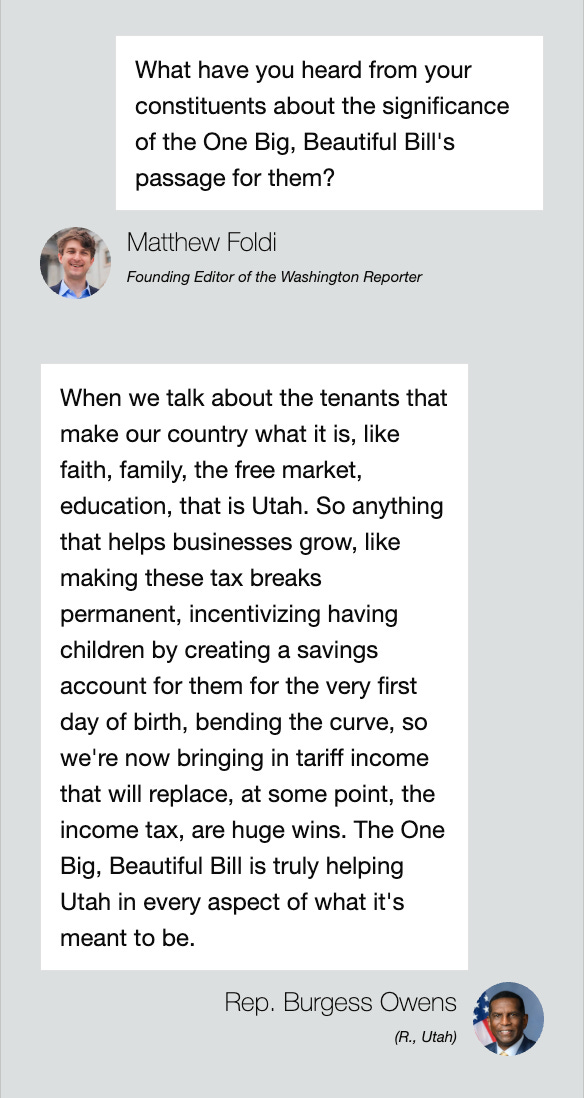
INTERVIEW: Rep. Burgess Owens on MAHA, OBBB, and the NFL
by Matthew Foldi
While Rep. Burgess Owens (R., Utah) never took the Presidential Fitness Test himself as a child, the Super Bowl winning lawmaker is ecstatic to see the Trump administration bringing it back.
As a child, Owens instead had the Burgess Owens family fitness test, which included an isometric bar above his bedroom door, a speed bag in his basement, and a lot of physical activity.
While he can “say with all confidence” that he can’t go toe-to-toe in the new workout challenge from Secretaries Pete Hegseth and Robert F. Kennedy Jr., the Utahn thinks it’s about time Americans took their physical health seriously.
“If you physically control yourself, then you start applying the same thing to mental and spiritual levels, all those other things that really make us who we are, our character,” he told the Washington Reporter in an interview. “We can control those things.”
When Barack Obama was president, America ditched the Presidential Fitness Test “because [that] was a time in which they thought comparing yourself against your peers was body shaming and that it would lead to mental illness,” Owens said. The lawmaker even wrote a book about the matter, called Liberalism or How to Turn Good Men into Whiners, Weenies and Wimps.
“It’s typical of the left,” he explained. “Anything that deals with merit is something the left hates…You think about what goes into the idea of getting in shape, staying in shape, it’s discipline, vision, hard work, merit, all those things that the left hates.”
On both an individual and on societal levels, Owens wants to see more merit.
In contrast with the Obama administration, “what the Trump administration put in place was a system where you compete against each other, where you have individual merit, where you have individual goals.
Heard on the Hill
WINKLEVOSS RULES: Wednesday saw the famous twin investors Tyler and Cameron Winklevoss announce they are donating 188.4547 Bitcoin — $21 million — to the Digital Freedom Fund PAC, which aims to accomplish President Donald Trump’s mission to turn America into the cryptocurrency capital of the world. Tyler Winklevoss praised President Trump and his administration on X, noting they “have been delivering on the promises they made on the campaign trail and then some” and that the investor pair wants “this unprecedented progress and momentum to continue.”
NOT SO FAST: Attorney General Pam Bondi just issued more than 20 subpoenas seeking to hold “medical professionals and organizations that mutilated children in the service of a warped ideology” accountable.
MAKING DC SAFE AGAIN: A White House official told the Washington Reporter that the latest arrests from President Trump’s efforts to Make DC Safe Again included 77 arrests; among them “were 24 illegal aliens arrested on charges including: sexual assault, carnal abuse (sexual abuse that typically involves illegal sexual acts often against children or adults who are unable to give consent), rape, assault, threats to injure a person, simple assault, resisting arrest, and failure to obey lawful order.”
INCOMING WIN: The RNC is poised to elect Joe Gruthers as its next chairman tomorrow.
JOHNSON VS. NEWSOM: Speaker Mike Johnson (R., La.) is not a fan of Gov. Gavin Newsom’s (D., Calif.) nascent presidential campaign. “Gavin Newsom should spend less time trampling his state’s laws for a blatant power grab, and more time working to change the disastrous, far-left policies that are destroying California. Newsom obviously wants to launch a presidential campaign on the backs of disenfranchised California voters, but it will not work,” Johnson said.
ANYBODY THERE? Former DNC Chairman Jaime Harrison claims to have one million subscribers on Substack; it turns out that was misleading, at best.
FROM HALO TO CONGRESS: Marty O’Donnell is back for another campaign against Rep. Susie Lee (D., Nev.). O’Donnell, who famously composed Halo’s iconic theme song, is introducing himself to voters with, fittingly, a video game-themed video about a goose laying — you guessed it — a golden egg. Watch for yourself here.
RAVING READERS: The Washington Reporter’s recent piece on congressional praise for President Donald Trump’s historic Europe summit got shared by lawmakers on X, including from Reps. Mike Simpson (R., Idaho), Marlin Stutzman (R., Ind.), and Pat Harrigan (R., N.C.). Thanks for reading!
A message from our sponsor.
We must protect American leadership in the life sciences and avoid damaging drug pricing policies. Meanwhile, China is making significant strides in clinical trials, drug approvals and new breakthroughs. Now is the time to strengthen American innovation, not hinder it. Learn more.
EXCLUSIVE: "Peacemaker-in-chief": Trump's historic Europe summit praised by Congress
by Matthew Foldi
THE LOWDOWN:
President Donald Trump’s historic summit with European leaders drew bipartisan praise, from former Obama administration officials to the president’s top allies currently in office.
For many in Congress, Trump’s summit was a stark contrast with how the White House ran under President Joe Biden.
Trump’s status as the “peace president” was repeatedly invoked by his congressional allies, including Sen. Eric Schmitt (R., Mo.).
The White House’s balance between diplomacy and military strength received rave reviews.
President Donald Trump’s historic summit with European leaders drew bipartisan praise, from former Obama administration officials to the president’s top allies currently in office.
Several of them told the Washington Reporter that Trump’s ability to rally the western world against Russia’s Vladimir Putin while shifting billions of dollars in costs of Russia’s war with Ukraine to Europe further proves that the president should win the Nobel Peace Prize.
Rep. Claudia Tenney (R., N.Y.), who has nominated Trump for the prestigious prize on numerous occasions, told the Reporter that the Europe summit was a “great moment for all of [the European leaders].”
For many in Congress, Trump’s summit was a stark contrast with how the White House ran under President Joe Biden.
EXCLUSIVE: Poll shows majorities of voters back Trump's FDA agenda on prescription drugs
by Matthew Foldi
THE LOWDOWN:
Voters of all parties do not believe that “pharmacies should be able to make compounded drugs beyond the very limited circumstances currently allowed by law,” new polling by pollster Fabrizio Ward, LLC found.
Rx Border Defense, which commissioned the poll, aims to counter the “dangerous, illegal and counterfeit drugs [that] have been flowing into our country across the Southern border and through other ports of entry.”
At the front of voters’ minds is still China when it comes to the health care space, and voters want what Fabrizio Ward calls “common-sense” policies, like requiring labels to show where drugs are both made and inspected.
By an 81-13 percent margin, the poll found that “compounded medication that was not FDA approved or was manufactured in an unregulated facility would not be trusted.”
Voters of all parties do not believe that “pharmacies should be able to make compounded drugs beyond the very limited circumstances currently allowed by law,” according to new polling conducted by one of President Donald Trump’s top pollsters and obtained exclusively by the Washington Reporter.
The poll by Fabrizio Ward, LLC, was conducted on behalf of Rx Border Defense, surveyed 1,000 voters across America and its findings are stark.
“When it comes to unregulated versions of popular diabetes and weight loss drugs like Ozempic and Zepbound, most voters, especially among Trump voters, think these knock-off drugs should not be on the market now that the production shortage for the brand-named drugs has ended,” the pollsters Tony Fabrizio and Bob Ward reported in their memo.
Rx Border Defense, which commissioned the poll, aims to counter the “dangerous, illegal and counterfeit drugs [that] have been flowing into our country across the Southern border and through other ports of entry.”
Trump’s policies on prescription medicine are winners, per the poll.
“There is broad bipartisan agreement that the FDA should make it a priority and should do more to protect Americans from unsafe prescription drugs being sold in the United States,” the pollsters explain. “There is similarly broad bipartisan agreement that part of President Trump's calls to have more things made in America should include prescription drugs.”
However, not everything is fully bipartisan, they explain.
“Trump voters are especially unified in their agreement that the U.S. border is not secure until we stop illicit and dangerous ingredients for prescription drugs from illegally coming across into the hands of Americans.”
SCOOP: Labor Secretary Lori Chavez-DeRemer celebrates latest milestone in her "America at Work" road trip
by Matthew Foldi
THE LOWDOWN:
Lori Chavez-DeRemer, the Secretary of Labor, has a mission this year: visit all 50 states. And she is well on her way.
This mission includes hearing from hardworking Americans about what they want to see from the Trump administration. She is the only Cabinet secretary to make this a first-year goal.
Chavez-DeRemer’s tour kicked off in April, and the Labor Secretary has used it to help pitch voters on the importance of the One Big, Beautiful Bill (OBBB), the signature domestic policy of both President Donald Trump and of her former colleagues in Congress.
As part of her tour, Chavez-DeRemer is meeting with core constituencies of the Trump coalition, including manufacturers, Teamsters, miners, and more.
Lori Chavez-DeRemer, the Secretary of Labor, has a mission this year: visit all 50 states.
This mission includes hearing from hardworking Americans about what they want to see from the Trump administration.
Even more impressive is that Chavez-DeRemer, a former Republican congresswoman from Oregon, is the only Cabinet secretary who’s made this a goal of theirs for the first year.
Chavez-DeRemer’s tour kicked off in April, and the Labor Secretary has used it to help pitch voters on the importance of the One Big, Beautiful Bill (OBBB), the signature domestic policy of both President Donald Trump and of her former colleagues in Congress.
Twin pillars of her trip include emphasizing the much-needed tax relief and igniting a blue-collar boom that Republicans aim to spur with the OBBB, legislation that was opposed by every Democrat in Congress.
This week, Chavez-DeRemer hit her latest milestone when she crossed the halfway mark of her tour. President Trump’s Labor Secretary told the Washington Reporter what she’s learned thus far.
“In just over four months, I’ve already traveled to more than half the country, and everywhere I go the message is the same: Americans are ready to work and eager to be part of President Trump’s new Golden Age of prosperity,” Chavez-DeRemer told the Reporter.
SCOOP: Inside Tulsi Gabbard's plans for "ODNI 2.0"
by Matthew Foldi
THE LOWDOWN:
ODNI 2.0 is a major redesign intended to coincide with the 20th anniversary of the DNI’s office. The changes that Gabbard is rolling out merge the decades of military, private sector, and government service that she and her team bring to the table, and have been well-received by the DNI’s career staff, many of whom emailed ideas directly to Gabbard herself.
One of Gabbard’s senior staffers said that the DNI’s DEI regime jeopardized national security by both deemphasizing merit and by requiring hours to be spent on courses in order for promotion.
Sunsetting is what Gabbard and her team have in mind. Multiple components of the DNI itself are being outright eliminated or are being folded into other agencies.
Gabbard’s reforms will save taxpayers around $700 million per year, and are separate from the $1 billion of savings that the Trump administration is aiming to achieve within the intelligence community (IC) itself.
Transparency and the Office of the Director of National Intelligence (ODNI) have historically been in conflict, but Director of National Intelligence (DNI) Tulsi Gabbard is resetting that relationship once again with her rollout of ODNI 2.0.
ODNI 2.0 is a major redesign intended to coincide with the 20th anniversary of the DNI’s office. The changes that Gabbard is rolling out merge the decades of military, private sector, and government service that she and her team bring to the table, and have been well-received by the DNI’s career staff, many of whom emailed ideas directly to Gabbard herself.
Gabbard’s reforms will save taxpayers around $700 million per year, and are separate from the $1 billion of savings that the Trump administration is aiming to achieve within the intelligence community (IC) itself.
“Trust in these [IC] institutions has been damaged,
Multiple senior ODNI officials explained the changes, in detail, to the Washington Reporter and to a handful of other media outlets. The reforms are geared towards “ensuring core mission and national security threats” are prioritized.
Under President Joe Biden, DEI initiatives exploded at the DNI. One of Gabbard’s first moves was the abolition of these programs.
One of Gabbard’s senior staffers said that the DNI’s DEI regime jeopardized national security by both deemphasizing merit and by requiring hours to be spent on courses in order for promotion.
Gabbard’s changes, which were worked on in close collaboration with the White House, the Hill, and the IC, center on twin pillars of President Donald Trump: “efficiency and transparency,” one of the officials explained.
SCOOP: Why Tom Cruise turned down the Kennedy Center's top honor
by Matthew Foldi
THE LOWDOWN:
The Kennedy Center unveiled the latest winners of its top honor, including George Strait, Sylvester Stallone, Gloria Gaynor, Kiss, and actor-singer Michael Crawford. Missing from among that group is actor Tom Cruise.
Cruise’s absence led to an immediate firestorm of misinformation, which implied that the legendary actor turned down President Donald Trump and Ambassador Richard Grenell for anything other than a “scheduling conflict.”
During Trump’s first term, high-ranking Hollywood icons frequently shunned appearing with him. Now, Trump tapped Hollywood icons — including Mel Gibson, Jon Voight, and Sylvester Stallone — as special ambassadors to America’s cultural center.
The View’s Ana Navarro immediately urged Gaynor to reject the honor, but there are no indications that that is in the works. The Reporter previously covered another recent bout of misinformation regarding the Kennedy Center and singer Ben Folds, who is currently boycotting the center.
The Kennedy Center unveiled the latest winners of its top honor, including George Strait, Sylvester Stallone, Gloria Gaynor, Kiss, and actor-singer Michael Crawford.
Missing among that group? Tom Cruise.
Cruise’s absence led to an immediate firestorm of misinformation, which implied that the legendary actor turned down President Donald Trump and Ambassador Richard Grenell for anything other than a “scheduling conflict.”
The reasoning, Kennedy Center insiders told the Washington Reporter, is straightforward: a scheduling conflict.
Sometimes, it turns out, a scheduling conflict is just that.
Cruise “wants it next year because he’s getting a massive Academy Award for lifetime achievement this year and wants to spread them out,” a high-ranking Kennedy Center official told the Reporter.
Despite some Cruise-related scuttlebutt, the rollout of the center’s awards was otherwise smooth. In fact, Trump is a clear fan of the center, and of Grenell’s leadership. He just visited the center again this week, marking yet another visit by the president, who is also the Chair of the Kennedy Center’s board of directors.
During Trump’s first term, high-ranking Hollywood icons frequently shunned appearing with him. Now, Trump tapped Hollywood icons — including Mel Gibson, Jon Voight, and Sylvester Stallone — as special ambassadors to America’s cultural center.
Leading Democrats, including Gov. Gavin Newsom (D., Calif.) have faced scrutiny amidst California’s inability to rebuild much of Hollywood following devastating fires earlier this year.
SCOOP: Power The Future unveils plan to reverse spiking energy costs
by Matthew Foldi
Decades of bad energy policy are threatening President Donald Trump and Republicans in the 2026 midterms, a leading American energy group is warning — even though the causes of spiking energy costs have little to do with the GOP’s agenda for energy independence.
“Are you paying MORE each month for food, electricity bills, health care? Thank a House Republican,” a staffer for the Democratic Congressional Campaign Committee (DCCC) recently tweeted.
For years, Trump has prioritized American energy dominance and independence; but if energy costs continue to rise, due primarily to failures of the Democratic Party’s energy agenda, Trump’s party could suffer simply because they are the ones in power; one of the policies at fault, for example, is the expansion of renewable portfolio standards and carbon regulations that forced premature plant retirements across America.
Higher energy costs ripple throughout the American economy far more than the spikes alone do; they impact small businesses, jobs, inflation, and more.
A whopping 73 percent of Americans are worried about rising electric and gas bills in 2025; however, Power The Future (PTF) explains, in its latest report obtained by the Washington Reporter, that “politically motivated energy policies, often prioritizing ideology over reliability, have steadily driven up electricity costs, which working families are now facing.”
PTF has four suggestions that the Trump administration can use to take the wind out of the Democrats’ sails on this issue. Utilize the Defense Production Act to support firm, dispatchable generation capacity; build new fossil fuel plants, which will be particularly necessary to augment the growth in artificial intelligence (AI); halt premature closures of fossil fuel plants; and expand existing coal capacity.
The alternative to these policies reveals a “clear correlation” to higher energy costs, PTF explains. “Every percentage point drop in fossil generation shifts more costs onto ratepayers, not just in power bills, but across every sector that depends on affordable electricity,” its report says. Even red states like Texas, Indiana, and West Virginia are cutting fossil fuel power.
As Democrats struggle to latch on to issues with which to attack Trump and Republicans, they have recently latched on to higher energy costs — and PTF’s executive director says now is the time for Trump to go on offense.
SCOOP: “Trump and Grenell are complete mensches": The Kennedy Center debuts powerful musical to combat anti-Semitism
by Matthew Foldi
THE LOWDOWN:
The Kennedy Center, which is now run by President Donald Trump as the board chairman and by Ambassador Richard Grenell as its president, premiered the musical Parade. The production is about the lynching of Leo Frank, a Jew in pre-World War One Georgia, who was killed for a crime he was framed for.
The musical kicked off at a critical juncture for Jews in America. In the FBI’s latest report on hate crimes in America, Jews account for almost all of the ones committed on the basis of religion.
Bethany Mandel, who attended the show’s premiere, told the Washington Reporter that “Parade is a gripping and unflinching portrayal of one of the most painful chapters in American Jewish history.”
That message was unmistakable throughout the center during the show. The Foundation to Combat Antisemitism’s trademark blue pins were freely available to visitors, many of whom donned them throughout the show.
The Kennedy Center doesn’t immediately spring to mind during discussions about combatting anti-Semitism, but its latest show puts it firmly at the forefront of these discussions.
The center, which is now run by President Donald Trump as the board chairman and by Ambassador Richard Grenell as its president, premiered the musical Parade. The production is about the lynching of Leo Frank, a Jew in pre-World War One Georgia, who was killed for a crime he was framed for.
The musical kicked off at a critical juncture for Jews in America. In the FBI’s latest report on hate crimes in America, Jews account for almost all of the ones committed on the basis of religion.
Parade’s poignant message about the horrors of anti-Semitism was received warmly.
Bethany Mandel, who attended the show’s premiere, told the Washington Reporter that “Parade is a gripping and unflinching portrayal of one of the most painful chapters in American Jewish history.”
“The Kennedy Center production brings this pivotal story to life with power and urgency, reminding us why art is essential to remembering, reckoning, and never forgetting,” Mandel said.
That message was unmistakable throughout the center during the show. The Foundation to Combat Antisemitism’s trademark blue pins were freely available to visitors, many of whom donned them throughout the show.
OPINIONATED
Op-Ed: Rep. Anthony D'Esposito: Washington D.C. needs President Trump's courageous leadership — and he is delivering
by Rep. Anthony D’Esposito (R., N.Y.)
The District of Columbia isn’t just another city — it’s the seat of our federal government, the symbolic heart of America, and the place where millions of visitors from across the country and the world come every year to witness the ideals of democracy in action. But anyone who’s spent real time here in recent years knows the truth: D.C. has been spiraling deeper into a crime crisis that has made its streets dangerous, its residents fearful, and its visitors uneasy.
That’s why President Donald J. Trump’s recent decision to use federal resources to crack down on crime in Washington, D.C., is exactly the kind of bold, decisive leadership that has defined his career. He’s not just talking about the problem — he’s taking action. And in a city where too many politicians are afraid to confront the truth about crime, that makes all the difference.
The District of Columbia is unique. It’s not a state. It’s not governed by a governor and legislature like the 50 states. Under the U.S. Constitution, Congress retains ultimate authority over the District, and the federal government has both the responsibility and the power to step in when public safety collapses.
President Trump understands this. Article I, Section 8, Clause 17 of the Constitution — often called the “District Clause” — explicitly grants Congress the authority to “exercise exclusive Legislation in all Cases whatsoever” over the District. That means the federal government not only has the right, but the duty, to protect the safety of its citizens, workers, and visitors here.
Unlike weak leaders who hide behind excuses, Trump is using the constitutional authority available to him to protect the American people. That’s real leadership — knowing the tools you have and having the courage to use them.
Op-Ed: Max Meizlish: South Africa wants to fight Trump. Here’s how he should fight back.
by Max Meizlish
South Africa is picking a fight with America it cannot win. This week, the country’s top general flew to Iran to deepen military cooperation with its Islamist regime. Just days earlier, African National Congress (ANC) Secretary-General Fikile Mbalula challenged Donald Trump to “bring on” sanctions.
A month prior, Deputy President Paul Mashatile — also of the ANC — visited China and Russia to expand economic ties. Beijing and Moscow went on to announce this month they would again participate in naval wargames off South Africa’s coast in November.
The ANC, once the party of Nelson Mandela, is moving South Africa away from its historical position of non-alignment and concern for human rights to active support for America’s enemies, all of them oppressive dictatorships.
This is the product of the ANC turning away from Mandela’s idealism and resurrecting historical anti-colonial narratives to garner cheap wins at home. This trend, along with measures of blatant corruption and simple recklessness, is why South Africa is no longer just courting America’s most dangerous adversaries but daring America’s leader to respond.
Here’s the playbook for fighting back.
Op-Ed: Lt. General Sami Sadat: President Trump can get Washington its global prestige back by helping Afghanistan
by Lt. Gen. Sami Sadat
Four years ago, Afghanistan fell under the yoke of Taliban. We lost our country, our liberties and the right to exist. America lost a mission that was both strategically imperative to global security and morally right to continue.
The aftermath of the Taliban takeover has been threefold: a major humanitarian crisis expelling around 10 million Afghans and affecting all 30 million who are enslaved to Taliban’s laws. The return of Al-Qaeda to Afghanistan shortly after the Taliban took over the country — all Al-Qaeda leaders, operators, their families and their associate groups moved into Afghanistan, making it their new HQ for global operations against the United States; furthermore, the Taliban has released over 2,500 so called Islamic State fighters who were imprisoned by Afghan and U.S. forces in Pule Charkhi prison. And finally, China’s invasion of Afghan minerals, strategic deposits and locations that has far reaching global impact.
Afghanistan today is a hell for Afghans who live there — but it is a safe haven for our enemies — particularly terrorists, along with the Russians, Iranians and Chinese. Afghanistan under the Taliban is effectively an American hate club.
The day the Taliban rolled onto the streets of Kabul as victors, the American image has changed in the minds of friends and foes globally. For friends it was seen as a questionable choice to be ally to the United States — hence weakening the link with the U.S. and instead empowering the opposition to the U.S. and encouraging BRICS, trying to end dollars as global currency, and shifting alliances.
This is especially true in Africa’s Sahel and in the Middle East. For enemies this was seen as a moment to take on America — terrorists went on steroids, making major gains in Africa, Pakistan and in the Middle East, increasing recruitment and revitalizing their hope for success.
Op-Ed: Michael Fragoso: How to fix the coming nominations crisis
by Michael Fragoso
There’s a crisis brewing on the Senate’s Executive Calendar. A staggering number of nominees are languishing on the Senate Floor because Democrats refuse to cut any nominations deals at all. Even in the run-up to the August recess — prime dealmaking time — Democrats stood firm (Sen. Chuck Schumer offered some low-hanging fruit in exchange for high-priority funding restoration, a hostage-taking non-starter).
There’s no reason to think this obstruction will stop naturally, so Senate Republicans should stop it themselves.
According to the Washington Post, 126 Trump nominees have been confirmed, while 241 are still being considered by the Senate. This confirmation number is in line with where it was under President Joe Biden and during the first Trump administration, but that statistic is misleading. Only one Trump nominee has not been filibustered: then-sitting Senator Marco Rubio. Leader John Thune (R., S.D.) has, thus, been able to confirm this many nominees through a constant stream of confirmation votes.
The Senate in 2025 had taken more votes by July 24 than all but four prior calendar years of voting. In other words, while Thune is keeping pace, it’s while on a death march.
Op-Ed: Jason Criss Howk: We ignore the failures of Afghanistan at our own peril
by Jason Criss Howk
August 2025 marks the fourth year of the final demoralizing betrayal of the people of Afghanistan by the U.S.-led NATO plus coalition.
While this month has little meaning to the majority of the world, it has a severe impact on those who risked their lives for twenty years to bring Afghanistan into the international fold and start their long journey towards fair governance and safety for the millions of Afghans that suffered under decades of war before September 11th.
Specifically, this month is difficult for veterans, diplomats, intelligence officers, aid and development officers, and the families that supported their mission for two decades. Just look at the suicide rates of this cohort to see how impactful our failed policy in Afghanistan has been.
But the pain of the coalition helping Afghans is very small compared to the people of Afghanistan. Afghans and their allies thought there might be a chance the Trump administration would reverse the failed Biden policies on Afghanistan.
So far that has not been the case, and it makes this anniversary of our collective failure even more challenging.
Afghanistan today is a nation occupied by the Taliban, Haqqani, and AQ terror regime. These terrorists are fully supported by Pakistan, China and Russia. The regime exists to make Afghanistan more pro-Pakistan and pro-China. This allows the two neighbors to loot all the resources of Afghanistan at rock bottom prices. That is trillions of dollars over the next decade going to two nations that hate America and our ideals.
Op-Ed: Kevin Schmidt: How vague statutory language enabled the Biden administration’s CHIPS Act overreach, and what Congress must do next
by Kevin Schmidt
When Congress rejected sweeping child care subsidies in the Inflation Reduction Act, the Biden administration’s Commerce Secretary Gina Raimondo reportedly told her staff, “if Congress wasn’t going to do what they should have done, we’re going to do it in implementation.”
That wasn’t just rhetoric — it became a blueprint for how the Biden administration would abuse a bill meant to support the domestic production of semiconductors, the CHIPS and Science Act, to instead impose progressive social policies through administrative fiat.
After more than two years of government stonewalling in Freedom of Information Act (FOIA) litigation, the Americans for Prosperity Foundation uncovered how the Biden administration’s Department of Commerce made political decisions to burden domestic chip manufacturers with additional requirements and mandates beyond what the statute allowed, undermining the national security argument that was key the bill’s passage.
In the wake of the Supreme Court’s decision in Loper Bright v. Raimondo, Congress has a renewed opportunity — and responsibility — to reclaim its legislative authority instead of granting vague authority to federal agencies like the language in the CHIPS Act.
