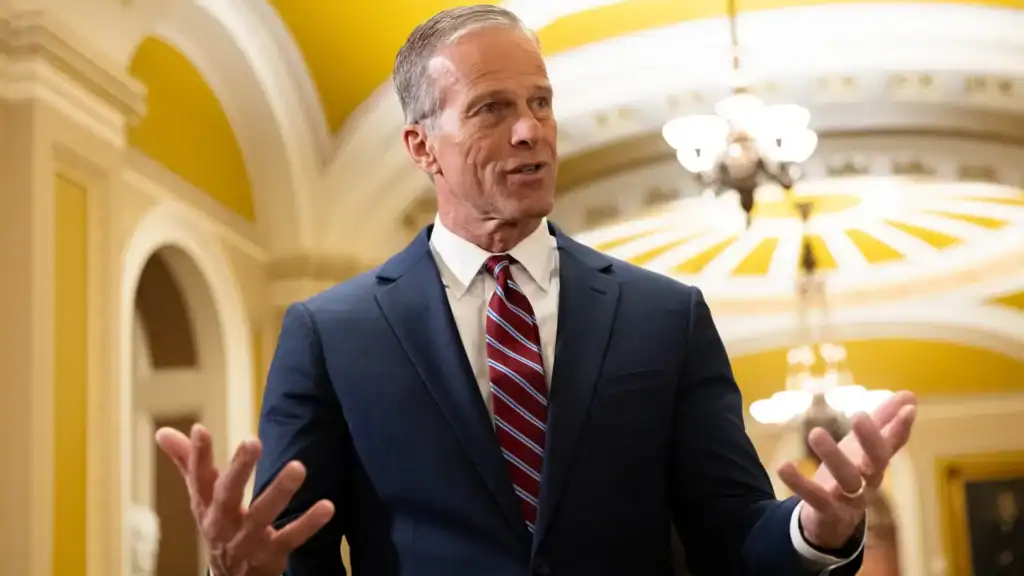
2026 has looked different for Senate Republicans, who entered their second year under Senate Majority Leader John Thune’s (R., S.D) leadership as they head into the midterm election. While Thune’s substance and style have differed from those of his predecessor, Sen. Mitch McConnell (R., Ky.), an objective review of Thune’s record shows that he has given Republicans plenty to campaign on ahead of November.
While Thune has faced criticism from some Republicans, and even from some within his own conference, over the Senate’s failure to pass legislation like the SAVE America Act, Thune’s successes in confirming President Donald Trump’s cabinet and judicial nominees, in the wake of unprecedented obstruction from Senate Democrats, have been universally commended by Republicans.
Thune’s success in confirming Trump’s nominees at a historic rate didn’t come easily for him, however. It necessitated the Senate changing its rules to clear up the backlog, which Thune and his colleagues have virtually eliminated. As a result, Senate Republicans have confirmed almost 600 of Trump’s nominees, and they have confirmed more Article III judges than they had done in Trump’s first term.
The Senate has also maintained an at-times frenetic pace under Thune, a former tri-sport athlete in high school; Thune kept the Senate in session for ten consecutive weeks — the longest stretch in almost two decades — and has already held six vote-a-ramas, which is the most of any Senate in modern history.
Senate Republicans under Thune’s leadership have also passed major pieces of legislation on both partisan and bipartisan bases, giving Trump both legacy items on his priorities like stopping the flow of fentanyl into America and putting Democrats between a rock and a hard place with bills like the Laken Riley Act; the latter’s passage was both important legislatively and politically.
But Thune and his colleagues aren’t just shoring up Trump’s legacy and codifying many of his executive orders; they have already passed over two dozen Congressional Review Act resolutions that are undoing some of the most destructive examples of red time from President Joe Biden’s time in office.
One of the most prominent examples undid a regulation that allowed Gov. Gavin Newsom’s (D., Calif.) California to de facto regulate the American auto industry. Were it not for congressional Republicans and Trump, that would have remained the law of the land.
Finally, while there is much discussion about what another reconciliation package may or may not include, Thune and House Republicans delivered on virtually every campaign promise of Trump’s by passing the Working Families Tax Cut, despite universal opposition from Democrats, and despite sporadic opposition from Republicans.
As the party out of power, Democrats have history on their side heading into the 2026 midterms, but Thune and his colleagues in the Senate, along with Speaker Mike Johnson (R., La.) and his colleagues in the House, have given Republicans in and out of office plenty to campaign on.
Democrats, on the other hand, have next to nothing to run on; the affordability crises plaguing Americans can be neatly blamed at the Democrats’ feet after they injected trillions of dollars of spending via legislation like the so-called Inflation Reduction Act — and that is a message that Republicans have fewer than 100 days to drive home to every voter in America.
Matthew Foldi is a co-founder and the editor-in-chief of the Washington Reporter.