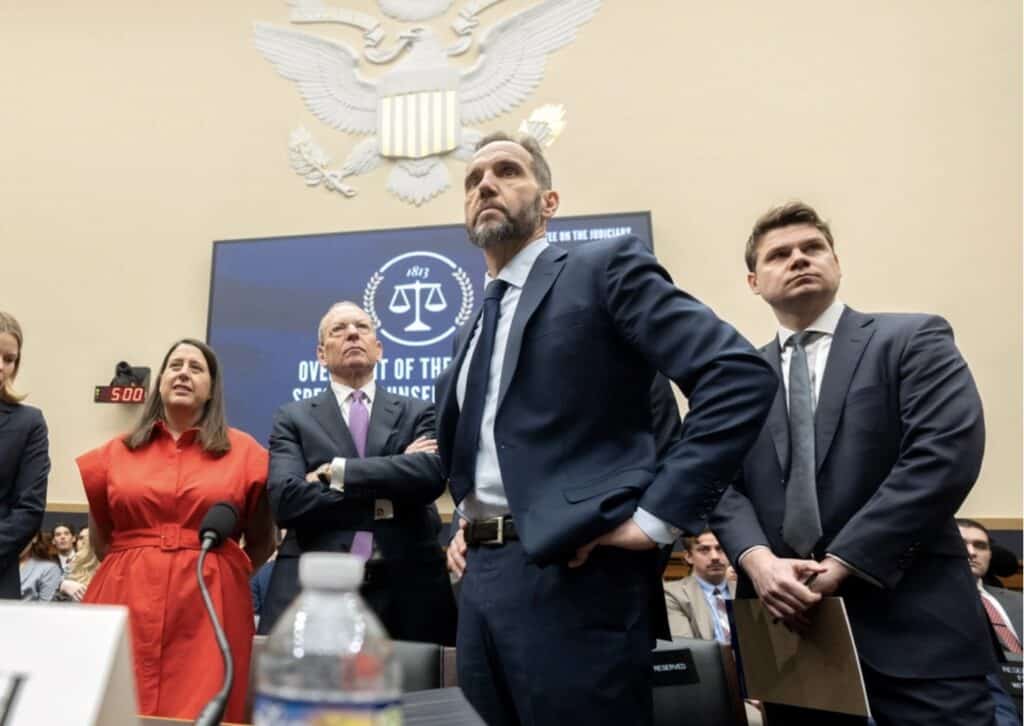
Jack Smith will testify before the Senate Judiciary Committee on September 29th regarding his investigation into President Trump, known as Arctic Frost. Republicans will attack him for targeting the President; Democrats will use him to allege the President tried to overturn the 2020 election. But little-noticed litigation brought by New York Times Reporter Charlie Savage creates an important opening for bipartisanship.
As has been reported at length, Mr. Smith’s team used grand jury subpoenas to obtain the call logs of Republican Members of Congress from cell phone companies. The decision arguably violated federal law, raised complicated constitutional questions, and was at a minimum unwise.
Importantly, Mr. Smith’s team obtained “non-disclosure orders”—or gag orders—prohibiting the cell phone companies from notifying the members of Congress that prosecutors had obtained their records.
The gag orders obtained by Mr. Smith were released nearly a year ago. To issue such an order, federal law requires a judge to find “reason to believe” notification will result in threat to life or limb, destruction of evidence, flight risk, witness intimidation, or similar conduct. That’s an easy standard to meet for a cartel member, but not so for a United States Senator. As a former prosecutor, I knew that the sealed information that was put before the judge—the “application” for the order—was the key to all of this and stated in an X post that “obtaining the application is key.”
Thanks to Mr. Savage’s litigation, we have an application. What’s in it should shock the conscience of every American.
The application gave this—and nothing else but boilerplate recitations—as the “reason to believe” notification to members of Congress would result in the obstruction of justice:
Specifically, this investigation concerns activity and conduct surrounding January 6, 2021, in Washington, D.C., including the certification of the vote of the Electoral College of the 2020 Presidential Election.
That, the prosecutor attested, was “reasonable grounds to believe that disclosure of the Subpoena would result in destruction of or tampering with evidence, intimidation of potential witnesses, or other serious jeopardy . . . .”
Mr. Smith’s response may be that the application is six pages long and met the applicable legal standard. But the only other part of those six pages that even attempts to address the factual basis for the request reads as follows:
The Subpoena seeks information relevant to establishing the illegal activity under Investigation and identifying the individual(s) responsible. Accordingly, disclosure may reveal the existence, scope, and direction of the Government’s ongoing and confidential investigation. Once alerted to this investigation, potential target(s) could be immediately prompted to destroy or conceal incriminating evidence, and otherwise take steps to undermine the investigation and avoid future prosecution. In particular, given that they are known to use electronic communication and remote computing services, the potential target(s) could quickly and easily destroy or encrypt digital evidence relating to their criminal activity.
In essence: because someone is under investigation and they use a cell phone, a court has reason to believe providing notice will result in the obstruction of justice. Hopefully, the repeated “(s)” is evidence enough of the boilerplate, non-case-specific nature of the application.
What is not in the application is the basic fact that the subpoenas were targeting the records of Members of Congress. What is not in the application is that the records requested could implicate constitutionally protected speech by Members of Congress and that Congress, as a separate and co-equal branch of government, had a clear constitutional interest in getting notice so it could protect its interests. What is not in the application is evidence to suggest that the Members of Congress, or any target of the investigation, would actually destroy evidence or intimidate witnesses.
This specific application was filed in April 2022—after the investigation had begun but months before Mr. Smith was appointed Special Counsel in November 2022—by a prosecutor who later became one of Mr. Smith’s senior deputies. But Judge Boasberg’s order to release the application said it “reflects the universe of records responsive to” Mr. Savage’s request for “all applications” before and after Mr. Smith’s appointment, which Judge Boasberg said were “largely identical.” In other words, this is the application put before the Court during Mr. Smith’s tenure too.
While the application indicts the approving Court as much as Mr. Smith’s team, its nature is unfortunately commonplace for the Department of Justice—across investigations, administrations, and the country. Mr. Smith would not be lying if that is his testimony.
That testimony should serve as a call to action for Congress. Congress should ensure that prosecutors can’t obtain these gag orders against Americans without a real, factual basis. While Smith’s hearing will surely be partisan, the Committee’s investigation into Arctic Frost is shining a light on a nonpartisan issue that has long been rotten in the federal justice system.
Lee Holmes is the Managing Shareholder of Maynard Nexsen’s D.C. Office. He has served as a federal prosecutor, a lawyer in the White House, and the top staff lawyer on the Senate Judiciary Committee.