Op-Ed: Bartlett Cleland: The PR war on American data centers, brought to you by foreign billionaires
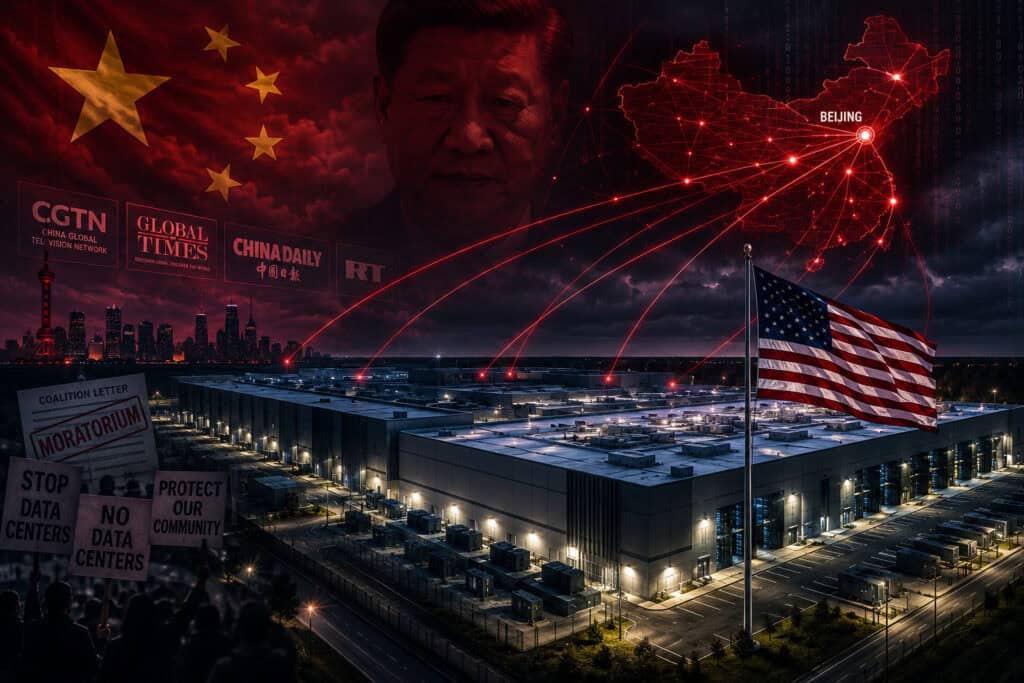
If you’ve been watching American energy debates for the past two decades, today’s campaign against data centers and artificial intelligence infrastructure feels uncomfortably familiar. While some concerns and questions about data centers are valid, much more seems designed to benefit America’s foreign competitors. As energy analyst and 40-year oil and gas veteran David Blackmon put it: the war on data centers is a replay of the campaign against fracking. “Just as the war on fracking was transparently designed to prevent the U.S. oil and gas industry from competing with Russia and Saudi Arabia, this war on data centers is transparently designed to harm America’s ability to win the fierce AI race vs. China,” wrote Blackmon.
The same foreign and billionaire interests. The same activist networks. The same Saul Alinsky tactics. The same manufactured local outrage seeded by sources thousands of miles away. The only difference is the target, and the strategic stakes are even higher this time.
Back then, foreign money backed American anti-fracking campaigns with a transparent purpose: to stop U.S. oil and gas from competing with Russian and Saudi production. That worked well enough to slow things down, generate years of regulatory uncertainty, and poison public opinion in communities that ultimately benefited enormously from the energy boom. Now the same playbook is being run against data centers and AI, but this time, the primary geopolitical beneficiary is not Moscow or Riyadh. It is Beijing.
The evidence is growing.
A new report from the Bitcoin Policy Institute documents three distinct vectors of foreign influence converging on a campaign to slow U.S. artificial intelligence development:
· Foreign-billionaire dark money pushed for a federal moratorium on AI data centers;
· Beijing’s state media apparatus; and
· A CCP-aligned nonprofit network.
The Foreign Funding Network
A report from the American Energy Institute documents nearly $40 million in foreign funding to activist organizations working to block American data center construction and prevent the enabling energy infrastructure from being built. The donors are not worried neighbors. They are foreign billionaires operating out of Switzerland, the United Kingdom, and Denmark. Most notable is Swiss billionaire Hansjörg Wyss, who channels money through the Sixteen Thirty Fund, a well-known dark-money hub for progressive causes, into groups like 350.org, the Sierra Club, Indivisible, and Oil Change International.
The report from the Bitcoin Policy Institute expands that picture: environmental activists like the Swiss billionaire Wyss and British billionaire Alan Parker have funneled more than $2 billion into U.S. non-profit advocacy groups, with grantees signing a coalition letter making the case for a nationwide moratorium on data centers. Those organizations then distribute funds to local pop-up groups that perform as concerned citizens at city and county zoning meetings, like “Stop The Data Center Coming To Martindale Brightwood” in Indiana. The vote on this data center zoning even led to political violence as an Indianapolis official had his home shot up and a note placed there saying “No data centers.”
Jason Isaac, a former Texas legislator and now CEO of the American Energy Institute, was direct about his organization’s findings: “This debate is not just about data centers — it is about whether the United States will build the infrastructure needed to remain a global leader in innovation. Delays or moratoriums don’t just pause construction. They push investment, jobs, and technological leadership elsewhere.” The pattern Isaac identified is damning in its consistency, “The same network of organizations that have long opposed American energy development are now targeting AI infrastructure.”
The CCP and Russian Connection
But that European dark money is only part of the story. The Bitcoin Policy Institute report exposes a more alarming network. Beijing’s English-language outlets, CGTN, China Daily, and Global Times, together with Russia’s RT, have run direct campaigns targeting U.S. AI data centers and export controls while the Chinese state simultaneously subsidizes up to half the energy costs of its own AI data center operators.
Alongside those state media campaigns runs a CCP-aligned U.S. nonprofit network receiving millions to push the narrative further. Nonprofits funded by Neville Roy Singham, a U.S. expatriate now living in Shanghai who openly promotes the CCP’s vision of a “new world order,” have openly collaborated with Chinese state media voices. Singham funneled an estimated $285 million into six nonprofits over several years using shell companies and a donor-advised fund that Goldman Sachs ultimately terminated in early 2024. His network includes CodePink, which in January 2026 published an article directly targeting Meta’s Hyperion project in Louisiana and Meta Cheyenne in Wyoming, framing their opposition as a fight against “the new Cold War on China.” His think tank, Tricontinental, published pieces arguing against U.S. semiconductor export controls and praising China’s AI development. Chinese state media echoes the same talking points. This is not a coincidence. This is coordination.
107 Days: From Coalition Letter to Federal Legislation
This advocacy echo chamber followed with remarkable mechanical efficiency. A December 2025 letter, organized by Food & Water Watch and signed by more than 230 organizations, called for a national moratorium on new AI data centers. A substantial number of those signatories receive funding from networks tied to Wyss and Parker.
Then, just 107 days later, Sen. Bernie Sanders and Rep. Alexandria Ocasio-Cortez introduced the Artificial Intelligence Data Center Moratorium Act in Congress. Researchers at the Bitcoin Policy Institute noted diplomatically, “that kind of efficiency typically distinguishes coordinated advocacy infrastructure from spontaneous grassroots opposition.”
Said another way, a 107-day pipeline from a foreign-funded coalition letter to federal legislation is not a grassroots movement. This is a supply chain. And the influence operation does not stop with the legislation itself.
On April 29, 2026, one month after Sanders introduced his moratorium, he convened a Capitol Hill panel titled, “The Existential Threat of AI.” Two of the four panelists were Chinese government affiliates: Zeng Yi, founding dean of the Beijing Institute of AI Safety and Governance, and Xue Lan, a Counsellor of the State Council of the People’s Republic of China and chair of China’s National AI Governance Committee.
Using a U.S. Senate-provided platform, Xue called the U.S.-China AI race “an inaccurate narrative” and promoted “safe zones” of cooperation on AI governance, messaging that parallels years of Chinese state media narratives surrounding AI policy and American technological development, according to the Bitcoin Policy Institute. Meanwhile, statewide moratorium bills have been filed in at least 12 states this legislative cycle. At least 54 local data center moratoriums have already passed in U.S. towns and counties, with many more under active consideration.
U.S. Interior Secretary Burgum: “Foreign Source Dark Money” and the Electricity Lie
Then, Interior Secretary and National Energy Dominance Council Chairman Doug Burgum, speaking at a Breitbart News policy discussion in May 2026, confirmed what the reports document and added another important dimension: these campaigns are deliberately exploiting anxiety about electricity prices even in communities that have never hosted a data center and never will. “Some of this is foreign source dark money coming in, and the people that used to fight on climate change have shifted,” Burgum said. “They don’t talk climate change because they realize it’s a losing argument. ‘I can’t get people excited about one degree of climate change, but, man, I can lie to them about why their electric bill went up.’”
Burgum was unsparing about the dishonesty involved. “There are elections occurring in states right now where people are running on the affordability of electricity, and there’s never been a data center built in their state, and there won’t be a data center.” His point is important: data centers are highly sensitive to energy costs and won’t locate where electricity is expensive. The infrastructure fears being stoked in many communities are fiction. But fiction travels fast when someone is paying for distribution.
Burgum also offered his own compelling counter-evidence to the narrative that data centers harm local communities. When he was governor of North Dakota, a $1.2 billion data center came to a town of 800 people. The result? Electricity rates went down. A large customer willing to pay a premium effectively subsidized the fixed costs of the grid for every local farmer, rancher, and small business with a meter.
This is the story the foreign-funded activists, and those who wittingly or not parrot their arguments, don’t want told.
A public policy debate is one thing, but the real goal here is much closer to foreign money directly trying to undermine our country.
The Progressive Electoral Strategy Behind the Campaign
The story goes well beyond our national security and is reminiscent of tactics from Tammany Hall. Data centers are being built primarily in rural America. They bring investment, jobs, tax revenue, and broadband capacity to communities that have watched helplessly as manufacturing and mining departed while their populations declined. Data centers are bringing wealth predominantly to red counties — the very counties that Democratic strategists have identified as essential to any path back to a congressional majority.
The Democratic Congressional Campaign Committee’s “Red to Blue” program is explicitly targeting 18 House seats in 12 states for November 2026. The DNC is pouring money into rural organizing across Iowa, Nebraska, Wisconsin, and more. Veteran Democratic strategist James Carville has said flatly that Democrats “lived in a folly of a world that we could exist in elections by just concentrating on large urban areas” — and that without reintroducing the party to rural America, the math for taking back Congress does not work.
So ask yourself: what better wedge issue to introduce into a rural red county than an industrial facility that opponents claim will drive up electricity bills, strain water supplies, and bulldoze the character of a community?
The political return on investment is already visible. As Fortune magazine documented in late 2025, opposition to data centers helped tip elections in Democrats’ favor in Virginia and Republican-leaning Georgia. Virginia provides a great example of the end goal of those tipped elections. As priority business the newly-minted Democrat government of Virginia, the House, Senate, and Governor moved to gerrymander the state to all but eliminate any GOP representation in a state that is approximately 46%-47% republican in voting.
Sabato’s Crystal Ball has noted data center battles are creating “intraparty rifts” for Democrats between building-trade unions who want the construction jobs and politicians calculating the voter backlash potential. That tension reveals everything. This effort is not a principled environmental debate, but it is rather a political calculation about which way to move the needle in competitive districts. The environment is the vehicle; the destination is the ballot box.
This is about whether Democrats can leverage local fears into congressional seats by flipping red counties to blue, and whether foreign-aligned interests can hollow out America’s AI future while doing it, not whether data centers strengthen American communities (which the data suggests they do).
The Bitcoin Policy Institute frames the ultimate choice bluntly: “The choice facing policymakers is not between AI or no AI, but between American AI or Chinese AI.”
Legitimate Concerns vs. Manufactured Opposition
Blackmon himself noted that the existence of a well-funded astroturf campaign does not mean all opposition is fake. Property rights do matter. Real noise and real impacts on local infrastructure are legitimate issues that communities and tech firms should work through together. As a parallel, the fracking industry had to confront real problems even amid a wave of foreign-funded propaganda. The data center industry should too.
But there is a world of difference between legitimate questions and a $2 billion foreign-funded influence operation designed to produce moratorium legislation in Congress within 107 days, ignite a wave of foreign-funded NGOs to ramp up anger and fake narratives, and then invite Chinese government officials to testify in the U.S. Senate in support of it. Americans deserve to know which one they are looking at when a neighbor shows up at a zoning meeting with a professionally printed sign and talking point that sound like something from a CCP-funded advocacy office. Because it probably was.
The Stakes for America’s Future
Free markets and innovation are the engines of American prosperity. Our data centers are the physical foundation of America’s future. This is the infrastructure that will determine whether the United States or the Chinese Communist Party shapes the technological architecture of the next half-century. The jobs, tax revenue, and economic opportunity they bring to communities that have been left behind by the coastal economy are real, and they are valuable. As Jason Isaac put it, this is not just a debate about data centers. It is about whether the United States will build the infrastructure needed to remain a global leader in innovation.
We have seen this horror movie before. Foreign money floods in, activist networks gin up local anger, and legislation gets introduced that happens to align perfectly with the interests of America’s geopolitical adversaries. And a political party looks for a way to harvest the resulting confusion at the polls. The fracking wars took years and enormous economic costs to work through. We cannot afford to let that replay unfold again, not when the prize is AI dominance, and not when the competitor is communist China that will use their AI tools for mass surveillance, censorship, and control.
The next time you hear about a “grassroots” campaign against data centers in your community from the left or the right, follow the money. Ask which Swiss, British, or CCP-adjacent billionaire is upstream of the organization handing out the flyers. Ask whether the lawmaker co-sponsoring the moratorium bill is doing so because of genuine policy conviction or because her party’s strategists have told her data center opposition moves voters in rural districts they need to flip. Ask the organization pushing an end or restrictions on AI and data centers their true motivation.
Ask who benefits when America slows down, and ask why Chinese government officials keep showing up at U.S. Senate events to tell us the AI race isn’t real.
The answers are not a mystery. They never were.
Bartlett Cleland is the General Counsel and Director of Strategic Initiatives for NetChoice, the leading technology trade association dedicated to defending free enterprise and free expression online.