Op-Ed: Rep. Tom Campbell: California’s latest innovation is a Constitutional crisis
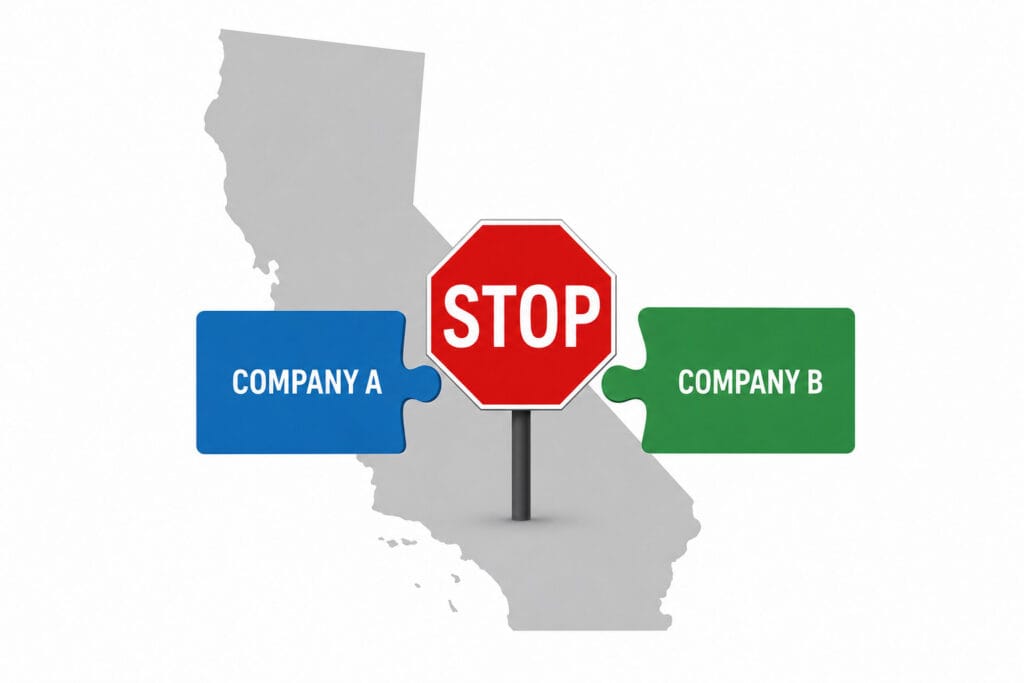
California is considering creating its own anti-merger law. Over a dozen states already have laws dealing with mergers in specific areas, like health care; but California would be the first with a comprehensive law allowing the state to stop mergers in any industry, even if the merger were approved by the federal government. This would likely be unconstitutional and would certainly be impractical.
Under the federal constitution, states cannot interfere with the exclusive right of Congress to supervise interstate commerce. States are prevented from directly targeting out-of-state businesses (e.g., keeping Florida citrus out of California markets), or by passing laws that have the effect of interfering with interstate business more subtly.
A single state anti-merger law could have this second effect. It’s not easy to stop a merger only within one state while allowing that merger to take place in others. Consider the merger of two national companies engaged in manufacturing tractors, where the whole purpose of the merger is to create a lower cost, more integrated production process.
If one tractor company’s chassis assembly is located in California, California could, in practical effect, prevent the consolidation of the entire two companies even if the companies’ other activities (electronics, transmission and motor installation, etc.) all take place in other states. The free flow of commerce nationally would have been impeded by California.
Why would a state want to stop a merger that is beneficial for the rest of the country? One situation may be where the merger would cause consolidation among the merging companies’ employees, causing local lay-offs, even while the lower costs of operation benefit competition and consumers in the national economy. A state court judge who has to run for re-election can’t ignore unemployment in that judge’s hometown – even if the words of the state anti-merger law were identical to those at the federal level.
In California’s case, the proposed words are not identical. They are intentionally drafted to be more critical of a merger with local effects. The experts’ report of the California Law Revision Commission, advising the Legislature on a proposed new anti-merger law, specifically mentions as a virtue the “friendliness of home state courts,” and directs them to consider the “local labor market implications” of mergers.
For a state to create its own anti-merger law is different from a state taking part in a lawsuit in federal court attempting to stop a merger, as California did to block the Kroger-Albertson grocery merger last year. Federal antitrust laws already allow states to be plaintiffs in antitrust lawsuits, including mergers. These cases are decided under federal antitrust principles that are uniform across the country. The federal law provides for a merger to be stopped if its effect “may be substantially to lessen competition, or to tend to create a monopoly,” “in any line of commerce or in any activity affecting commerce in any section of the country.” If the merger is economically beneficial, however, the federal law allows the merger to go ahead.
The existing federal merger law does not create any incentive for a company to avoid doing business in California. The single national standard applies wherever a company has facilities or does business. However, a new law making it more difficult to acquire another company, or to be acquired by another company, in California diminishes the attractiveness of locating in California. Many a Silicon Valley start-up envisions its eventual end-game of being acquired by an established company, in a “liquidity event” that rewards the start-up’s investors. If California law makes such a liquidity event less likely, a start-up will find Austin, Texas more attractive than Menlo Park, California for its headquarters.
California’s legislators should resist the temptation to create California’s own anti-merger law. It’s likely to violate the federal constitution, and it’s certain to provide one more reason for companies to escape California’s vortex of burdensome laws by leaving the state.
Tom Campbell was the Director of the Bureau of Competition, the antitrust arm of the Federal Trade Commission, during the Reagan Administration. He taught antitrust law for many years at Stanford Law School, where he was a tenured professor, and at the Fowler School of Law at Chapman University, where he served as Dean and is now a professor of law and a professor of economics. He was also Dean of UC Berkeley’s business school. He served five terms as a US Congressman from Silicon Valley, including being a member of the antitrust subcommittee of the House Judiciary Committee. Mr. Campbell is an antitrust advisor to NetChoice, a trade association focused on promoting free expression and free enterprise. These views are his own.