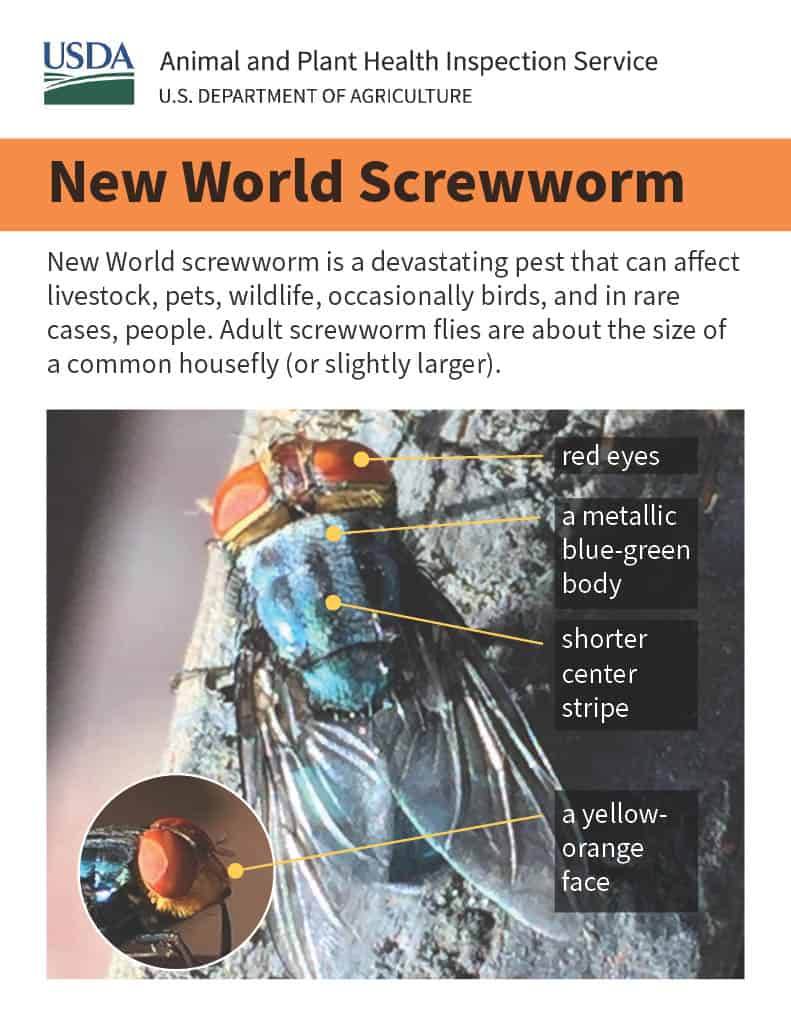
While the Trump administration has notched historic wins on the southern border when it comes to stopping the flood of illegal immigrants that was ushered in by President Joe Biden and his Border Czar, Vice President Kamala Harris, America’s cattle industry is currently grappling with another consequence of an open border: an influx of the New World screwworm fly, which broke containment in Central America and has made its way to America.
Doctor Mindy Brashears, the Under Secretary of Agriculture for Food Safety of United States, is one of the many at the forefront of the Trump administration’s response to the screwworm, along with her boss, Agriculture Secretary Brooke Rollins and Undersecretary Dudley Hoskins.
In an interview with the Washington Reporter, Brashears explained how the screwworm is simultaneously a threat to America’s cattle but also not a public health threat to Americans, as well as how the Department of Agriculture (USDA) took proactive actions to mitigate the screwworms’s damage.
For decades, America had eradicated the screwworm within its borders. That changed as millions of people came illegally from South America to Central America to the American south, she explained. “There’s a lot of speculation, but we do know one thing, and that is that people were moving across the border, and this really came up from South America into Central America up through Mexico very quickly,” she said. “Now, we think about cattle, and that’s where we’re finding it now, but it can be on any warm-blooded species, so dogs, pets, all of those things that come when people come across our border, and we had a really good containment down in Panama.”
The sheer influx of people overwhelmed America’s preparedness, she said. “We had our sterile flies there, but when people start moving, you overwhelm our containment and our containment mitigation strategies. As they move up, it just starts moving up faster. That is for sure one of the things that caused that. There are also other factors that as a scientist, we can’t necessarily measure, but that is absolutely something that caused the movement to come this way.”
The screwworm, Brashears explained, is “unique in that it is an insect, as opposed to avian influenza, or some of our other animal diseases that we face, but the protocols are really very similar; because of that, we have the protocols in place prior to ever detecting those, and that’s why we were ready to implement these strategies very quickly.”
“As a scientist,” Brashears said she is hesitant to lay blame squarely at the feet of the Biden administration. “I can’t say that as an absolute, but it would have slowed the spread this way, and it could have given us the opportunity to have more sterile flies faster as we saw it spreading. Now, they did speculate that the screwworm would have been here last summer. That’s when it was supposed to be here.” But, she said, the Trump administration took major proactive actions. “Immediately, Secretary Rollins took action, and we slowed it down for an entire year. That year is when we were able to develop some of these technologies, start building the facility, so that slowed it down, and the impact should be much less because of the strategies that we’ve put in place after she came into office.”
“As soon as we found the first one, Secretary Rollins went down, and she saw the first calf that we found that was infected, and the calf is running around, and it’s been cured, so to speak, and it should grow up and have a good life, and be able to become a part of our breeding herd, or enter the food supply,” she added.
Unlike foodborne illnesses, she explained, the screwworm needs living flesh in order to survive. “There are other insects that will feed on a carcass,” unlike the screwworm, she explained. “To be crude, if you see roadkill, you’ll see flies buzzing around that, and if you could look, and you see the infestation and maggots in that. They are eating the flesh. The New World screwworm only feeds on living flesh, which is also good when you think about meat and poultry; that’s not living flesh. So it’s not going to live on that, and then if the animal dies, the screwworm is not going to live and thrive on that tissue.”
One of the problems that Brashears and her USDA colleagues face is that the United States hasn’t encountered screwworms in its borders in decades. One distinction she drew is between how the insect can infect cattle flesh, but does not pose a direct threat to human safety.
“We want to contain this and push it back, because we don’t want our livestock industry, whether it be cattle or pigs or other animals, because it can infect pigs and any warm-blooded species, to be decimated by the screwworm,” she explained. “If it’s not treated and contained, it can reduce the number of animals, which would ultimately reduce the availability of the food supply. However, the difference is that when you eat meat, you’re not going to get a screwworm in your digestive tract, or if you pick up meat and it touches a wound, it’s not going to cause you to have a screwworm get infected in that. Same thing if you get a scratch on your arm; that’s really the distinction between screwworm versus salmonella or E. coli.”
In order to combat the screwworm, the Trump administration has unleashed a series of science fiction-worthy policies, along with a traditional rapid response apparatus. The former, Brashears explained, is another in the litany of public-private partnerships that the Trump administration has created between the federal government, universities, and the private sector.
It led to the release of the NovoFly, a sterile screwworm that leverages the biology of the screwworm against itself. “It’s simple biology,” Brashears said. “The female fly only mates once, so it just simply doesn’t have the ability to reproduce, and if it loses the ability to reproduce, then we’re not going to have more flies in the area.”
The radiated NovoFly is the result of “a collaboration with universities…The chemicals used for treatment were developed in the private industry. We absolutely rely on universities, industry, and the government to have an all-out attack on this, so we can have the best and most rapid response.”
That rapid response also requires pushing back against the increasing spread of misinformation, she added.
One false narrative, she said, is that “USDA hasn’t taken action. We have been working on this since I came in. Now, I only started in January, but I know looking back that they have been working on this since day one: closing the border, anticipating what’s going to happen when it gets here, putting boots on the ground in Texas, because they knew that’s where it was moving and probably going to cross the border. People were there and ready immediately; all of that was in place. There was a very strong preparation plan.”
“The other thing that I’ve heard a lot of is that the fact that USDA had budget cuts, and that we didn’t have enough people to manage this,” she said. “That is 100 percent wholly untrue. We have the people ready to act. Yes, there were positions that are no longer here, but that was not related to this area, and as a matter of fact, there has been $1.3 billion invested in this area, so there are no budget cuts whatsoever. You hear a lot of that as well, and it’s just simply not true. There has been a tremendous amount of time, resources, and effort invested in this, and that’s why we’re ready.”
But, she cautioned, she doesn’t “want to gloss over the fact that New World screwworm is a serious animal health concern. It is a threat to our livestock industry, and Animal and Plant Health Inspection Service is leading the charge on that; those are our neighbors across the hallway there at APHIS, but what I’m seeing on Facebook are things like ‘our meat and food supplies are unsafe,’ that ‘it’s going to be in my hamburger meat,’ or ‘there are going to be worms in my steak.’ There’s a fear of that. New World screwworm is an insect. It threatens livestock, but it is not a food safety issue. The good news about it is once it’s found, the wounds can be cleaned, they can be treated, and those animals can actually enter the food supply chain.”
While the Trump administration has taken major efforts to halt the spread of the screwworm, Brashears noted that there is a lot of work to do. “First of all, we want to get it out of the U.S., then out of Mexico, and then again down past Panama to get it into South America,” she said. “Now, that doesn’t mean that we don’t want to get it out of South America, but in order to do that, that’s going to require substantial investment in South America in the sterile flies and in other technologies to get rid of it, and right now that doesn’t exist in South America. They can choose to do that, but that’s going to be something that will have to be invested in in those countries.”
For Brashears, a Texan and daughter of a cattle farmer, the issue is deeply personal, and still unsolved. But, to emphasize how safe America’s beef supply is, she noted that her favorite beef dish is a ribeye.
Below is a transcript of our interview with Doctor Mindy Brashears, lightly edited for clarity.
Washington Reporter:
Dr. Beshears, let’s start with how you found yourself back in the Trump administration.
Doctor Mindy Brashears:
After I left the administration the first time, I never dreamed that I would have the opportunity to come back, and I love the job. I’m a food safety expert. I went back to being a professor at Texas Tech University, and I went back to my research in salmonella, E coli, all of those things. Then I got the phone call; you just never know if they’re going to call or if they’re going to want you back. And I went through the process again. I had already decided that I would want to come back if asked. It’s a very unique opportunity to have a job, step away from it, reflect for four years, and watch someone else do it. I’m trying not to be too critical, but I was able to watch and decide how I would do that job differently, and how I would do it better. A lot of wisdom comes from that kind of perspective and reflection. Most people in these types of jobs don’t have that opportunity to step away and really think about it, and let it process, and then come back and do it again.
Washington Reporter:
I have to ask, do you have any thoughts on the Texas Tech quarterback situation?
Doctor Mindy Brashears:
I have many thoughts, but that’s outside my area of expertise. I’m grateful that we have moved on, and we will be able to have a different quarterback. Clearly, as someone in higher education, I am supportive of individuals, of students, and you want them to get the help they need to get better, and I am supportive of our programs at the university, but whenever you have something that casts a negative light, it makes it very challenging not only for the football program, but for the university as a whole. I love college sports. I love college football. It was amazing to go to the playoffs last year. I still have my season tickets. I am going to hold on to those tickets, no matter what, but I’m happy to move on and see where we go from there.
Washington Reporter:
Now that you are back at USDA, you’re dealing with a public health battle and also a public information battle. When it comes to the New World screwworm fly, what are the biggest misconceptions that you’re seeing take root in Americans’ minds about this fly and its impact on the food supply system?
Doctor Mindy Brashears:
I don’t want to gloss over the fact that New World screwworm is a serious animal health concern. It is a threat to our livestock industry, and Animal and Plant Health Inspection Service is leading the charge on that; those are our neighbors across the hallway there at APHIS, but what I’m seeing on Facebook are things like ‘our meat and food supplies are unsafe,’ that ‘it’s going to be in my hamburger meat,’ or ‘there are going to be worms in my steak.’ There’s a fear of that. New World screwworm is an insect. It threatens livestock, but it is not a food safety issue. The good news about it is once it’s found, the wounds can be cleaned, they can be treated, and those animals can actually enter the food supply chain.
Washington Reporter:
Is there a sense that this misinformation is foreign adversary-fueled to throw chaos in America’s food supply?
Doctor Mindy Brashears:
I hate to speculate; generally, when I see things like this it comes down to people who are misinformed. They don’t understand it, and it can be anything from what USDA is doing in terms of controlling pathogens to the New World screwworm. It’s our role, and especially as an educator, I want to get that information out, but I always try to look for the best in people. Usually it’s someone who’s uninformed, they don’t understand, but there are also those who want to do harm, and that’s an unfortunate thing.
Washington Reporter:
You were talking about your period of reflection during the Biden administration. Secretary Brooke Rollins has been very strident in her criticism of the Biden administration when it comes to the New World screwworm, and how Vice President Kamala Harris as the Border Czar and Joe Biden let in millions of people here illegally; can you talk about how this broke containment during the Biden administration? What policy decisions led to this New World screwworm returning to America for the first time in half a century?
Doctor Mindy Brashears:
There’s a lot of speculation, but we do know one thing, and that is that people were moving across the border, and this really came up from South America into Central America up through Mexico very quickly. Now, we think about cattle, and that’s where we’re finding it now, but it can be on any warm-blooded species, so dogs, pets, all of those things that come when people come across our border, and we had a really good containment down in Panama. We had our sterile flies there, but when people start moving, you overwhelm our containment and our containment mitigation strategies. As they move up, it just starts moving up faster. That is for sure one of the things that caused that. There are also other factors that as a scientist, we can’t necessarily measure, but that is absolutely something that caused the movement to come this way. Another thing is that the sterile fly facility in Mexico stopped operating. That should have been turned back on. We should have been investing in the U.S. and building our own facility, which is what Secretary Rollins did. We’ve opened one in Texas, and people say, ‘why does this take so long?’ Well, it’s radiation. We have to use radiation, and it takes time to get those approvals. It is very fast tracked, but she did that. She invested in research, invested in developing the new NovoFly, which will actually increase our efforts by two fold. A lot of investment went into the efforts in this administration, and obviously the borders are closed to keep the cattle out, but again, we have our dogs and our wild animals that can carry it as well.
Washington Reporter:
You don’t often think about the Department of Agriculture when it comes to the border and border security. Is it the case that if the Biden administration had not had the open border, we would not be having this infestation of New World screwworms?
Doctor Mindy Brashears:
Well, as a scientist, I can’t say that as an absolute, but it would have slowed the spread this way, and it could have given us the opportunity to have more sterile flies faster as we saw it spreading. Now, they did speculate that the screwworm would have been here last summer. That’s when it was supposed to be here. Immediately, Secretary Rollins took action, and we slowed it down for an entire year. That year is when we were able to develop some of these technologies, start building the facility, so that slowed it down, and the impact should be much less because of the strategies that we’ve put in place after she came into office.
Washington Reporter:
You were talking earlier about the food inspectors; how does your department fit into this?
Doctor Mindy Brashears:
We have inspectors in every single facility in the United States; USDA has continuous inspection of meat and poultry products and processed eggs, which means our inspectors are there and they look at every single animal that’s inspected, before they’re harvested and after, so both antimortem and postmortem. Prior to the screwworm ever being detected in the U.S., we trained our inspectors to identify this if they saw it on an animal coming in, so they could identify it, and they would know how to contain it if they found it, what to do with that sample, and where to send it to confirm it. Now, does that mean it’s in the meat? No, it doesn’t. It’s usually it’s going to be on the hide, and they’re going to cut that out. It’s not going to be in the rest of the animal. It’s not a disease that spreads, it’s an insect. We also started developing protocols for detecting any of the chemicals. Now that we’re treating it, they treat it with various chemicals, we want to make sure that we detect those in the meat if it’s there, and we monitor it, because there is a withdrawal time, and we monitor that withdrawal time, so we play a role. APHIS is the lead on this, but if it gets into a plant, we can find it and make sure that our food supply is safe.
Washington Reporter:
You were just talking about how this is an insect, not a disease, and your background is in microbiology. Are there lessons that you learned or that you’ve taken from your time studying that apply here, or is it just apples to oranges?
Doctor Mindy Brashears:
Absolutely. Whenever you study food safety, as I have, and public health, it pertains to all containment, even though it’s a different mechanism of moving the illness, so to speak. It is an illness or a wound in the cattle, but the containment, the management, the mitigation, all of those kind of have the same foundational principles. Absolutely, you have to look for it, you have to have treatment for it, you have to contain it, you have to make sure it’s not spreading, and then ultimately we want to eradicate it and push it not only out the country, but back down to where it’s not a threat to our food supply.
Washington Reporter:
It seems to me that when most people would think about foodborne problems, they are thinking about the microbiology, you’re thinking about an E coli or salmonella. Is there an instance like this New World screwworm that America has dealt with since the 1960s when it was last here, or is this just a fundamentally different public health challenge?
Doctor Mindy Brashears:
It’s unique in that it is an insect, as opposed to avian influenza, or some of our other animal diseases that we face, but the protocols are really very similar; because of that, we have the protocols in place prior to ever detecting those, and that’s why we were ready to implement these strategies very quickly. As soon as we found the first one, Secretary Rollins went down, and she saw the first calf that we found that was infected, and the calf is running around, and it’s been cured, so to speak, and it should grow up and have a good life, and be able to become a part of our breeding herd, or enter the food supply.
Washington Reporter:
Can you clarify the distinction between how this poses a threat to animals, but it does not pose a threat to the American consumer as a food safety problem? How is that possible to not overlap?
Doctor Mindy Brashears:
Well, first of all, it all overlaps a little bit, but because we think about food security being national security. We want to contain this and push it back, because we don’t want our livestock industry, whether it be cattle or pigs or other animals, because it can infect pigs and any warm-blooded species, to be decimated by the screwworm. If it’s not treated and contained, it can reduce the number of animals, which would ultimately reduce the availability of the food supply. However, the difference is that when you eat meat, you’re not going to get a screwworm in your digestive tract, or if you pick up meat and it touches a wound, it’s not going to cause you to have a screwworm get infected in that. Same thing if you get a scratch on your arm; that’s really the distinction between screwworm versus salmonella or E. coli.
Washington Reporter:
The screwworm needs living warm-blooded flesh. How does that present challenges different from other insects?
Doctor Mindy Brashears:
There are other insects that will feed on a carcass. To be crude, if you see roadkill, you’ll see flies buzzing around that, and if you could look, and you see the infestation and maggots in that. They are eating the flesh. The New World screwworm only feeds on living flesh, which is also good when you think about meat and poultry; that’s not living flesh. So it’s not going to live on that, and then if the animal dies, the screwworm is not going to live and thrive on that tissue.
Washington Reporter:
Is this an area where the Trump administration’s public-private partnerships come into play, or is the response needed to this solely coming from the federal government?
Doctor Mindy Brashears:
It’s coming from both. For example, look at the developing of the NovoFly. We had a collaboration with universities to develop that. The chemicals used for treatment were developed in the private industry. We absolutely rely on universities, industry, and the government to have an all-out attack on this, so we can have the best and most rapid response.
Washington Reporter:
How does the American farmer fit into that response?
Doctor Mindy Brashears:
Great question; it’s very, very important that if any farmers or ranchers are listening to this, that it is reported. Don’t be afraid to report it; call your local vet. The vet will get into contact with, most likely, your state animal health department, or even at the county level. They know the route. Then USDA will be notified, but what your local vet will know what to do is how to treat that, and how to clean the wound, and they will have the treatment. You want to protect not only that animal that’s sick so that it can grow up, and cattle are very valuable animals, but to also protect the rest of the herd. Reporting it is key, and it’s a key part of the eradication and the control of this. Then, making sure that we trace it, track it, and know where it’s gone and spread is important, so that we can take our appropriate actions to mitigate it.
Washington Reporter:
You’re talking about the way in which misinformation can spread during this infestation. I imagine that the prospect of flooding the sky with irradiated flies is a thing that sounds like it’s out of science fiction; can you explain biologically for the screwworm why that is, if not the solution, that it is a solution to containing this infestation?
Doctor Mindy Brashears:
It’s simple biology; the female fly only mates once, so it just simply doesn’t have the ability to reproduce, and if it loses the ability to reproduce, then we’re not going to have more flies in the area.
Washington Reporter:
Is there any health concern with the radiated flies flying around that is posed to humans or to any of the other animals?
Doctor Mindy Brashears:
No. The radiation is simply to impart the sterility onto the flies. It doesn’t make the flies radioactive. That’s an important component; just because something is treated with radiation, doesn’t make it radioactive. The radioactive flies are colored green so you can see them, but they’re not going to be radioactive or cause any issues.
Washington Reporter:
As the Trump administration has been doing this rapid response pushback on the screwworm, what other narratives are emerging and have emerged about the screwworm that the Trump administration and the USDA are pushing back on via this increasingly sprawling rapid response apparatus that you’re building out for the screwworm?
Doctor Mindy Brashears:
There have been several. One, as you mentioned, is that USDA hasn’t taken action. We have been working on this since I came in. Now, I only started in January, but I know looking back that they have been working on this since day one: closing the border, anticipating what’s going to happen when it gets here, putting boots on the ground in Texas, because they knew that’s where it was moving and probably going to cross the border. People were there and ready immediately; all of that was in place. There was a very strong preparation plan. The other thing that I’ve heard a lot of is that the fact that USDA had budget cuts, and that we didn’t have enough people to manage this. That is 100 percent wholly untrue. We have the people ready to act. Yes, there were positions that are no longer here, but that was not related to this area, and as a matter of fact, there has been $1.3 billion invested in this area, so there are no budget cuts whatsoever. You hear a lot of that as well, and it’s just simply not true. There has been a tremendous amount of time, resources, and effort invested in this, and that’s why we’re ready.
Washington Reporter:
Was USDA impacted at all by the historically-long government shutdown last year?
Doctor Mindy Brashears:
Every agency was impacted by the shutdown. Our essential personnel were here.
Washington Reporter:
Does that include everyone who was dealing with the screwworm?
Doctor Mindy Brashears:
Yes, those on the ground who were needed for those emergency responses were still there and available, and of course the leadership was here as well, doing what they needed to do to address anything that was emerging. Our field staff remained at work as well. If our inspectors aren’t in the plants, then the plant doesn’t operate. It literally cannot work. There has to be an inspector there to operate it. They are essential, and they’re there every day, just like the airport. If you don’t have TSA there, the airport’s not going to run. Same with the food industry.
Washington Reporter:
Despite what you were laying out, we’re seeing at least some efforts by Democrats in Congress to try and make this a political wedge issue against the Trump administration. Can you talk about your thoughts on that effort?
Doctor Mindy Brashears:
It’s a tragedy when someone tries to weaponize a national crisis and turn it into a political issue, because it distracts from what’s going on, it distracts from the strategy to get rid of it. At the core of who I am, I’m a scientist, and I know that what we are doing is utilizing the best science, the best technology, and we have the best people on the ground to take care of this effort, and when people say that that’s not happening, it’s tragic, and it’s bad for the country, it’s bad for the food supply, it’s bad for the cattle industry, and it simply just results in distraction, which ends up taking longer. We don’t need to spend our time answering questions and combating misinformation. We need to spend our time battling this problem.
Washington Reporter:
On the flip side of that, have you seen Democrats wanting to work with the Trump administration on combating the new world screwworm?
Doctor Mindy Brashears:
Not directly, but my focus is on food safety. Ultimately that would be a question for the Secretary’s office, or for those across the hall.
Washington Reporter:
What does this mean for America’s cattle? It could kill a lot of cattle. How do you make sure that that industry remains robust for both the industry and for the American food eater?
Doctor Mindy Brashears:
I grew up on a cattle farm. My mom still raises cattle, and I’m from Texas. The cattle industry is very important to me. Right now, cattle numbers are at an all-time low. The herd in the U.S. and across the world is at the lowest level, and it takes a long time to rebuild that herd. Unfortunately, the screwworm comes in and it starts reducing the number of animals, whether in the U.S. or in other countries, and it takes longer to rebuild that herd. We really want to mitigate this, and to get rid of it. We want to make sure that the animals that do get infected with it are treated so that we can keep them as a part of our food supply, because it is a threat to food security when we lose any segment of the industry, and we want to keep our beef industry strong, and we want to keep beef on the shelves for our consumers and for our American families.
Washington Reporter:
As you look to six months and a year from now, is the goal with combating the New World screwworm to just get it out of America? Or is it to fully eradicate it globally?
Doctor Mindy Brashears:
That’s always the goal for something that is such a devastating problem for any industry. It becomes a challenge to completely decimate a species. At this time, first of all, we want to get it out of the U.S., then out of Mexico, and then again down past Panama to get it into South America. Now, that doesn’t mean that we don’t want to get it out of South America, but in order to do that, that’s going to require substantial investment in South America in the sterile flies and in other technologies to get rid of it, and right now that doesn’t exist in South America. They can choose to do that, but that’s going to be something that will have to be invested in in those countries.
Washington Reporter:
You were explaining how this doesn’t pose a threat to food safety. What is your go-to beef product?
Doctor Mindy Brashears:
A ribeye steak.