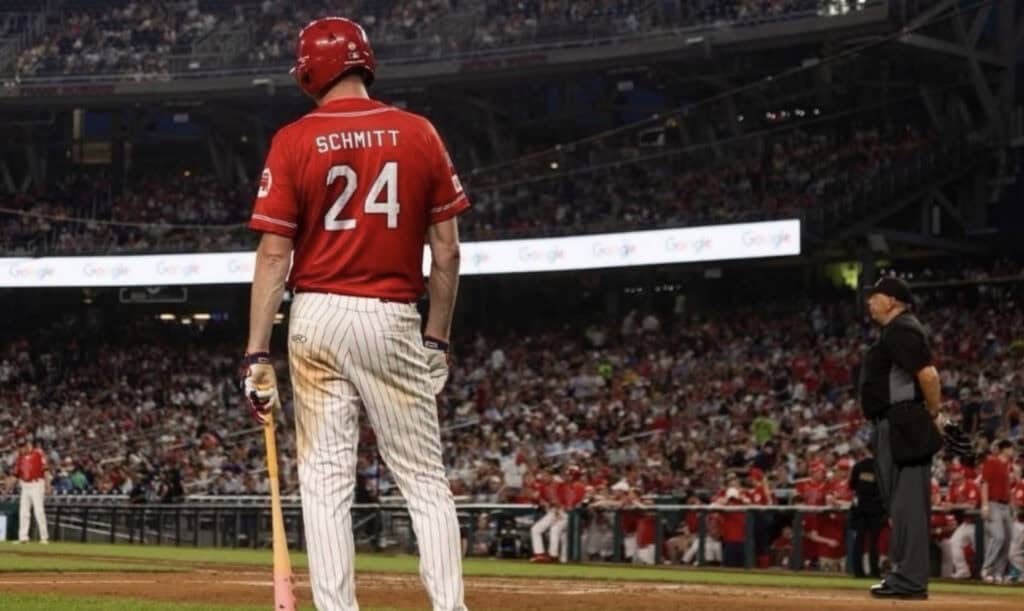
For years, Sen. Eric Schmitt (R., Mo.) has been a mainstay on the GOP’s team for the annual Congressional Baseball Game. This year, he’s combining his expanded workout routine with a push to save everything from collegiate sports to women’s sports to Olympic sports in his day job as a U.S. Senator.
The Washington Reporter interviewed Schmitt at an early morning batting practice ahead of the annual baseball game, during which he covered everything from his legislation to fix college sports to foreign policy to how President Donald Trump and his cabinet are doing, and more.
During his time in Washington, Schmitt’s star has quickly risen, even though he is only in his first term — he’s been talked about for a possible Supreme Court opening or to have served as President Donald Trump’s attorney general — and he’s been using his spot on the Senate Commerce Committee to “sav[e] college sports.”
“Look around the landscape, and it’s on the precipice of some real challenges in college sports,” he explained. “You’ve got the base of college football subsidizing all the other non-revenue sports, women’s sports, Olympic sports. If you’re losing money in college football, you’re not gonna be able to do that.”
His legislative push, he said, is “really about protecting women’s sports, Olympic sports, and having some rules. Right now, the NCAA can’t really have enforcing rules, so it would give antitrust protection, and say ‘hey, you’ve got one time to transfer, you’ve got five years of eligibility, you’ve got the portal that can get fixed,’ and then also provide some additional opportunities for revenue, but with a unified rights deal among the conferences; that is the right direction to go in, and a lot of it’s education, because people see what the challenges are.”
During his interviews with the Reporter, Schmitt often talks about the difference between what D.C. focuses on and what his constituents back in Missouri talk about, and this legislation hits both marks. “It’s of a lot of interest to me, but culturally it’s relevant to a lot of people,” he added. “Sometimes people get caught up in the bubble here in D.C. of what motion is pending, but when you go home people are asking very different questions, and one of the things that I get asked a lot is what’s going on with college sports, and this is an effort to try to find some solutions.”
When it came to the main subject at hand — winning the Congressional Baseball Game — Schmitt explained just how seriously he takes his preparation, even when he is not hitting dingers at dawn.
“It’s a lot of protein,” he said of how he stays in shape. “A lot of it is diet, and then I work out every morning. After this, I’ll go work out, and I get a good routine when I’m here, honestly. And so it’s just weights, honestly. I slimmed down from the first two years, no doubt.”
That dedication to his craft gives Schmitt optimism heading into next year, when Republicans are expecting former professional baseball player Mark Teixeira to join their team after he wins a seat in Congress in November.
“I’m also excited about Mark Teixeira,” Schmitt said, joining the chorus of Republicans who are eager to see Teixeira return to playing baseball. “I’m already lobbying to make sure our skipper [Rep. Roger Williams] keeps me in hitting the two hole to make sure that if Teixeira is batting three, I’m batting two.” One of the reasons that Schmitt is excited about the incoming freshman Republican from Texas is because he doesn’t know if “we have that [level of baseball talent] on the horizon in the Senate.”
But Schmitt and Sen. Joni Ernst (R., Iowa) have both taken their Senate talents to the team for years. “It’s great to be out here because Joni Ernst and I are really the only senators who show up here, so I get to know a lot of these House members that otherwise I wouldn’t,” he said. “We don’t see each other. People think we see each other all the time, we don’t. Building those relationships, and getting to have casual conversations, getting to know people, has been a lot of fun for me.”
Schmitt also sees a lot of talent from some of his former Senate colleagues — namely Vice President JD Vance and Secretary of State Marco Rubio — who are perhaps too busy to play in this year’s game.
“He’s doing great,” Schmitt said of Rubio. “Marco is doing a great job. He’s perfectly suited for that position [of Secretary of State].”
More broadly, Schmitt said that Trump has “got a great team: Vice President JD Vance, Rubio, the president’s team. As hopefully the Iran situation calms down, there are other interests that we have, certainly in our hemisphere,” he said, turning his eyes closer to home.
“I think you saw even the discussion early on about the Panama Canal and Greenland,” he said. “These are all very focused on the homeland and how we protect the United States, and to make sure that we’re prepared. A lot of people are surprised at how quickly China has militarized their economy, and everything’s dual use. We just need to talk about that. We need to prepare for it. We need to have a procurement process that allows us to do things quicker with asymmetric weapons, and that’s not been what we did in the Cold War era.”
But, Schmitt also likes what he’s been seeing from Trump when it comes to Iran. He noted that Trump has “knocked back their nuclear ambitions and their military, and it’s given room for this diplomacy that’s happening right now. So I’m hopeful. That’s President Trump’s North Star. I think he’d like to see that kind of resolution here. I want to give him the space to go do that.”
“Writ large,” he added, “you’re seeing a pivot; we’re making sure our European allies step up for their own defense as we focus on our chief rival, which is China, and that has to be the direction for the next century. The 21st century will be defined by who wins this great powers competition: the United States of America or communist China. I think you can frame everything in that way. It’s an America First foreign policy that we’re focused on on the homeland, the Western Hemisphere, and then our chief rival in the Pacific. That’s the direction we should be headed.”
When it comes to both baseball and to geopolitics, Schmitt has a simple philosophy.
“I like winning, and I’m not tired of winning yet,” he said with a smile.
Below is a transcript of our interview with Sen. Eric Schmitt, lightly edited for clarity.
Washington Reporter:
This first question is actually from my friend Melanie Meyers; she’s a big fan of Barstool. You recently went on the Macrodosing podcast. Why was that an important decision for you do to?
Sen. Eric Schmitt:
I actually think that with longer form, you can talk about things in more detail, and that one was mainly about talking sports, so that’s very natural to me. We’re working on saving college sports legislation, so it was good. It’s around 50 minutes long, so you can really dive into topics. I can do the hits that are 90 seconds or two minutes or whatever, but I actually like doing those more non-traditional shows.
Washington Reporter:
You’re a star athlete on this team, but you are working on this college sports bill as well. Why is that important in Missouri?
Sen. Eric Schmitt:
Look around the landscape, and it’s on the precipice of some real challenges in college sports. You’ve got the base of college football subsidizing all the other non-revenue sports, women’s sports, Olympic sports. If you’re losing money in college football, you’re not gonna be able to do that. So it’s really about protecting women’s sports, Olympic sports, and having some rules. Right now, the NCAA can’t really have enforcing rules, so it would give antitrust protection, and say ‘hey, you’ve got one time to transfer, you’ve got five years of eligibility, you’ve got the portal that can get fixed,’ and then also provide some additional opportunities for revenue, but with a unified rights deal among the conferences; that is the right direction to go in, and a lot of it’s education, because people see what the challenges are, but even today we’re having a hearing in the Commerce Committee on that bill. It’s of a lot of interest to me, but culturally it’s relevant to a lot of people. Sometimes people get caught up in the bubble here in D.C. of what motion is pending, but when you go home people are asking very different questions, and one of the things that I get asked a lot is what’s going on with college sports, and this is an effort to try to find some solutions.
Washington Reporter:
We’re at this time of year where we’re doing an interview, and I’m about to go to a war zone. How do you see the Trump foreign policy playing out around the world right now?
Sen. Eric Schmitt:
As it relates to what’s happening in Iran, he’s knocked back their nuclear ambitions and their military, and it’s given room for this diplomacy that’s happening right now. So I’m hopeful. That’s President Trump’s North Star. I think he’d like to see that kind of resolution here. I want to give him the space to go do that. And then, writ large, you’re seeing a pivot; we’re making sure our European allies step up for their own defense as we focus on our chief rival, which is China, and that has to be the direction for the next century. The 21st century will be defined by who wins this great powers competition: the United States of America or communist China. I think you can frame everything in that way. It’s an America First foreign policy that we’re focused on on the homeland, the Western Hemisphere, and then our chief rival in the Pacific. That’s the direction we should be headed.
Washington Reporter:
How do you think your former colleague, Marco Rubio, is doing?
Sen. Eric Schmitt:
He’s doing great. Marco is doing a great job. He’s perfectly suited for that position. They’ve got a great team, Vice President JD Vance, Rubio, the president’s team. As hopefully the Iran situation calms down, there are other interests that we have, certainly in our hemisphere. I think you saw even the discussion early on about the Panama Canal and Greenland. These are all very focused on the homeland and how we protect the United States, and to make sure that we’re prepared. A lot of people are surprised at how quickly China has militarized their economy, and everything’s dual use. We just need to talk about that. We need to prepare for it. We need to have a procurement process that allows us to do things quicker with asymmetric weapons, and that’s not been what we did in the Cold War era. You’re seeing it.
Washington Reporter:
You’ve been playing in the Congressional Baseball Game for years. You’ve talked in the past about why it’s important for you as a senator to play in this game. How’s that been panning out this year for you?
Sen. Eric Schmitt:
It’s been great. This is my fourth year. This is my fourth game. It’s great to be out here because Joni Ernst and I are really the only senators who show up here, so I get to know a lot of these House members that otherwise I wouldn’t. We don’t see each other. People think we see each other all the time, we don’t. Building those relationships, and getting to have casual conversations, getting to know people, has been a lot of fun for me. And plus, I like winning, and I’m not tired of winning yet.
Washington Reporter:
On the House side, everyone’s excited about Mark Teixeira joining the team. Are there any Senate candidates who you’re particularly excited about this year who might be a really good player with you on this team?
Sen. Eric Schmitt:
I don’t know that we have that on the horizon in the Senate, but I’m also excited about Mark Teixeira. I’m already lobbying to make sure our skipper keeps me in hitting the two hole to make sure that if Teixeira is batting three, I’m batting two.
Washington Reporter:
Every year, you get taller, you get more fit. What’s the workout routine that you’re doing?
Sen. Eric Schmitt:
It’s a lot of protein, a lot of it is diet, and then I work out every morning. After this, I’ll go work out, and I get a good routine when I’m here, honestly. And so it’s just weights, honestly. I slimmed down from the first two years, no doubt. But I had three statewide races in six years.
Washington Reporter:
You had a lot of barbecues.