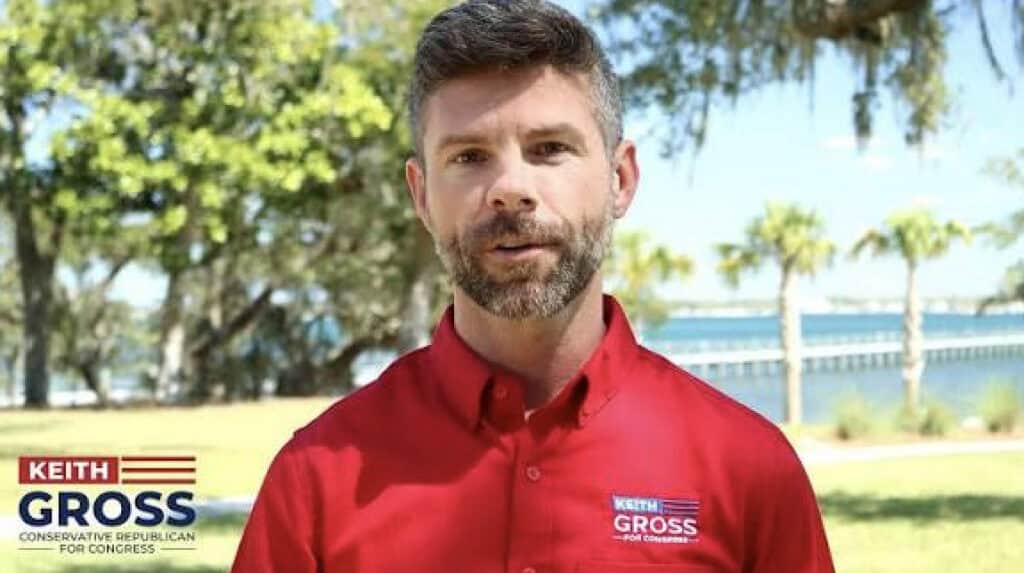
While control of the House remains up for grabs in November, Rep. Neal Dunn’s (R., Fla.) seat is all but certain to remain in GOP hands. However, with Dunn’s retirement, the GOP has a crowded primary — and Keith Gross is putting his money where his mouth is in the race.
Gross has poured $10 million of his own money into the race, and he spoke with the Washington Reporter about the top issues in the race, what he’d like to do in Congress, and the lessons that Florida can offer the rest of the nation.
“Affordability is one of the top concerns,” he said; while Florida’s 2nd District is reliably red, and while Gross leads any possible Democratic opponent in a poll obtained exclusively by the Reporter, the issues are the same there that they are in tossup races across the country. “People are struggling to make ends meet while Washington taxes us a lot and wastes the money. We see a lot of fraud and and waste, and that’s certainly frustrating for people. Everyone is happy that President Trump closed the border and that illegals are no longer pouring across, there’s still a lot of work to do to deport the millions of illegals here to ensure that our infrastructure, hospitals, schools, and other things are not overcrowded with people who shouldn’t even be here.”
While Gross still has to win a GOP primary that includes multiple credible and well-funded candidates, he explained that his immense self-funding is both a campaign trail asset and a way to reach voters throughout the district.
His self-funding shows that “I can’t be bought,” he said, and that “I won’t be able to be bought by special interest groups or lobbyists. I think that’s what we really want here in this district. We want honest representation that represents our values in Washington, not someone who goes there for a paycheck, but someone who goes to represent us, and that’s what I’m pledging to do. I’ve already achieved a successful business career in my personal life, and I now have the time and the freedom to serve.”
Should Gross win in November, he already has his eyes set on what he’d like to do in Congress, while acknowledging that “there’s limited negotiating room” as a freshman lawmaker.
“I hope to sit on Energy and Commerce and on Transportation,” he said. “If I can get a waiver for a third, perhaps Intelligence or Steering. I’m pretty open to a few options, but Energy and Commerce is probably one of the the highest priorities, just because of how much red tape we can cut to help establish American business dominance.”
As a successful businessman in his own right, he’s seen how Florida can lead the nation in establishing that American business dominance.
“The more we get government out of the way, the lower taxation is, the more business growth we’re going to experience,” he said. “We can see that at a national level and at a state level. Certainly, President Trump’s efforts on the One Big Beautiful Bill were huge. It preserved some important tax cuts for the long term to ensure that those who are establishing and growing companies continue to do so. It also impacted our local communities by ensuring no tax on tips, no tax on Social Security, overtime, etc. These are meaningful things that put more money in people’s pockets so that they can keep those dollars flowing in our economy and drive growth.”
Below is a transcript of our interview with Keith Gross, lightly edited for clarity.
Washington Reporter:
You’re running in a very crowded open primary; why do you think the White House thus far has been reluctant to weigh into this primary?
Keith Gross:
It may just be that the president is busy and this election is pretty late. I don’t believe the president has weighed in on most of the current open seats in the state of Florida. The batches of endorsements I have seen appear to be for races that have elections with dates earlier than ours. So it could simply be a matter of timing. But who knows? I would never get myself into the business of trying to predict what the president is going to do.
Washington Reporter:
What is the case that you’re making for Keith Gross in the primary to voters?
Keith Gross:
I was born and raised in this district. I’m a businessman, a veteran, and an outsider. I’ve demonstrated that I can get things done in my own life, having gone from a life of very humble beginnings to an incredibly successful business career. I’ve lived the American Dream, and I want to preserve that dream for future generations.
Washington Reporter:
And why has it been a priority for you to self fund as substantially as you have? You’ve far outpaced the field in terms of fundraising, but this is coming at a not insignificant cost to yourself.
Keith Gross:
I can’t be bought, and I won’t be able to be bought by special interest groups or lobbyists. I think that’s what we really want here in this district. We want honest representation that represents our values in Washington, not someone who goes there for a paycheck, but someone who goes to represent us, and that’s what I’m pledging to do. I’ve already achieved a successful business career in my personal life, and I now have the time and the freedom to serve.
Washington Reporter:
What are the top issues that you’re hearing from voters as you traverse the district?
Keith Gross:
Affordability is one of the top concerns. People are struggling to make ends meet while Washington taxes us a lot and wastes the money. We see a lot of fraud and and waste, and that’s certainly frustrating for people. Everyone is happy that President Trump closed the border and that illegals are no longer pouring across, there’s still a lot of work to do to deport the millions of illegals here to ensure that our infrastructure, hospitals, schools, and other things are not overcrowded with people who shouldn’t even be here.
Washington Reporter:
Looking to that general election, you are favored to beat whoever the Democrats nominate in a head-to-head matchup. Give us a sense for people who aren’t tracking this as closely: is this a district where you’re seeing DSA-infused Democrats versus more establishment Democrats?
Keith Gross:
Their field appears to be a variety of Democrats; one of the candidates is a former USAID staffer. One of the candidates is an immigration lawyer from Tallahassee, and one of the candidates is a businessman who tries to appear moderate. I wouldn’t say the DSA-type candidates are going to prevail in a Democrat primary just because of how red this district is. The Democrats here work really hard to pretend to be moderate.
Washington Reporter:
What about your time in the military? Are you leaning on that experience in this campaign for Congress? And how would that inform your role and your work as a legislator?
Keith Gross:
I never did anything all that interesting in the military. I was in only briefly, and by the time it was my unit’s turn to prepare for deployment, we were pulling out of Afghanistan. I certainly defer to many of the veterans who sacrificed far more than I did in military service. But the underlying component is the drive to care for my fellow man, to take care of my country, and to do what’s right.
Washington Reporter:
To put the cart before the horse here, what committees would you want to serve on in Congress? You’ve run for office before, so I’m sure you’ve given thought to what you would want to work on when you’re here.
Keith Gross:
I’m intending to be flexible. Obviously as a freshman, there’s limited negotiating room, but I hope to sit on Energy and Commerce and on Transportation. If I can get a waiver for a third, perhaps Intelligence or Steering. I’m pretty open to a few options, but Energy and Commerce is probably one of the the highest priorities, just because of how much red tape we can cut to help establish American business dominance.
Washington Reporter:
What in your background in the private sector would you want to lean on either on E and C or more broadly as a legislator? What lessons have you learned as a lawyer and as a business owner in Florida that you want to share with the rest of the country?
Keith Gross:
Building national companies highlights the impact that excessive government regulation has on the ability for businesses to grow and create good-paying jobs for American citizens. Cutting that red tape can energize American business and allow American companies to compete better on a world stage.
Washington Reporter:
Can you give us a sense of how the Trump economic agenda and DeSantis’s work as governor has played out in Florida?
Keith Gross:
The quickest takeaway here is that freedom drives growth. The more we get government out of the way, the lower taxation is, the more business growth we’re going to experience. We can see that at a national level and at a state level. Certainly, President Trump’s efforts on the One Big Beautiful Bill were huge. It preserved some important tax cuts for the long term to ensure that those who are establishing and growing companies continue to do so. It also impacted our local communities by ensuring no tax on tips, no tax on Social Security, overtime, etc. These are meaningful things that put more money in people’s pockets so that they can keep those dollars flowing in our economy and drive growth.
Washington Reporter:
We recently saw Rick Scott, who you ran against not that long ago, excoriate Dr. Anthony Fauci during a hearing. Did you catch any of this hearing on the Hill?
Keith Gross
I saw bits of it.
Washington Reporter:
Fauci pled the Fifth on everything that he was asked, but Florida has a lot of lessons that the rest of the country can learn from in its success in how it handled the COVID pandemic. What lessons did you see when you were running your business in Florida during that era that others can learn from?
Keith Gross:
The lack of government accountability is a problem at every level, and COVID was a perfect example of how government will grab power under the guise of an emergency and do things that are purely unconstitutional and immoral. Government is willing to take your freedom, take your money, and lie to you along the way. We need a smaller government. That’s the lesson.
Washington Reporter:
Like Trump, you were a Democrat in the past as well. What has happened, both in Florida and nationally, with the Democrats? We are seeing DSA candidates oust longtime Democratic incumbents and win open seat primaries? When did that shift happen in the Democratic Party?
Keith Gross:
I’m not sure when the shift really happened. I was a Democrat roughly 20 years ago and that was a different time. Democrats were not outright communists back then, and of course, that’s probably why President Trump was also a Democrat 20 years ago. Since then, two things have happened with me. One, I grew up and realized where I fit in in the political spectrum. It’s not so much that I was ever a flaming liberal; it’s that I didn’t realize where I fit in until I grew up. And since then, of course, the Democratic Party has become the party of communism. Zohran Mamdani is a good example of someone who actually campaigns quoting Karl Marx. The rise of greed and jealousy has replaced the belief in the American Dream in many ways. Instead of working hard and innovating, there’s this culture of jealousy and class war that’s been developed on the left, and I don’t know why, but I know that we’ve got to turn that around. And if we don’t, America is going down a rough path.
Washington Reporter:
Keith, thanks so much for your time.