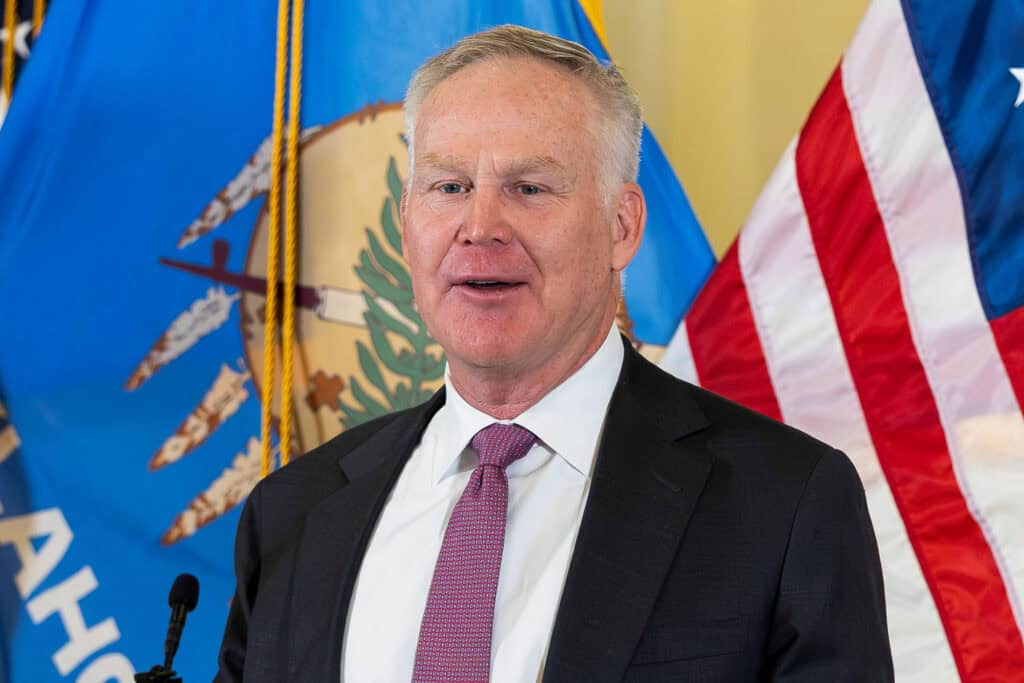
Sen. Alan Armstrong (R., Okla.) and 17 of his Senate cosponsors for his American Energy and Mineral Infrastructure (AEMI) Act are building even more momentum behind his landmark legislation — and Kristin Whitman, the SVP of Government Relations at the American Petroleum Institute (API) has an idea why.
“Senator Armstrong recognizes how America’s broken permitting system can delay the infrastructure we need, and his leadership has brought renewed urgency to this debate,” Whitman told the Washington Reporter. “Too many critical energy projects remain tied up for years in red tape, making it harder to deliver affordable, reliable energy to American families. We urge lawmakers to come together this year to pass durable, bipartisan permitting reform.”
For weeks, Armstrong has been steadily making the case for the AEMI Act to his colleagues of both parties and in both chambers on the Hill. Armstrong, one of the Senate’s newest members, previously told the Reporter in a lengthy interview that he is “optimistic” that permitting can be done this Congress, despite deep partisan divisions, an ever-expiring clock, and his lack of seniority.
“I’m not going to quit being optimistic about it,” Armstrong said of his efforts. “We’re bringing a lot of attention to it. I get encouraged every day. The event I just did really brought some energy to the issue; my legislative team back there has done an equally great job of developing a really strong bill that we’ve been connecting with the House on, so that we don’t surprise anybody over there, and so that we maintain support when we do get through the Senate. I’m optimistic because of the great work that people are doing.”
Among his bill’s planks is a clarification to the National Environmental Policy Act (NEPA); should his legislation, pass, it will codify a targeted scope of review, preventing overly expansive environmental analyses, reaffirming the statute’s procedural nature, and establishing meaningful judicial review standards to ensure NEPA cannot be misused to stall critical infrastructure projects, the bill notes.
In the weeks since Armstrong rolled out his AEMI Act, 17 of his colleagues have signed onto it, as have countless advocacy groups, like API. The increased momentum comes because of, not despite, the narrowing time frame to pass the legislation.
In recent days, Sens. Tom Cotton (R., Ark.), Lisa Murkowski (R., Alaska), David McCormick (R., Pa.), Bernie Moreno (R., Ohio), John Cornyn (R., Texas), Tim Sheehy (R., Mont.), Marsha Blackburn (R., Tenn.), Steve Daines (R., Mont.), Roger Marshall (R. Kansas), John Kennedy (R., La.), Ted Budd (R., N.C.), Roger Wicker (R., Miss.), and Jon Husted (R., Ohio) have joined Sens. Cynthia Lummis (R., Wyo.), Rick Scott (R., Fla.), and James Lankford (R., Okla.) in signing on to the bill.
“The growing support comes as the Senate left Washington for the August recess without producing a bipartisan permitting reform package,” Armstrong’s office explained. “Negotiators say they are making progress and hope to unveil an agreement in September, but significant issues remain unresolved — including Clean Water Act and National Historic Preservation Act reviews — and the shrinking legislative calendar leaves little time to turn a deal into law. Against that backdrop, [he] is working to reinvigorate conversations on permitting reform in the Senate by advancing concrete provisions that find bicameral and bipartisan support.”
“The AEMI Act cuts through bureaucratic red tape, provides long-overdue certainty for builders, and prevents project delays that threaten economic growth and national security,” his office added.
Amidst the latest momentum for his bill, Armstrong noted that “our national energy infrastructure is like a bridge: nobody really cares about it until it falls down, and the cracks are starting to show right now. We have a narrow window to act, and we cannot afford to let this opportunity pass us by. I am grateful to my 17 Senate colleagues who are co-sponsoring the AEMI Act. Together, we recognize that America cannot afford another year of delay.”
Scott, one of the legislation’s original champions, added that “previous generations of Americans built the greatest economic powerhouse the world has ever seen.”
“Nowadays, however, government seems to be doing everything it can to kill the American spirit with needless bureaucracy,” Scott noted, putting his sponsorship of the bill in a national security context. “While Communist China cuts corners to get ahead, a mountain of red tape has America fighting the energy war with one hand tied behind our backs. This bill slashes red tape and meets 21st century demands to help President Trump restore American energy dominance.”
Cotton, one of the newer cosponsors, added that “bureaucratic red tape and radical environmentalists’ delay vital energy projects needed to advance American manufacturing. Our bill would streamline the federal permitting process to ensure we can accelerate critical energy infrastructure projects.”
API is joined in its support for the Armstrong-led legislation by a coalition of oil and gas associations from across the country. Among API’s fellow endorsers are ONE Gas, Inc., TC Energy, Williams, EQT, Woodside Energy USA, NextEra Energy, Expand Energy, Labor organizations, United Association of Union Plumbers and Pipefitters (UA), South Central Pennsylvania Building Trades, Brotherhood of Boilermakers Local 154, Pipe Line Contractors Association (PLCA), American Public Power Association, National Rural Electric Cooperative Association (NRECA), Interstate Natural Gas Association of America (INGAA), American Gas Association (AGA), American Exploration & Production Council (AXPC), Natural Gas Supply Association (NGSA), Center for LNG (CLNG), GPA Midstream, GPSA, Liquid Energy Pipeline Association (LEPA), The Petroleum Alliance of Oklahoma, Virginia Oil & Gas Association, National Mining Association (NMA), National Hydropower Association (NHA), Energy Infrastructure Council (EIC), Essential Minerals Association, Colorado Oil and Gas Association, Petroleum Association of Wyoming (PAW), Texas Pipeline Association, Electric Power Supply Association (EPSA), Partnership to Address Global Emissions (PAGE), American Council for Capital Formation (ACCF), Americans for Prosperity (AFP), ClearPath Action, ACC Action, America First Policy Institute, Cato Institute, and the Pacific Legal Foundation.