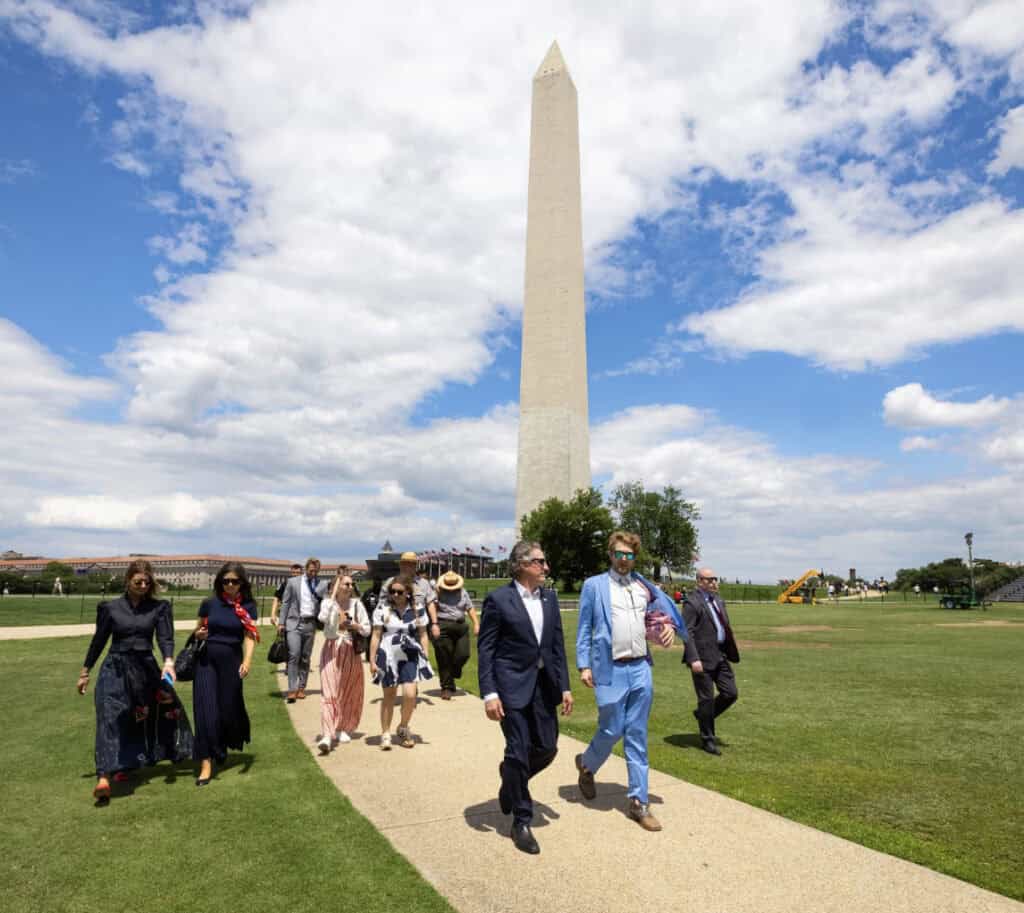
President Donald Trump is one of the most famous builders in modern American history, but Interior Secretary Doug Burgum is quickly putting his own mark on Washington, D.C. alongside the President of the United States.
Pursuant to Trump’s executive order to make “the District of Columbia safe and beautiful,” Burgum’s department has made viral progress on restoring some of the most dilapidated sites in the nation’s capital — and most will spic and span by the Fourth of July. The Washington Reporter joined Burgum for a four-hour ride along as he touted his successful cleanup across four sites: the roof of the Lincoln Memorial, the top of the Washington Monument, Union Station, and Meridian Hill Park.
Despite the beautification successes that Trump and Burgum have already scored, he noted that there are “$4 billion unspent that we inherited from the Biden administration that never got allocated” that he’d like to see go to protecting National Parks all across America.
“One of the most significant pieces of legislation [from Trump’s first term] was the Great America Outdoors Act,” Burgum explained. “There was a portion of that which received a permanent authorization called the Land and Water Conservation Fund. So that’s ongoing. The Legacy Restoration Fund was meant to go towards deferred maintenance at our parks, U.S. Forest Service, Bureau of Indian Affairs, and U.S. Fish and Wildlife, but with the majority going to the National Parks.” That, however, has “expired, and it was riddled with a bunch of ways that prevented the money actually getting out the door. There’s almost $4 billion unspent that we inherited from the Biden administration that never got allocated. We would like to get reauthorization and then get that those dollars out the door. We have huge deferred maintenance issues in the park.”
Burgum, a longtime private sector executive, explained that he is on the case. “We’re working with Senator Mike Lee and Senator Steve Daines on the Republican side, and Senator Martin Heinrich and Senator Angus King on the Democrat side, and then through the Committee on the House side with Bruce Westerman and Jared Huffman on the House side, with the idea that we would think at the time of the celebration that we could get Congress to agree on one thing, which is that if the National Parks are considered our best idea, maybe we should actually allocate the dollars to take care of them.”
Work like this, Burgum repeatedly stressed, should not be partisan. In fact, he views it as a “blueprint” that blue states and blue cities can take from him and from Trump, and he hopes they do take it. But, he said, Trump’s legacy is clear on this issue in how it stands alone.
“If we can get the reauthorization of the Legacy Restoration Fund through Congress, combined with what President Trump did the first time, then President Trump will have earned the title of doing more for conservation than any of the modern presidents since [Roosevelt],” Burgum added.
But Burgum has been able to stretch the dollars he currently has at his disposal, and he was eager to show off the results. From atop the Lincoln Memorial, Burgum addressed two topics on everyone’s minds: the upcoming Fourth of July fireworks display and what is going on with the Reflecting Pool.
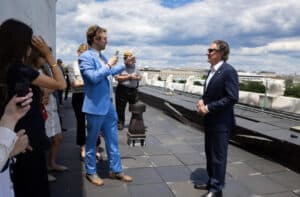
Under Burgum’s supervision, the fireworks display for the Fourth of July will set record after record.
“There are so many locations where the fireworks are going to be going off, including barges,” this time, Burgum said. Kevin Griess, the Superintendent of National Mall and Memorial Parks, joined Burgum for the tour, and he added more information about the staggering number of fireworks.
“Usually the front part of the on both sides of the Reflecting Pool [are] just lined up…They’ll come all the way down this year, all the way down to here, and then we’ll have 13 barges out in the river, and then we’ll have some sites going down along West Potomac…851,000 fireworks,” compared to a paltry “7,000” from 2025.
Burgum also noted that D.C.’s eight-acre Reflecting Pool is the largest of its kind “in North America, possibly in the world… Think of this as the Empire State Building with the Washington Monument on top of it, that’s about how long this is.”
But, it needed a lot of repairs in order to get back to being a pool that actually reflected. “The bottom, which was concrete, was leaking 45,000 gallons per day has for a long time, and so the brilliant idea of the president was to actually have a essentially an industrial swimming pool liner go into the pool.” But, he noted, “before you even get to do the liner, you’ve got to fix the expansion joints.” Burgum proceeded to deliver a “whole physics lesson here.”
“When you have a 2,000 foot long pool, if there was a 1 percent change every day between when it’s 100 degrees out in the summertime versus when it’s zero in the wintertime, a 1 percent change would be 20 feet of shrinking…what that means is that bottom would shrink up to six inches, and even during construction, on days when they were working on the liner with a digital heat gun, that surface, when it was dark, was 115 degrees, and then at night it would cool down, so when we put in the liner, we had to have the ability for it to handle the expansion to shrinkage of up to six inches that had never been accommodated before. The expansion joints were just stuffed with this old gooey stuff back during the the last two years of the Obama administration, and when it was closed for those two years, that expansion joint material all had to be pulled out, hauled away by multiple giant dumpsters.”
Now, he said, there are “four different applications that had to go into those expansion joints with a new material that we know can handle that amount of expansion and shrinkage, and then on top of that both the epoxy layer…After we prepared all of this, the two and a half miles of expansion joints and seams, then on top of that was the American flag blue vinyl coating that came on top of that.”
Burgum, who previously helped revitalized North Dakota’s Fargo, learned from that experience that when mass revitalization projects are undertaken, there are always more problems than expected.
“I had an opportunity in downtown Fargo to work on historic renovations, and we saved over 40 buildings,” he told the Reporter. “Some of those were repurposed, and then philanthropically moved towards things like a low-income homeless clinic, an art museum, saving lots and lots of buildings for that. When you go in and save an old building, you go in with an assumption, and then you get inside it, and you decide there’s a lot more here that needs to be fixed. A lot of those buildings were from the same era, because most of the buildings in downtown Fargo were built between the late 1890s and the 1930s, and the ones that we’re working on saving were too, so it’s similar to the construction that was done here.”
“When you’re doing a restoration of something that’s 100 years old, you find out when you get into it, there’s more stuff that you have to do, and one of the things was the system responsible for cleaning the water and taking care of the algae in the old days was a chlorination system, but the chlorine had eaten out all of the pipes…so temporary nano bubblers were brought in…Those were known to be temporary, but we wanted to be open ahead of the Fourth of July…We knew there’s going to be an algae bloom because of all the water that was in the pipes, even though we tried to flush and rinse, flush and rinse. When we were going to restart it, we’re going to get some of that intake in here, but the algae is absolutely working,” he said.
As Burgum spoke, there was a man by the poolside who was “working on vacuuming up the algae because when it’s dead, it drops down to the bottom.”
But that fix is just temporary, he said, adding that “the permanent nano bubbler equipment has arrived. It’s going to be installed over this week, should be running by next weekend…There are going to be 28 locations where you won’t see any bubbles at all, because it’ll be a dispersed amount, and we expect that we’re going to be back where we were a week ago when we first filled it up with this beautiful clear water that you’ll see here.”
For years, many have remarked that Burgum closely resembles George Washington — perhaps because of that fact, he noted that “they kept all the axes away from me” when the Japanese were sending additional cherry trees to the Tidal Basin.
Jokes aside, Burgum has a deep personal connection to the National Parks, which is one of the reasons that he rallied the private sector community of North Dakota while he was governor to raise hundreds of millions of dollars to create the almost-open Theodore Roosevelt Presidential Library.
“Theodore Roosevelt certainly understood that one of the things that we underestimate is the power of these private public partnerships,” Burgum explained. “Upcoming is the opening of the Theater Roosevelt Presidential Library. That’s a $450 million project, the largest of its kind in any one of the flagship national parks that we have. Zero federal dollars have gone into the library. It’s all been raised through the private sector and through a challenge grant with the State of North Dakota; those dollars stayed with the state, but it was a challenge grant for the library to fundraise. It’s going to be spectacular, and of course I think when we take a look at some of these other better known, more highly trafficked parks, the opportunity for similar scale opportunities exists because so many people in this country want to give back, and they want to give back to something that they know is going to last and be permanent. In keeping with Theodore Roosevelt, his presidential library is going to be the first one that you can hike to as part of 150 trail systems. You can ride a mountain bike to it, or as I intend to do, I’ll be riding horse to the hitching post in front of the library.”
Over Memorial Day weekend, Burgum visited Gettysburg, where the park staff set up a commemoration for his great-grandfather, who fought at that battle for the Union in the Civil War.
In the decades after that war, Burgum noted to the Reporter that “America just did have a great idea [to open National Parks], and a lot of it goes back to Theodore Roosevelt. There was a couple of National Parks that have been created before he got into office, but we were really the first country that had this concept, and now you’ll see national parks in most countries around the world.”
“But in some ways,” he said it was “an American invention, and we’ve secured the spaces, and now we have to do a great job of making sure that we’ve got the appropriate business model, if you will, revenue and expenses, to maintain these beautiful places.”
From the Lincoln Memorial, Burgum headed to the Washington Monument, which Griess noted has been a model of a “public-private partnership” for much of its history. Most recently, following the 2009 earthquake, a massive donation from David Rubenstein helped fix it.
As Burgum headed to the Interior shuttle from the Washington Monument, he was stopped by a pair of tourists who clocked that he was on foot, and they told him they had just been in North Dakota.
The next stop was Union Station, in order to see the Columbus Fountain. While en route, Burgum explained that it is made of the same Carrara marble that Michelangelo’s David was made of, and that — since he and Trump cleaned the years of graffiti off of it — longtime D.C. residents have asked him “is that new?”
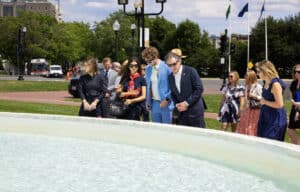
“It was covered with a graffiti, including a bunch of pro-Hamas stuff. It was one of the most defaced ones we have. And then we got the thing cleaned up, the fountains restored and opened, and I’ve had many people who’ve lived in D.C. a long time ask me ‘is that new?’”
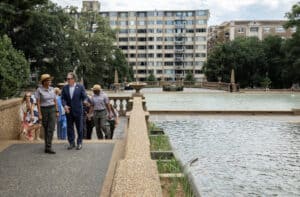
The tour concluded with a visit to Meridian Hill Park, where the transformation, Burgum noted, “has probably been the most dramatic. It was among the most explosive on social media, because people who lived in the neighborhood hadn’t dared even walk through there. It was a place to avoid, as opposed to being a place to visit. There’s a famous Joan of Arc statue there, which has been completely restored, that’s at the top of the cascading fountains.”
Both Trump and Burgum have been using their experience as builders from their time in the private sector to reform how contracts are given out in the National Parks space.
“Both during my time in the private sector and during my time as a governor, I saw how important it is to have sources of revenue that support things like the outdoor recreation industry, which is now a $1.3 trillion industry that employs about 3 percent of the nation’s public,” he told the Reporter. “All of those companies have got business models that rely on access to public lands, so one of the things we’ve been doing is making sure that we get public lands open. Now, public lands are open unless there’s specific reason to close them, as opposed to ‘it’s public land, so it’s closed,’ and you have to fight the government to actually get access, turn the dial in another direction, and that includes making sure that things are open for fishing and hunting, because the biggest contributors to conservation are hunters in the country.”
One reform Burgum wants, however, has yet to take place. “One of the common sense modifications that we’re seeking would include the ability to work with great partners like the National Park Foundation, U.S. Fish and Wildlife Foundation, the Bureau of Land Management’s launching a foundation, and then also our state partners,” he explained. “In places like my own experience in North Dakota, where a road washed out in the Theodore Roosevelt National Park, it turned into a six and a half year closure that cost $53 million, and then I was getting mansplained about why it took so long,” he said. “That was apparently because of the harsh climate in North Dakota, and the difficult challenge for road building, when the very own North Dakota Department of Transportation, which had reported to me for eight years, was building 1,000 miles of road a year in the same conditions, and I’m like, ‘I think we could have done two more miles.’”
Another innovation in contracting that he has implemented is giving bonuses for completion ahead of schedule. In the Great Smoky Mountains, the Department of Interior awarded a bonus to the contractors working on repairing a massive washout for every day they completed it ahead of schedule, in order to accommodate the seasonal travel that would have suffered had the repairs taken too long into the fall.
“They were done almost a week early,” he remarked. “It’s a better, faster, smarter, get it done attitude.”
Burgum is now looking to take that attitude to completing the updates to the George Washington Memorial Parkway. He noted that he was recently at “a ribbon cutting of the completion of $161 million section had been going on for years, but we got it done…it was a Monday morning when we were doing the ribbon cutting, and I said this could be the first time there’s been a gathering of people who want to intentionally spend this much time standing still on the GW Parkway.”
“We got that section completed and opened; but highways are expensive…one of the ideas we’re kicking around is why wouldn’t we, within Interior, essentially like a state, have a DOT? That would provide some efficiency, because in North Dakota, we then understood here’s how many miles we have…You can get very analytical in the road world if you want to, in terms of how you manage and extend those lifespans.”
While Trump and Burgum have gotten most of the credit for D.C.’s revitalization, Burgum told the Reporter that he is open for feedback from everyone. After Stephen and Katie Miller went touring around Teddy Roosevelt Island with their family, they told Burgum that the site needed repairs, so he added it to his list.
Another partner of Burgum’s has been Robert F. Kennedy Jr., the Secretary of Health and Human Services (HHS).
“Bobby Kennedy and I did a round table in Colorado last week with people from the outdoor recreation industry from Colorado, specifically talking about the benefits of prescribing outdoors” for Americans. “Bobby’s the most outdoors-experienced Secretary of Health and Human Services that we’ve ever had. At one point he popped an answer, which included, ‘well, my brothers and I ran a rafting guiding company for 15 years, and I’ve done first descents in many rivers from the Arctic to Patagonia.’”