BALTIMORE —
Growing up, Kelly Loeffler waited tables for six years. Now, she is the administrator of the Small Business Administration (SBA), and in that role she has traversed the country visiting American small businesses touting the wins that President Donald Trump and congressional Republicans have delivered for the American workforce.
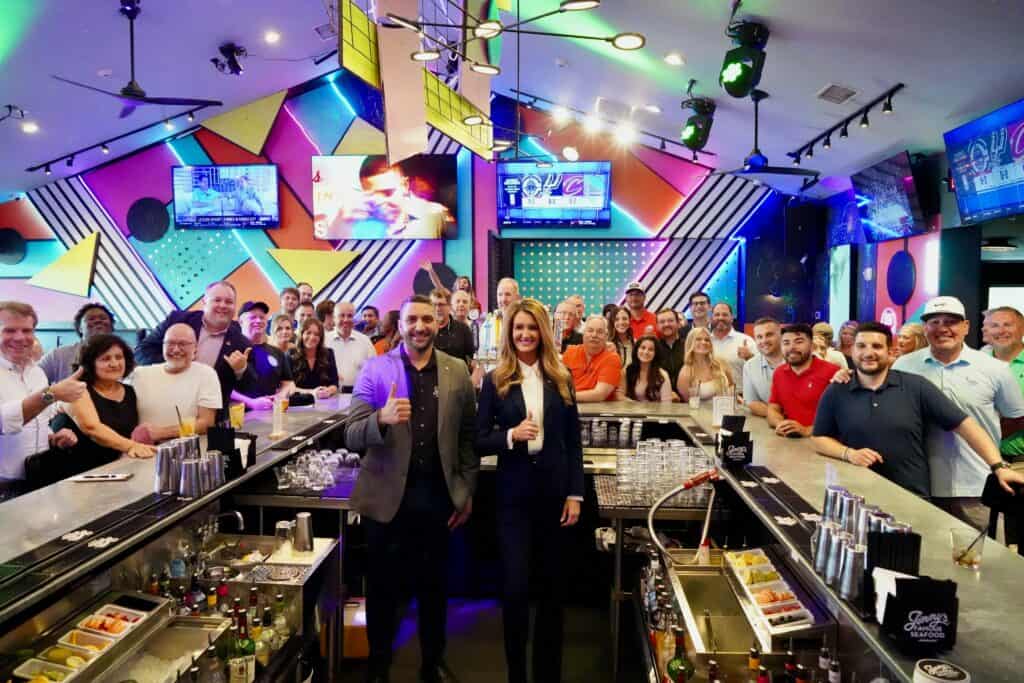
Loeffler spent her Tax Day at the White House and at Jimmy’s Famous Seafood in Baltimore, which regularly goes viral for both its spicy social media and seasoned seafood. A crowd of vocal Trump supporters greeted her upon her arrival, and she spoke with customers, workers, and management alike about how bills like the Working Families Tax Cuts (WFTC) are keeping local institutions like Jimmy’s afloat.
Jimmy’s, she said, “is a great example of what small businesses mean to our communities, and how important President Trump’s Working Families Tax Cuts are to generational businesses that not only create jobs, but are the cornerstone of their community, constantly giving back, creating that economic opportunity, but also philanthropy and really creating the feel of a community and what they mean to it.”
In an interview with the Washington Reporter, Loeffler said that her visit to Jimmy’s was “incredibly informative,” and it reminds her of why she “got involved in the public policy space.”
“I saw, as an entrepreneur, Washington trying to crush our ideas 15-20, years ago, to overregulate without understanding them,” she added. “So I got involved in the policy space. I look at everything through the eyes of an entrepreneur, or even better, through the eyes of my dad, a farmer who built a trucking company when he got out of the military on a high school education. I watched my parents fill out paperwork at all hours of the night, trying to deal with regulators. I’ve seen them deal with the difficulties of hiring and firing and paying benefits before they put food on our table. So it comes from a deeply ingrained sense of responsibility that small business owners bear on their shoulders and making sure that we don’t put more pressures on them than they already have.”
During her visit, Loeffler stood shoulder-to-shoulder with Tony Minadakis, the co-owner of the restaurant. Minadakis gave Loeffler and others a firsthand look at how the Trump tax cuts benefit workers like those that he employs.
“In our industry, Tax Day isn’t necessarily a happy one, but this year, there’s a little bit of a celebration going on, because they get to see exactly what they saved and what they got to keep,” Minadakis said, after he gave Loeffler a behind-the-scenes tour of his famous restaurant. “This is a cycle that they get to keep it in their pocket, and it’s going to get poured right into the economy. And for the hospitality industry, the tips are the backbone of that industry. That’s how we can continue to employ them and obviously bring great talent into the industry.”
But that work is not always easy, Loeffler noted to the Reporter. Every Democrat in Congress, including all 9 in Maryland’s House and Senate delegations, voted against the WFTC and the policies that Loeffler came to Jimmy’s to tout.
“There’s a competition between states for building businesses, for attracting talent and labor, and Maryland is so fortunate to have a business like this that is reinvesting in their community, that is an economic engine that is hiring and growing,” she told the Reporter. But she added that “there’s competition for that between red states and blue states. And right now, the red states are seeing tax relief and deregulation and abundant energy, and the blue states are going in the completely different direction, taxing the residents more, regulating them more, making energy harder to get, making their health care more costly. And so I think it comes down to making sure that you’re doing things to reward your citizens’ hard work, not punishing it.”
As a second-generation owner of the business, Minadakis has seen its ups and downs over the years. His message to policymakers, including the Maryland Democrats who voted against the WFTC, is that “at the end of the day, you can’t always look at things on paper. A lot of the people that are making the decisions have not been through the trenches like the hospitality industry has.”
“The last thing you want to do, like Kelly mentioned, is pay another tax rate,” he said. “It’s a trickle effect. What are they going to do with the money? They’re going to spend it right back out in other restaurants and at other bars. It’s been happening for years. It’s not going to go away magically, that’s the cycle that we want. That’s the cycle that America, the consumer, has been known to do. So you just need to get that money back in there. And that’s how you get the instant impact. We’ve been here 52 years. We understand that in order for it to be a long standing thing, you got to eat s—t for a little bit of time in order to really sustain a long term plan. But something like the tax cuts is something that you see immediately, immediately.”
One of the aspects of the WFTC that Loeffler touted was the certainty in the tax code that it creates, which Minadakis said is helpful to businesses like his. “We’re not always chasing growth, per se,” he explained. “We’re just looking to be sustainable and run a profitable business. But our biggest challenge is always, is the team that you have right you’re going as good as your team. So if you can’t attract the right team to come in and work for you, it’s going to be very hard to do anything, let alone anything, let alone grow. So the tax cuts when it comes to the hospitality industry just makes it that much more attractive. Everybody knows the hospitality is built on the tips. It’s not a secret. Everybody knows it. So it’s really a breath of fresh air for us as the owners, obviously, and even for the staff.”
“The average small business, 12 million so far, have seen a $7,000 tax cut, working families have had an average refund of $3,400 that’s an 11 percent increase from last year. That’s 15 percent more families now, 80 million families, getting a tax refund this year. Now let’s talk about the workers. This is what it’s all about no tax on tips, no tax on overtime. Over 30 million workers already, before the end of Tax Day, have benefited from that, hard working waitresses, barbers, welders, construction workers, people that are going to now get paid, not punished, for working hard. And then finally, I’ll just say President Trump knows that small business is big business. That’s why he fought so hard to get the working family tax cut through, backed by congressional Republicans. Every single congressional Democrat voted against this bill that is putting thousands of dollars back into the pockets of hard working families.”
Attendees told the Reporter that they appreciated the national spotlight that Loeffler brought to Baltimore and to the seafood industry. Luke McFadden, a local crabber, said that “it’s really cool, we have such a niche product in an area that’s built around that niche product, and we are getting some national recognition. It’s pretty sweet.”
McFadden also wanted policymakers to “consider the working man, look outside the bubble a little bit where a lot of people exist.”
While at Jimmy’s, Loeffler ran through other highlights of both the WFTC and of Trump’s economic agenda.
“The Working Families Tax Cuts are certainly about tax cuts for small businesses, which make up 99 percent of all businesses in our country,” she said. “There’s 36 million of them, and they create two out of every three new jobs. But…workers are [also] able to lower the withholding, and they’re going to see instant boost in take home pay now that those tax brackets have been preserved. Democrats expected the tax rates to go back up. That meant working families would have had a 20 percent tax increase had this bill not passed. No family, no business I talked to, wanted to pay an extra dollar in tax, and so they’re going to have more take home pay throughout the year. They’re going to count on continued low tax rates next year, depreciation 100 percent expensing for small businesses on all their purchases for years to come.”
Beyond that, Loeffler noted the “529 and workforce Pell, so families can take advantage of putting their kids into trade school to get great paying jobs as part of America’s reindustrialization. And then the Trump Accounts. Already, 5 million children have been enrolled in President Trump’s Trump accounts, which is $1,000 per child, and they’ll be able to participate in the economic boom in the free enterprise economy that is growing thanks to this administration.”
Loeffler expanded on the broader America First agenda that the Trump administration is pushing to help working families. “It’s about deregulating, getting the red tape, the bureaucracy, off the backs of hard working small businesses,” she said. “It’s about fair trade and energy dominance, access to low cost, affordable energy. That’s what this administration is about. It’s creating long term, generational opportunity, just like this small business had. And I think the Trump administration is obviously just getting started one year in though, we’re already seeing the results in the form of putting more money back in the pockets of hard working Americans.”
While in her role as the top official at the SBA, Loeffler has visited small businesses in almost all 50 states. She told the Reporter about how other businesses across the country have showcased the benefits of the WFTC, and in some cases, how they named their expanded facilities after the One Big, Beautiful Bill (OBBB) itself.
“One that I was just in this week is in Omaha, Nebraska,” she told the Reporter. “It’s a manufacturer of pipes. It’s called Blue Patriot. They pointed out a building that they just built called the Big, Beautiful Building, because they were able to afford to do it, to put more equipment into it, and to hire people, because they knew they had 100 percent expensing.”
Another that she visited was in her home state. “Coosa Steel in Georgia was down to one shift one day a week, thanks to President Trump’s fair trade agenda and tax cuts, they’re now up to three shifts, six days a week,” she added. “They’ve completely rebuilt their competitive position in a global context, and now you see it playing out in the numbers. You see America having two consecutive months in a row of export records. We’re back to exporting again because of fair trade, we’re expanding our manufacturing base.”
More broadly, she added that American manufacturing “had been hollowed out, and our manufacturers, losing 50,000 of them over the last 40-50, years, cost us 5 million manufacturing jobs, and all the know-how, the skilled labor this administration is bringing back that focus, because President Trump believes in American industry, the American worker. He knows it’s not just economic security, but it’s national security, and that’s all driven by small manufacturers, because they make up the majority of manufacturing in America.”
Below is a transcript of our interview with Small Business Administrator Kelly Loeffler, lightly edited for clarity.
Washington Reporter:
What policy lessons differences have you seen between blue and red states when it comes to advocating for small businesses? You noted that all Democrats, including every one in Maryland’s congressional delegation, voted against the tax policies that you are here to promote.
Administrator Kelly Loeffler:
From a broad perspective, traveling across the country, I’ve been to almost all 50 states, there’s a competition between states for building businesses, for attracting talent and labor, and Maryland is so fortunate to have a business like this that is reinvesting in their community, that is an economic engine that is hiring and growing, but there’s competition for that between red states and blue states. And right now, the red states are seeing tax relief and deregulation and abundant energy, and the blue states are going in the completely different direction, taxing the residents more, regulating them more, making energy harder to get, making their health care more costly. And so I think it comes down to making sure that you’re doing things to reward your citizens’ hard work, not punishing it.
Washington Reporter:
Can you talk about some of the other stops that you’ve made across the country, and what lessons you feel like those have helped you formulate as you work to have small businesses be able to expand in America?
Administrator Kelly Loeffler:
Absolutely. I’ll talk about a couple. One that I was just in this week is in Omaha, Nebraska. It’s a manufacturer of pipes. It’s called Blue Patriot. They pointed out a building that they just built called the Big, Beautiful Building, because they were able to afford to do it, to put more equipment into it, and to hire people, because they knew they had 100 percent expensing. Coosa Steel in Georgia was down to one shift one day a week, thanks to President Trump’s fair trade agenda and tax cuts, they’re now up to three shifts, six days a week. They’ve completely rebuilt their competitive position in a global context, and now you see it playing out in the numbers. You see America having two consecutive months in a row of export records. We’re back to exporting again because of fair trade, we’re expanding our manufacturing base. This country had been hollowed out, and our manufacturers, losing 50,000 of them over the last 40-50, years, cost us 5 million manufacturing jobs, and all the know-how, the skilled labor this administration is bringing back that focus, because President Trump believes in American industry, the American worker. He knows it’s not just economic security, but it’s national security, and that’s all driven by small manufacturers, because they make up the majority of manufacturing in America.
Washington Reporter:
How has your experience as an entrepreneur played a role in all of this work?
Administrator Kelly Loeffler:
It’s incredibly informative for me, because it’s why I got involved in the public policy space. I saw, as an entrepreneur, Washington trying to crush our ideas 15-20, years ago, to overregulate without understanding them. So I got involved in the policy space. I look at everything through the eyes of an entrepreneur, or even better, through the eyes of my dad, a farmer who built a trucking company when he got out of the military on a high school education. I watched my parents fill out paperwork at all hours of the night, trying to deal with regulators. I’ve seen them deal with the difficulties of hiring and firing and paying benefits before they put food on our table. So it comes from a deeply ingrained sense of responsibility that small business owners bear on their shoulders and making sure that we don’t put more pressures on them than they already have.