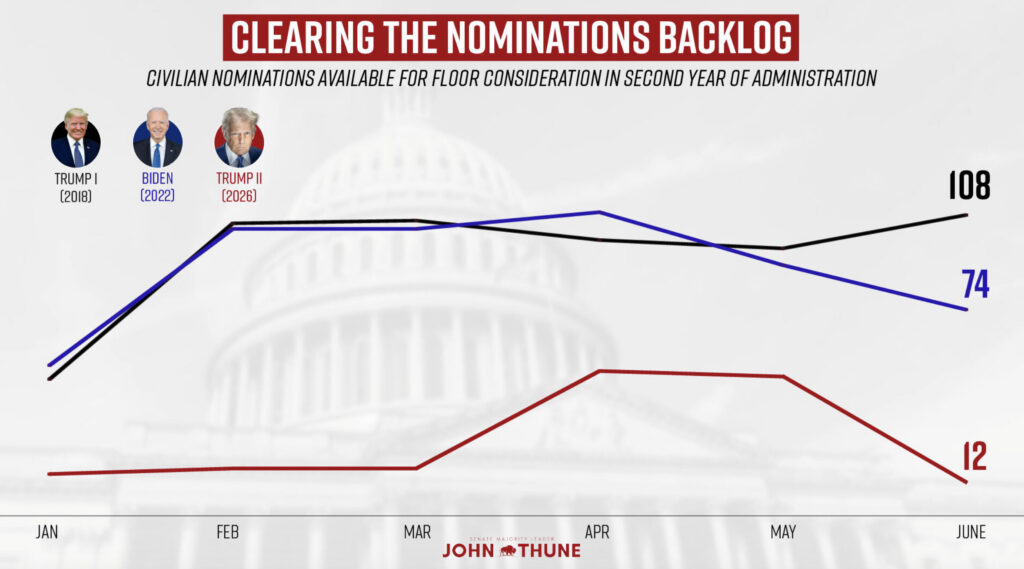
Senate Majority Leader John Thune (R., S.D.) celebrated 500 days on his new job by “essentially eliminat[ing] the nominations backlog” that Senate Democrats have thrown in his way, confirming another batch of 49 nominations send by President Donald Trump to the Senate.
Thune started his tenure as Majority Leader by confirming Trump’s cabinet at a historic pace — work that has continued despite Senate Democrats attempting to block every one of Trump’s civilian nominees. Trump is the only president on record who has not had a single civilian nominee confirmed by voice vote or unanimous consent during a term in office.
The contrast is stark; during Trump’s first term in office, 65 percent of his civilian nominations were confirmed by either unanimous consent or by voice vote. 57 percent of President Joe Biden’s nominees were confirmed by either process, and the numbers only go up from there. Presidents Barack Obama and George W. Bush had 90 percent of their first-term civilian nominees go through in these processes, and Presidents Bill Clinton and George H.W. Bush had almost all of their nominees confirmed by one of them.
With the latest round of confirmations, Thune and Senate Republicans have confirmed over 301 nominees en banc in Trump’s second term; that accounts for over 60 percent of the nominees the Senate has confirmed thus far — and this achievement was enabled by a rule change, which allows for some nominees to be confirmed in en bloc batches. Senate Republicans restored the Senate’s longstanding practice of confirming noncontroversial nominees in large numbers in September 2025 following another round of Democratic obstruction.
Ambitious Democrats in both chambers have used Trump’s nominees as foils for potential presidential — or Senate leadership — bids. “I have decided that I’m not going to vote for a single nominee,” Sen. Chris Murphy (D., Ct.) declared days into Trump’s second term. “This moment demands some extraordinary tactics.” Rep. Alexandria Ocasio-Cortez (D., N.Y.) went even further, urging Democrats to “blow [the Senate] up.”
Thune and his colleagues, like Sen. Tim Scott (R., S.C.), the Chair of the Senate’s Banking Committee, have also shepherded confirmations of high-profile Trump picks amidst unified Democratic opposition.
The Senate recently confirmed Kevin Warsh as the next Chair of the Federal Reserve, and despite the Wall Street Journal touting Warsh’s “invaluable” experience in financial crises, Democrats were resolutely opposed.
Warsh had even once received rave reviews from Senate Minority Leader Chuck Schumer (D., N.Y.), who praised his 2006 nomination to serve on the Federal Reserve’s Board of Governors. “Mr. Warsh is tremendously accomplished for a man his age, and for that reason, it is no surprise that he is already no stranger to the Federal Reserve,” Schumer said at the time. “He knows unequivocally that the Fed must be independent, nonideological, and nonpartisan, and for this reason, I am proud to support his nomination.”
Despite Warsh’s qualifications and experience, he was confirmed in the most partisan vote in Federal Reserve Chair history — only Sen. John Fetterman (D., Pa.) voted with Republicans to confirm him, and every one of Scott’s Democratic counterparts on the Banking Committee opposed advancing the Warsh nomination — another first. Only one Democrat on the committee showed up to the Warsh markup.