This week, the Wall Street Journal pointed out that Arkansas has become a hub for defense productions. In fact, over the past decade, Arkansas has quietly become one of the most important states in America’s defense industrial base.
According to multiple sources in D.C. and in Arkansas, the elected official who has played the leading role in making that happen is Sen. Tom Cotton (R., Ark.), who serves in a senior role on the Senate Armed Services Committee. Cotton also leads the Senate Intelligence Committee and he retains close ties with Secretary of War Pete Hegseth and other defense officials in the Trump administration.
The Natural State now produces missiles, rocket motors, artillery ammunition, advanced military aircraft components and other critical systems that are essential to rebuilding the U.S. military and deterring adversaries like China, Russia and Iran. As the Trump administration pushes to dramatically expand American weapons production, Arkansas is increasingly at the center of that effort.
As far back as his first speech on the Senate floor in 2015, Cotton called for increasing defense spending. And since then, sources in Arkansas and in D.C. tell the Washington Reporter that he has worked nonstop to deliver defense spending to Arkansas in the Defense Authorization Act (NDAA) and through other means.
Long before shortages were exposed by the war in Ukraine, Cotton repeatedly warned that the United States lacked the manufacturing capacity needed for a prolonged conflict with a near-peer adversary. Those warnings have increasingly become bipartisan consensus.
Today, the results of Cotton’s work are visible across Arkansas.
South Arkansas has emerged as one of the country’s premier hubs for missile production.
Camden, Arkansas, for example is home to major facilities operated by Lockheed Martin, L3Harris Technologies and General Dynamics Ordnance and Tactical Systems, producing systems ranging from Guided Multiple Launch Rocket System (GMLRS) rockets to Precision Strike Missiles, solid rocket motors and other advanced munitions that have become indispensable to both U.S. forces and allies around the world.
Those facilities have received billions of dollars in public and private investment as demand for munitions has surged following Russia’s invasion of Ukraine and growing concerns about China.
Cotton has also consistently advocated for expanding those production lines, arguing that rebuilding America’s “arsenal of democracy” requires dramatically increasing manufacturing capacity rather than relying on depleted stockpiles.
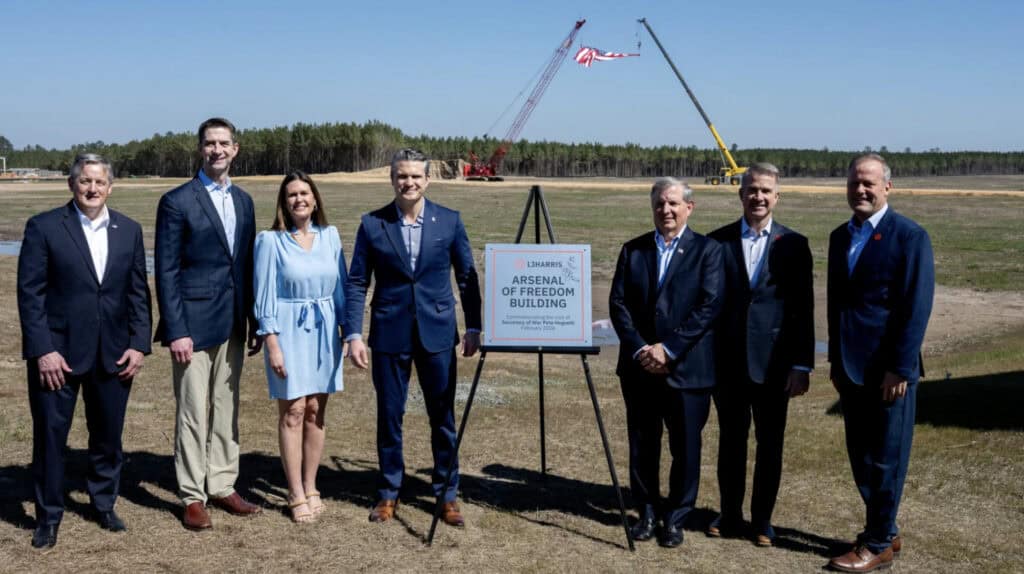
That work reached another milestone earlier this year when Defense Secretary Pete Hegseth traveled to Arkansas as part of his “Arsenal of Freedom” tour.
Hosted by Cotton, Hegseth visited Camden’s growing defense manufacturing complex, highlighting Arkansas’s expanding role in supplying the American military. During the visit, Hegseth praised Arkansas workers and emphasized that rebuilding domestic weapons production is central to President Donald Trump’s national security agenda. Cotton called the visit an opportunity to demonstrate “how Arkansas leads the way in rebuilding America’s defense industrial base.”
The visit underscored just how dramatically Arkansas’s role has changed.
For decades, the state’s defense industry was important but relatively overlooked.
Today, Arkansas has become one of the Pentagon’s fastest-growing manufacturing centers.
The momentum extends beyond Camden.
Earlier this year, the Army announced a landmark enhanced-use lease allowing Hanwha Defense USA to establish operations at Pine Bluff Arsenal, one of the nation’s historic military installations.
Cotton celebrated the announcement, saying he had worked alongside Hegseth, Gov. Sarah Huckabee Sanders (R., Ark.) and Arkansas’s congressional delegation to secure the partnership.
“I have long called for modernizing and increasing our nation’s munitions supply,” Cotton said after the announcement. “This partnership is a great development for the economic future of central Arkansas and the future of our nation’s defense.”
The Pine Bluff investment represents more than new jobs.
It reflects a broader Pentagon strategy to revitalize aging government-owned ammunition and weapons facilities through partnerships with private industry, something Cotton has repeatedly championed in Congress.
Meanwhile, northwest Arkansas has become an increasingly important supplier for aerospace manufacturing, while Little Rock Air Force Base remains one of the Air Force’s premier mobility installations and a critical training center for C-130 operations.
Perhaps no single achievement better illustrates Cotton’s influence than the transformation of Ebbing Air National Guard Base in Fort Smith.
After years of advocacy from Arkansas’s delegation, Ebbing was selected to host the Foreign Military Sales F-35 pilot training mission, bringing billions of dollars in long-term economic activity while strengthening partnerships with allies purchasing America’s fifth-generation fighter.
The project elevated Arkansas’s importance within the Air Force while creating another cornerstone of the state’s growing defense economy.
Cotton has also worked to ensure Arkansas benefits from broader strategic priorities beyond traditional weapons manufacturing.
He has frequently highlighted the importance of securing domestic supplies of critical minerals, including lithium found in south Arkansas’s Smackover Formation. As demand for batteries, defense electronics and advanced military technologies continues to grow, Arkansas is positioned to become an increasingly important part of America’s secure supply chain.
For Arkansas, the payoff has been significant.
Thousands of high-paying manufacturing jobs have been created or expanded.
Billions of dollars have flowed into communities across the state.
And Arkansas has become indispensable to America’s ability to produce the missiles, rockets and munitions needed to deter adversaries and support allies.
Cotton often argues that national security and economic growth are not competing priorities.
Arkansas increasingly demonstrates that they can be one and the same.