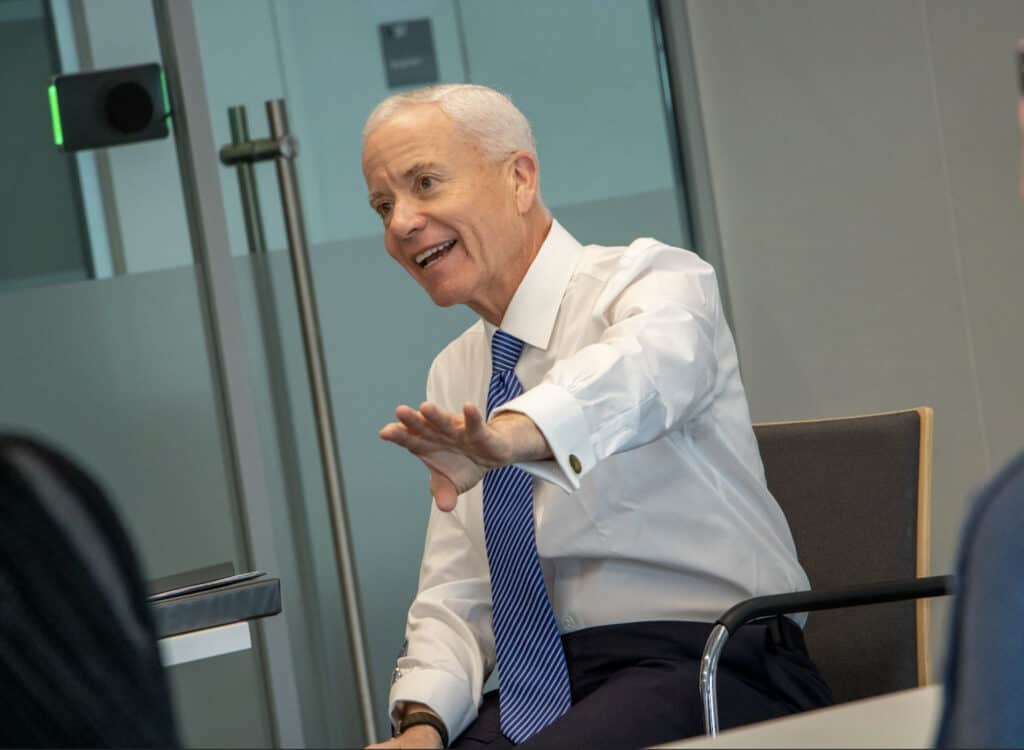
The General Services Administration’s (GSA) leadership is pushing back against a bipartisan bill that the GSA’s Administrator stated would “make projects larger, slower, and more expensive.”
Edward C. Forst told the Washington Reporter that the proposed bipartisan bill, S. 5194, the Judicial Space and Facilities Management Effectiveness Act is “misguided” and that the bill, if passed, would distract the Judiciary from its chief responsibilities.
“The Judiciary’s core mission is to deliver justice—not to manage buildings,” Forst explained. “The misguided Judicial Space and Facilities Management Effectiveness Act would expand the Judiciary’s real‑property authority even as decades of independent GAO audits confirm the Judiciary is not prepared to manage major facilities. Shifting complex real‑property responsibilities onto an institution not structured for them will increase costs and weaken oversight.”
Some in the Judiciary are pushing for the Judicial Space and Facilities Management Effectiveness Act, which would allow the Judiciary to assume repair and maintenance responsibilities for courthouses in up to ten districts, despite new federal oversight showing that the Judiciary’s design and planning decisions are driving larger, more expensive courthouses. Those findings come as many in the GSA believe that the Judiciary’s track record demonstrates that it cannot manage complex facilities work.
For decades, independent audits have found that the Judiciary routinely builds more space than it needs. A GAO audit from 2010 found the Judiciary could have reduced the number of courtrooms built since 2000 by 40 percent, which was a problem the Judiciary acknowledged, but never corrected. Last year, the House of Representatives responded by passing the H.R. 3426, Courthouse Affordability and Space Efficiency (CASE) Act of 2025, which was aimed at curbing wasteful courthouse construction.
While some in the Judiciary advocate for increased spending authority, Judge Julia Gibbons testified before the Senate Judiciary Committee, arguing that acquiring Real Property Authority for the Judiciary “would constitute a significant responsibility that veers dramatically from our core mission to deliver justice.”
“After these upfront investments are made, we believe there could be cost efficiencies, however, given the austere federal budget environment, we do not believe it is prudent to actively pursue independently real property authority for the Judiciary,” Gibbons argued.
As Forst sees it from GSA’s perspective, “the real issue is the statutory bottleneck Congress created,” he told the Reporter. “GSA is trapped under a $3.96 million prospectus threshold that pushes even routine repairs into a congressional approval process averaging 426 days. Some projects have waited up to 11 fiscal years, and costs have escalated as much as 436 percent from initial proposals.”
This issue is one that Forst has spent months working on. “In May, I led a letter with 22 Cabinet members and agency leaders urging Congress to raise the threshold to $75 million for routine and emergency maintenance,” he added. “If Congress wants faster, safer courthouse repairs, it should raise the prospectus threshold and let us do our job — not expand an authority that will make projects larger, slower, and more expensive.”
Forst’s claims are backed up by independent GAO findings; in one recent audit, the GAO provided the most current evidence that the Judiciary’s design decisions are increasing federal costs.
“GAO found that the Judiciary did not fully collaborate with GSA or the Federal Protective Service, missing opportunities to align design standards with federal expertise; based revised circulation requirements on a 2012 assessment of older courthouses GAO had already found to be oversized.; [and] did not address GSA’s concerns that the new standards would expand space unnecessarily, driving up long-term construction and operating costs.”
“This audit shows the Judiciary is still making unilateral decisions that increase size, cost, and long-term federal liabilities,” GSA found. Its conclusions were striking, and provide further rationale for Forst’s opposition to the bill.
“If the Judiciary struggles to manage small projects, and to update its own internal thresholds, how does it plan to take on hundreds of millions of dollars in courthouse repairs and construction?” it posited. “This is a central question for taxpayers and policymakers.” As President Donald Trump and his entire administration make countering fraud an all-of-government priority, that message will likely prove highly salient.
Instead of the Judicial Space and Facilities Management Effectiveness Act, Forst and 22 Cabinet secretaries and federal agency leaders want Congress to pass legislation to raise the prospectus threshold to $75 million for routine and emergency maintenance.
Forst and others at the GSA believe that the fault for the lack of repairs was a problem created by Congress, and the Judicial Space and Facilities Management Effectiveness Act, which is being spearheaded by retiring Sen. Dick Durbin (D., Ill.) would exacerbate it. In contrast, raising the prospectus threshold, Forst believes, would solve most of the problems that Durbin’s bill attempts to fix.