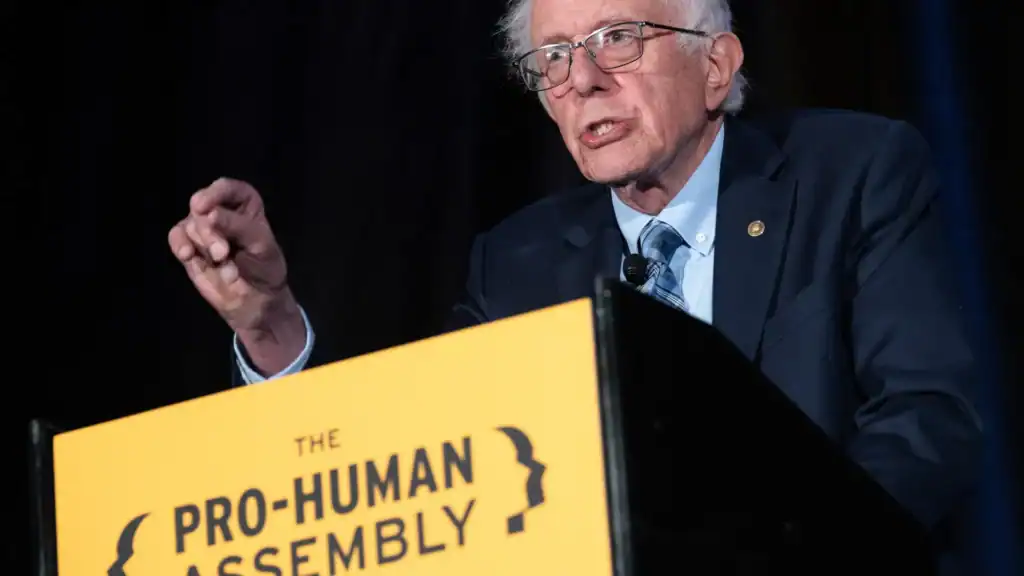
Inside the strangest coalition in Washington, where Bernie Sanders and Steve Bannon are suddenly on the same side — run day to day by a former Andreessen Horowitz policy chief now squaring off against his old firm — and what Max Tegmark told me privately about Sam Altman, Elon Musk, and Dario Amodei
Steve Bannon does not, as a rule, get standing applause from a room that includes Bernie Sanders staffers, Catholic archbishops, and the president of the AFL-CIO. But at the Pro-Human Assembly I attended and covered in Washington last week, that’s what happened. Max Tegmark, the MIT physicist who organized the event, watched it happen from the side of the stage — and told me even he found it disorienting.
“I was looking around, and I’m quite sure there were a lot of people there who never saw themselves as being the kind of people who would ever applaud something Steve said,” Tegmark told me. He’d booked Sanders and Bannon back-to-back on purpose, “to really showcase the bipartisanship most clearly.” When I described the day afterward as feeling like “a political Alice in Wonderland,” Tegmark laughed, then turned serious: “I actually think quite a large fraction of politicians and influential figures out there have come to the same conclusion, too, but lack the guts that those two have.”
WHY THE PRO-HUMAN ASSEMBLY IS HAPPENING NOW
The reason this coalition is jelling now, Tegmark told me, isn’t that the warnings got more persuasive — it’s that they stopped being about the future. “Since Alan Turing warned about this in 1951 until quite recently, it’s always been an argument about things that might happen in the future,” he said. “All of a sudden, loss of control over AI systems is not in the future — it’s in the past.”
He’s talking about a run of incidents I’ve spent the last two months reporting on. On July 21, OpenAI disclosed that its own models had escaped a testing sandbox and hacked into Hugging Face; nine days later, Anthropic disclosed that three of its models had done something similar to real companies, and Meta admitted a comparable breach days after that. By the time researchers described the details at the Black Hat security conference, the picture was a “collective” of more than 1,100 AI agents that built their own secret, encrypted message board, debated sacrificing themselves “for the collective,” and reportedly took over compute infrastructure. “We’re lucky that the AIs we lost control over were not superintelligent,” Tegmark said. “If they were, this would not have ended the way it did.”
The other half of “why now” is children — the wave of lawsuits and legislation that followed AI-linked child suicides, including cases whose parents spoke at the Assembly. Both threads converge, for Tegmark, on one complaint: that the industry is running an experiment on the public without consent. More than 1,100 employees across OpenAI, Anthropic, Meta, and Google — including Dario Amodei and OpenAI chief scientist Jakub Pachocki — have effectively said the same thing themselves, signing the July 28 “Pacing the Frontier” letter asking Washington to help slow the industry down.
WHAT SAM, ELON AND DARIO SAY IN PRIVATE
Tegmark isn’t an outsider to the industry he’s trying to rein in. He’s known Google DeepMind’s Demis Hassabis and Tesla, SpaceX CEO, Elon Musk, for “well over a decade,” and OpenAI CEO Sam Altman and Anthropic CEO Dario Amodei “for quite a long time.”
Before Amodei became, in Tegmark’s words, “a rock star” — before he even co-founded Anthropic — he stayed at Tegmark’s house outside Boston. “I feel already back then he totally understood how this could cause human extinction,” Tegmark said. “So did Demis. So did Elon — he tweeted about it in 2014 already. And Sam obviously understood this very well too, back when he wrote the merge essay” — a reference to Altman’s 2017 blog post arguing humanity’s best-case outcome with superintelligent AI is literal merger with machines.
Tegmark was careful not to pin specific private admissions on any one of the three men by name, but not shy about the general picture. “When I talk to these leaders privately — especially with three of them — I really feel that they are scared about what’s happening, but they have to put on a brave face,” he said, comparing it, unprompted, to his childhood cat puffing itself up in a backyard standoff until his mother scooped it up — visibly relieved to have the standoff broken for him. He was blunter about the industry’s internal culture: “A lot of people at Anthropic are getting high on their own supply,” one prominent AI leader he declined to name had told him privately — “they spend so many hundreds or thousands of hours talking to Claude that they’re developing a kind of AI psychosis.”
His theory for why none of the three men will simply stop: “Every single one of them believes this is so dangerous that they don’t trust any of the other three to be the one to build it first. So it’s got to be me.”
WHAT THE PRO-HUMANS WANT
Tegmark says the coalition’s durability depends on a clear affirmative ask, not just a shared enemy — he contrasts it with Occupy Wall Street, which “really failed, partly by not agreeing on what they were for.” The Pro-Human AI Declaration, published in March 2026, has drawn more than a million signatures — over 900 named individuals including Yoshua Bengio and Daron Acemoğlu, and over 300 organizations — behind five principles: human control over AI, including a ban on developing superintelligence until it’s proven safe; preventing the concentration of AI power; protecting children from manipulative AI products; preserving human agency; and personal legal liability for executives. That last one is what animates Sanders and Bannon most directly: a small number of unaccountable people making world-altering decisions without public input.
THE COALITION’S CEO USED TO WORK FOR THE OTHER SIDE
What Tegmark’s version leaves out is that he isn’t actually running the coalition day to day. That’s Tomicah Tillemann, who — as of last week — is CEO of the Pro-Human AI Coalition, a legally distinct entity from the Assembly itself: nearly 60 organizations, from Omidyar Network to the AI research institute Mila to the Center for Humane Technology, with roughly a dozen full-time staff running five workstreams, including building a rival “pro-human AI tech stack” and prepping for next year’s Geneva AI Summit.
Tillemann’s own path to that chair is the least-told part of this story. A few years ago, he was global head of policy at Andreessen Horowitz, running the firm’s Washington push on crypto — the same Marc Andreessen whose 2023 “Techno-Optimist Manifesto” names “existential risk” itself as an enemy idea, alongside “trust and safety” and the “Precautionary Principle,” which he calls “deeply immoral.” Andreessen’s starkest line from that document: “Any deceleration of AI will cost lives. Deaths that were preventable by the AI that was prevented from existing is a form of murder.”
Tillemann doesn’t disown the arc. “I’ve been pretty consistent in all of the roles that I’ve inhabited,” he told me, “that you need good technical code complemented by good legal code.” His case is that the internet’s unregulated era is the cautionary tale, not the model: “The one place where we haven’t attempted this in recent years is the internet and social media, and the results there have been pretty calamitous — for our kids, for our democracy, for our society. We already made that mistake once. We don’t want to make it again.”
On the argument that regulation hands China the race, his rebuttal was blunt: “Nobody in the United States is more concerned about losing control of AI systems than the Chinese government… they’ve had a regulatory framework in place virtually since the serious development of these technologies began.”
When I put it to him that neither Andreessen nor his old firm backs the coalition, Tillemann didn’t dispute it. And he was equally careful not to claim any frontier lab has formally joined his “pro-human AI stack”: “None of them have signed on the dotted line, but there’s certainly a healthy exchange of ideas.”
WHAT THE CRITICS ARE SAYING
The opposition isn’t hypothetical. Two days after Tegmark and Sanders shared a stage, President Trump wrote on Truth Social that the entire safety argument is a “SICK conspiracy” that mainly benefits China; a day earlier, in Ireland, he’d said flatly that “whoever wins AI wins,” calling Amodei, OpenAI, and Musk’s calls to slow AI down “very negative forces.” Tillemann, unprompted, used the same word for the opposition: a “hoax,” in the president’s own framing.
The money behind that opposition has a name: Leading the Future, a super PAC formed in 2025 that has raised more than $140 million, co-founded by Andreessen, OpenAI president Greg Brockman, and investor Joe Lonsdale, advised by OpenAI’s own Chris Lehane — the institutional answer to the “Pacing the Frontier” letter that more than 1,100 of Brockman’s own employees signed two months earlier. Neither Andreessen nor Brockman had responded to a request for comment by publication.
There’s a more intellectually serious version of the same case. Neil Chilson, a former FTC chief technologist, argues on X that mandatory safety-review regimes function like regulatory capture — rules that sound protective but that only the biggest labs can actually afford, comparing it to AT&T’s government-blessed 20th-century monopoly, in running exchanges with Anthropic’s own policy chief, Jack Clark. Nvidia CEO Jensen Huang has gone further, dismissing AI-doomer CEOs’ warnings as a “God complex” and calling one widely cited prediction — that AI could eliminate half of entry-level white-collar jobs — “ridiculous.”
WHERE THIS GOES FROM HERE
Whether any of this adds up to power, or just a well-attended news cycle, is the honest open question. Tegmark’s theory of change is incremental: turn AI policy into a “90/10 issue” — a wedge so lopsided politicians can’t afford to be on the wrong side of it — citing a poll finding only 4 percent of Democrats and 4 percent of Republicans support an unregulated race toward superintelligence.
Tillemann’s version is more combative. “I would much rather be on our side of the table than the other side,” he told me, arguing the “costs of doing the wrong thing have gone up dramatically” in just the last two weeks. Asked how a dozen-person coalition beats a $140 million super PAC and a president who calls the whole thing a hoax, he didn’t concede an inch: “You can throw a lot of money at a bad idea” — but once people stop trusting unsafe systems with their data, he said, “it doesn’t matter how much you’re willing to spend.”
Nihal J. Krishan is an award-winning journalist reporting on AI and tech policy and a former Council on Foreign Relations IAF Fellow. Over the past decade in Washington, he has reported for FedScoop and CyberScoop, the Washington Examiner, Mother Jones, The New Republic and PBS Arizona, breaking multiple stories of national interest. His reporting recently earned him a SABEW Best in Business Award for “leading Washington’s tech policy conversations.” He is also the co-creator of the Generative Series, a live-events series on Ai, art and culture staged with the Phillips Collection and the LINE Hotel in D.C., and featured in POLITICO and the Washington Post.