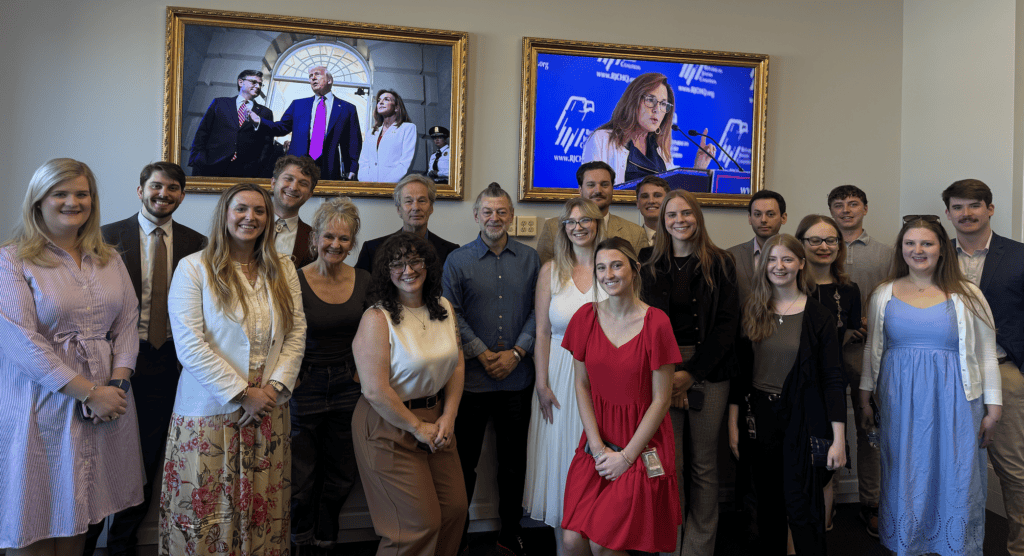
The Republican Communication Association (RCA) brought some star power to its latest meeting, with legendary actor Andy Serkis talking about his latest cinematic adventure: the newest portrayal of Animal Farm, which he wanted “specifically to be for a much younger audience.”
“We wanted to make this a properly family film, which had genuinely darker themes that Orwell had,” he told the room of GOP communicators, “but which could be absorbed by a proper family.”
While both the right and the left have attempted to co-opt George Orwell and his messages, Serkis said that in his latest movie, “we’re not pointing a finger at any administration in particular.” While the movie is often viewed through political lenses, he said that it could even be workplace power dynamics.
But in today’s climate, most films can easily take on political lenses, which Serkis — who is best known for his portrayal as Gollum in the Lord of the Rings series — said is part of why the animated film took years to make. “There was enormous interest, you could say hatred” when it was released, he said, “because Orwell is revered and hated by both right and left.”
Orwell’s legendary tome has been made into several movies, but Serkis and his producer, Jonathan Cavendish, said that they wanted to make a version that was geared towards children six and over, arguing that Orwell himself would have wanted that.
Orwell also was a huge believer in the youth, Cavendish noted, adding that the author “meant [for Animal Farm] to be for kids.”
“I do love the 1954 adaptation, but it’s very of it’s time,” Serkis said, adding that while the book has moments of humor and levity, the CIA-funded flick had no humor. In addition to some humor, Serkis wanted to “get inside the decisionmaking and the headquarters of the pigs, which happens offstage in the book.”
The team at Angel Studios is “very vocal about wanting to take it to schools,” Serkis said, and it also wanted to make the movie’s message resonate with the modern era, so it asked Orwell’s estate what Orwell himself would be writing about if he were alive today.
“He obviously wouldn’t be writing about a totalitarian Russia taking over the world,” Cavendish said. He would be writing about the unfairness between the rich and the poor, about tyranny, and about corruption. They tried to work those themes into the movie, while adding a third act filled with hope that wasn’t in the book or previous movies.
“If he was writing today, it would be a message of hope,” Cavendish said; the movie’s third act “gives a message of hope, but hope clouded by mankind’s abilities to keep making the same mistakes.” Despite some tweaks, the movie remains true to what he described as Orwell’s prophetic vision of the future.
Orwell, a farmer and a vegetarian, hated pigs. But he also “prophetically saw the way that we would fail completely to look after the planet and the animals of the planet.”
The duo also discussed what comes next for their industry. The Washington Reporter asked them what the advent of artificial intelligence (AI) will mean for movie-making.
“Having been at the nexus of technology and performance and creativity,” Serkis replied. “We would be hypocritical if we didn’t say that we embrace technology as a means of storytelling.”
The way people consume information has changed drastically in years, he added, pointing to news and to streaming services as examples. “There’s nothing wrong with technological advances,” Serkis said. “The use of performance capture [a type of acting that he perfected] was a threat to cell animators. What we are faced with now is an exponential drive towards AI. AI is like any other technology, it’s all in the lap and the destiny of people who create rules around which it’s used.”
Serkis pointed to other technological revolutions that sorted themselves out, like music sampling in the 1980s, where many musicians were “exploited.” Now, he said, he’s “interested in immersive story telling; we’re not luddite in our attitude towards AI, but there have to be guidelines,” like contracts where if actors or their physicality are used, there is protection.
Cavendish was also optimistic, telling the Reporter that “we can to some extent control” what AI will be.
He and Serkis are working on something that will come out this fall that will “cause quite a stir” in this realm. In the United Kingdom, Cavendish is involved with a group called AIMICI, which “creates a stamp of approval for the use of AI” that works to ensure that “AI is not being misused, [and is] never taking the role of the creative person.” He added that he doesn’t think “that any credible production is going to be allowed where an actor is an AI-generated thing.” Agents and unions will help to ensure that. “The only way to do it is to link it to the money,” he noted.
Following the event, Miranda Dabney, the RCA’s president, told the Reporter that Serkis coming to town was a “starstruck moment in the halls of our Capitol.”
“The Lord of the Rings, and the Tolkien works at large, are foundational texts for my generation and, specifically, for conservatives,” Dabney, who noted that she herself “quotes Gollum way too often,” added. “There’s so much we learned from these books and movies about friendship, loyalty, integrity, truth, and the strength of hope. If politics is downstream of culture, storytelling is one of the greatest tools we have to shape the future and preserve what matters. Hearing directly from such an accomplished and compelling storyteller was an honor.”
Kate Vittone, the RCA’s Professional Development Chair, added to the Reporter that “Andy Serkis’s visit underscores the importance of engaging with storytellers whose work shapes public dialogue.”
“Animal Farm has remained relevant for generations because it challenges audiences to think critically about power and accountability,” Vittone added. “Having Andy Serkis join RCA gave our members a unique opportunity to hear directly from a filmmaker bringing that story to a modern audience, and to discuss how narrative continues to influence political and cultural conversations today.”
For his part, Serkis also spoke with the Reporter about a series of fan theories about the Lord of the Rings, and ranked all of the movies in order. A fan theory that he was inspired by Gurgi from The Black Cauldron in his portrayal of Gollum is fake news, he said. The inspiration behind Gollum’s famous voice “lies fairly and squarely with my cat,” he said.
Serkis also predicted that the “Hunt for Gollum is going to be the best film,” and that “Stephen Colbert’s film may run a close second.” But as far as current Lord of the Rings movies go, his ranking is The Fellowship of the Ring, following by The Two Towers which “personally meant a lot to me,” then The Return of the King, and then the Hobbit trilogy. When it comes to the prequels, he said the best is An Unexpected Journey, followed by The Battle of the Five Armies, followed by The Desolation of Smaug.
He also noted that while he has heard of the “Battle for Middle Earth” game series, he has never played it himself.