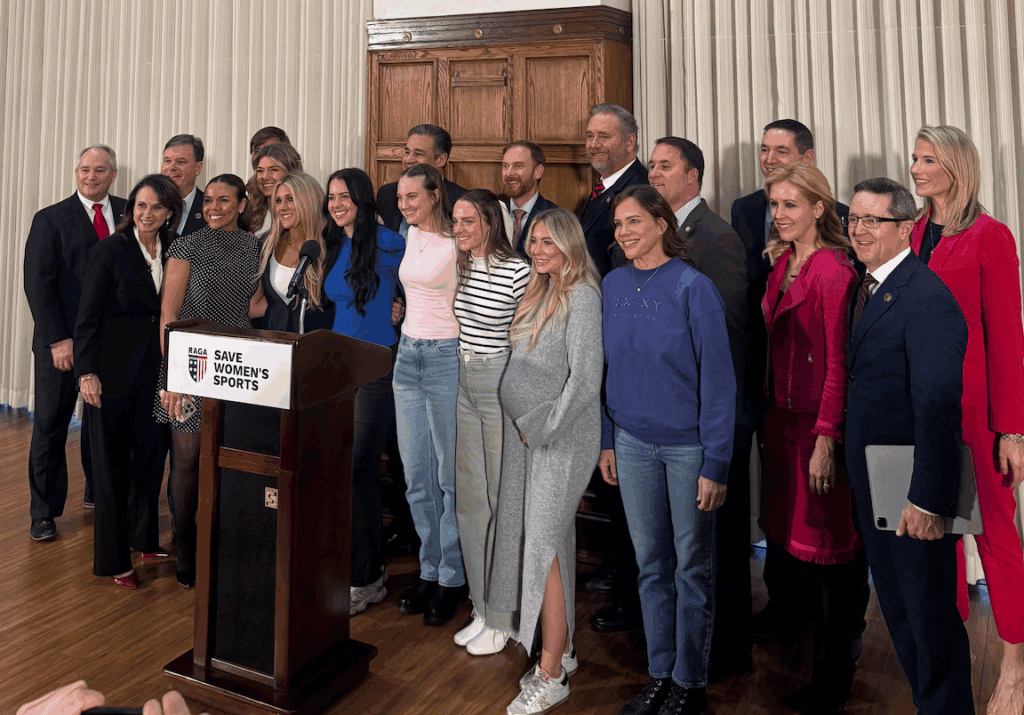
A slew of Republican Attorneys General came to Washington, D.C. to defend women’s sports last week as the Supreme Court deliberated cases that could save — or destroy — women’s-only sports teams.
West Virginia Attorney General JB McCuskey’s state is at the center of one of the cases. He predicted that the Supreme Court will unanimously side with female athletes in West Virginia and allow the state to ban men from playing on women’s sports. Should the Supreme Court rule against the girls, McCuskey cautioned that “every women’s sports team in the entire United States would be illegal.”
Not every Republican attorney general was as optimistic as McCuskey about the final decision. Idaho’s Raúl Labrador predicted victory, but noted that he is “not as optimistic as JB” about the final outcome.
The Washington Reporter joined a group of the GOP AGs at a press conference hosted by the Republican Attorneys General Association (RAGA) before the Supreme Court arguments. The Reporter asked several of the AGs why the issue had become so partisan.
Austin Knudsen, Montana’s attorney general, wondered where RAGA’s Democratic counterpart was. “Where’s DAGA?” Knudsen, RAGA’s chair for the year, said that he is “sure one of the RAGA staff here can get you their phone numbers…this just seems like an issue that Democratic state officials and elected officials are terrified of.” Part of the reason why, Knudsen speculated, is “money. [Democrats are] completely beholden to the far-left, ten percent…this is a bipartisan issue…the screaming maniac left wing, five, six, percent people are able to swing an entire demographic of state leaders.”
Virginia’s outgoing attorney general, Jason Miyares, said that when it comes to women’s sports, Democrats are “so open-minded that your brain falls out.”
While West Virginia and Idaho are involved directly in the Supreme Court case, several other states with GOP attorneys general have found themselves at the forefront of the debate.
Indiana’s attorney general, Todd Rokita, noted that “Indiana was one of the first states to pass and enact into law a common sense law that says that boys should play in sports of their own sex, and we were, within minutes, sued by the left-leaning ACLU, and a plaintiff who was only 10 years old.”
“Let me tell you the Indiana story,” Rokita continued. “We were able to get that case against us dismissed,” largely due to the technicality of the child leaving the jurisdiction, but “we were able to submit a ton of good evidence…The left-leaning ACLU has been unable to find a plaintiff” to file another suit “but they could tomorrow in Indiana, and that’s why [the] Supreme Court case is so important…That plaintiff in Indiana was 10 years old, and in my opinion was co-opted by the left. That 10 year old needs love, and so do all the rest like her. That 10 year old needs therapy, but that 10 year old and all them ones like that person does not need to be affirmed in their wrongness that was that case in Indiana…may justice prevail.”
Adam Piper, RAGA’s executive director, said that on the issue of women’s sports, “while Congress talks, Republican AGs work and win.” Piper specifically mentioned the landmark Supreme Court case led by Tennessee’s attorney general, United States v. Skrmetti, which allows states to ban puberty blockers for minors.
The attorneys general of Louisiana and Utah also said that their states have been fighting this legal battle for years. Liz Murrill, Louisiana’s attorney general, said that her state “filed the first lawsuit on the Biden administration rules…13 minutes after the rule was filed in the Federal Register.” For Murrill and for many others, the issue is personal; her 14-year-old niece had to get undressed in front of a boy, she said.
In Utah, Attorney General Derek Brown said that his “office has been litigating that issue for a number of years…It’s not political, it’s parental.”
The GOP AGs were also joined by twelve-time National Collegiate Athletic Association (NCAA) All-American swimmer Riley Gaines, who said that the issue is ultimately political, because Democrats “take the wrong side of every 80-20 issue.”
Gaines said that the NCAA and its leadership “did not” comply with one of President Donald Trump’s executive orders that required men to stay out of women’s sports. Gaines, who sued the NCAA in Gaines v. NCAA, said that “[NCAA leadership] Charlie Baker is really good at sitting on the fence.”
Macy Petty, a former NCAA volleyball star, was another female athlete who joined Gaines and the AGs. “The NCAA’s worst nightmare” are the female athletes they claim to represent, Petty said. “They would not hear a single word from” the female athletes. Petty also noted that both Baker and Democrats like Gov. Gavin Newsom (Calif.), are “phony” leaders on this issue.
Sophia Lorey, a former NCAA soccer player, said that California’s attorney general “refuses” to protect women’s sports. Lorey said that odd coalitions have come together to support women’s sports, like California’s conservative Christians and San Francisco’s atheists. “What we’re seeing from the California capital” is not representative of California,” Lorey said, adding that she is “calling on Rob Bonta to stand with these attorney generals…if not, we need to see him lose his seat.”
The current and recent college graduates were supported in their message by legendary female athletes of other eras as well. MyKayla Skinner, a 2020 Olympic silver medalist, said that she was with them because “staying silent on issues that matter doesn’t serve the next generation of girls.”
Jennifer Sey, the CEO of XX-XY, a sportswear company for women, said that “we need every mom in America to say ‘there are no boys on my daughter’s team.’”
Several of the female athletes whose cases were part of the Supreme Court’s deliberations joined towards the end of the press conference. Lainey Armistead noted that “a soccer scholarship from West Virginia State University” made her dream possible; she is “so grateful” to McCuskey and his team, because she noted that college sports are far different than recreational leagues, which are regularly co-ed. “The risk we accept in a women’s match is vastly different” from what happens when men start playing. “The differences between men and women have real world consequences, and nothing in federal law prevents states like West Virginia” from defending women and girls.
Idaho’s Madison Kenyon and Mary Kate Marshall rounded out the event. Kenyon said that “being a competitive athlete is about sacrifice.”
“While women can beat the odds, we can’t be biology,” she noted. “It’s like racing a cheetah against an ocelot. Sure, they’re both fast cats with spots,” but we all know who will win. “Men and women are different, whether some want to admit it or not…Nobody should lose before the start of the race.”
Marshall added that “when I lose to another woman…it inspires me to train harder…but losing to a male feels completely different.” Does he even have to work as hard? “I’m hopeful that the court will protect the sports that I love.”
For the AGs assembled, those women were the stars. Ohio’s Dave Yost told them that “if any of you want to go to law school, we’ve got a job for you.” McCuskey added that if his “girls grow up to be anything like these girls, I will be one enormously proud father.”