The Trump-Kennedy Center (TKC) hosted a pair of shows geared toward combating anti-Semitism.
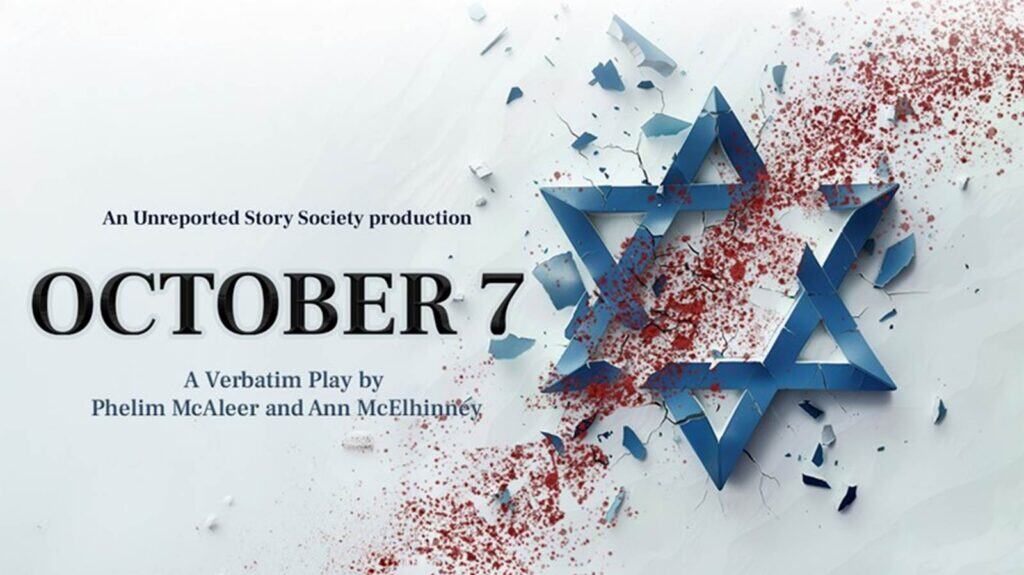
Back to back, the TKC hosted Enduring Music: Compositions from the Holocaust, which was sponsored by the Counter Extremism Project, and a stage reading of the play October 7, which was written by a pair of Irish producers and based on interviews with survivors of the October 7, 2023 terrorist attack in Israel.
Prior to the Enduring Music performance, the TKC hosted a VIP dinner; among those in attendance were Rabbi Levi Shemtov, Martin Marks, the President of Yeshiva University Rabbi Ari Berman, and Counter Extremism Project Ambassador Mark Wallace.
The Enduring Music featured several premiere performances from Maestro Francesco Lotoro’s archive, honoring and bringing to life a repertoire of music that endured for years. One of the songs was a tune that its composer heard a child sing shortly before the Nazis executed the child. While the composer forgot the child’s name, he never forgot the song.
A series of speakers discussed the history behind how the songs were saved by Holocaust survivors and kept alive by Lotoro and his orchestra. One of the speakers was Allan Hall, who was four and a half years old when WWII began.
Hall and his family hid for years in a building that housed the Nazi headquarters in Warsaw, Poland, and he spoke from the main stage at the TKC about how lullabies can help people survive amid unimaginable conditions.
“My father created a fictitious company to conceal us. In the evenings, he also created an entire world for me: the imagined kingdom of Hoka Boka Doka,” he said. To comfort me, he would repeat the same stories about a king and queen and price, me. I was seven to nine, and this creation kept me quiet and entertained as we sat in the dark, cramped in a closet for two years. Like a lullaby, these stories were a relief at the end of my day. They were also a tune for our survival.”
Other speakers included former Rep. Ileana Ros-Lehtinen (R., Fla.), Sophia Sacks, Matt Schlapp, and more. One speaker, an Iranian human rights activist, tied the Nazis’ barbarity to that of the regime ruling Iran today, which she said is a modern-day inheritor of the Nazis’ anti-Semitism. During her activism, she was shot in the face at point blank range and lost an eye. “Remembrance must lead to action,” she said.
During Schlapp’s remarks, he said that his Catholic faith is one of the main reasons that he is staunchly opposed to anti-Semitism. “My Catholic faith demands that I be guided by a belief that every human life is created with dignity, purpose, and infinite worth,” Schlapp said. “That belief carries with it a responsibility: to recognize and confront evil, wherever it takes root. Anti-Semitism did not begin with the Holocaust, nor did it end there, and its consequences do not stop with the Jewish people.”
“The Holocaust was not an accident of war,” Schlapp added. “it was the deliberate and ideological attempt to erase an entire people. We are here to confront the truth about what happens when dehumanization is allowed to grow unchecked: it is not a relic of the past, and it is not confined to just one side. It is a hatred that has survived centuries by changing its language, its symbols, and its excuses. And we must say something uncomfortable: the west still does not understand the depth and persistence of anti-Semitism, including in this very capital.”
The following night, the TKC hosted a reading of October 7, which tells the story of many Israelis who survived the October 7 terrorist attacks. After the show, its authors, Ann McElhinney and Phelim McAleer hosted a question and answer session with the audience, where they were joined by Bethany Mandel, Deputy Assistant to the President of the United States Sebastian Gorka, and former Rep. Michele Bachmann (R., Minn.). They discussed topics ranging from whether Israel should declassify the footage of Hamas’s barbaric terrorism from October 7 to Qatar’s funding of American universities.
“I am Catholic, and while I am pro-Israel almost by default, this show was incredibly important and provided a visual I had not seen before,” one attendee told the Reporter following the show. “It’s sometimes hard for me to visualize the horrors of October 7, because it’s something that doesn’t naturally come across my radar. But this show was eye opening, and it showed me as both a Catholic and as an American why we need to make sure that Israel knows that it is not alone in its fight against these barbarians.”
Another attendee described the events of the question and answer period to the Reporter as: “McAleer and McIlhenny recognize the importance of words and as journalists they know that words matter. They deliberately called the play October 7 so that the topic of the play and the reality of the sickening attacks on Israel are not erased.”
“They were asked by the media if they would cancel the play’s performance because of President Trump’s decision to change the name of the Kennedy Center,” the attendee added. “Their response was simple: canceling the play is exactly what Holocaust and October 7 deniers want. They will not cave to external pressures. Their goal is to have their play staged in environments that will be difficult. They want to go to Harvard, Columbia, and to Ireland — among the worst anti-Semitic and anti-Israel entities of the contemporary world.”