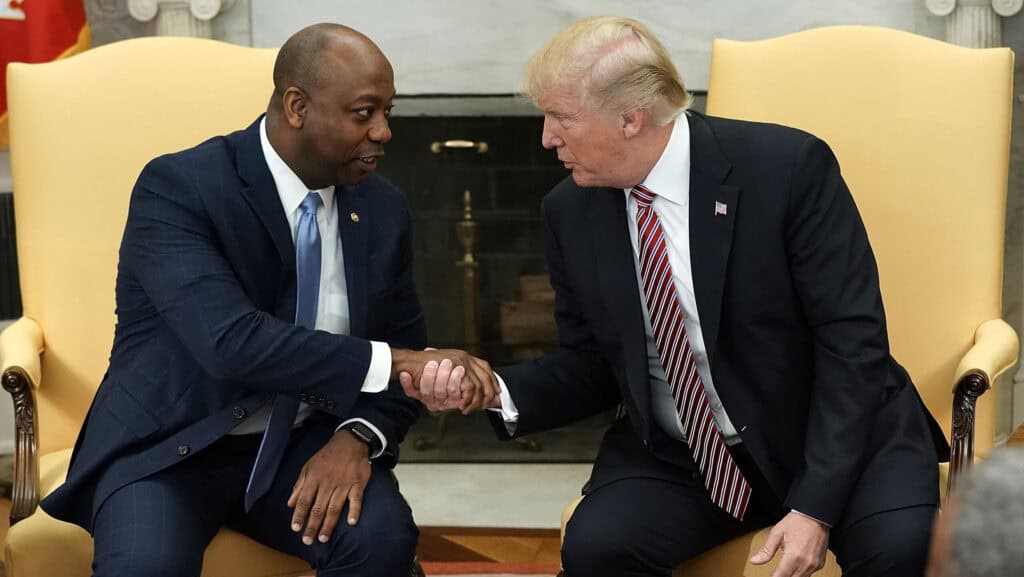
Banking Committee Chairman Sen. Tim Scott (R., S.C.) is supporting President Donald Trump’s effort to roll back what Republicans describe as years of pressure that pushed banks to restrict services to lawful but politically controversial industries, including firearms manufacturers and fossil fuel companies.
“As Chairman of the Senate Banking Committee, I’ve pushed back on Washington regulators who tried to pressure banks into cutting off lawful businesses and everyday Americans,” Scott told the Washington Reporter. “President Trump understands that no one should be locked out of the financial system, which is why he signed an executive order to stop this practice. We’re already seeing real results – regulators are pulling back rules that punished banks for serving legal customers, thanks to the President’s action and my FIRM Act.”
Scott’s comments come as federal reviews and executive actions have renewed scrutiny of how political activism, proxy advisory firms, and bank supervision intersected during the height of environmental, social, and governance (ESG)-driven policymaking.
In December 2025, the Office of the Comptroller of the Currency (OCC) released findings from a review of the nation’s largest banks, concluding that between 2020 and 2023 several institutions adopted internal policies that restricted access to financial services or subjected customers to heightened scrutiny based on lawful business activity, rather than individualized financial risk.
The OCC specifically identified oil and gas exploration, coal and energy production, and firearms manufacturers and retailers among the industries affected. The agency said these distinctions were based on internal policy judgments rather than traditional credit risk analysis. The OCC emphasized that it was not alleging violations of law but flagged the practices as inconsistent with neutral supervision.
The OCC review followed Trump’s August 2025 executive order, “Guaranteeing Fair Banking for All Americans,” which directed federal financial regulators to review and remedy practices that deny banking services based on political, religious, or other non-financial considerations.
The order instructs agencies to ensure banking decisions are based on objective, individualized risk and criticizes prior tolerance of policies that treated entire lawful industries as disfavored.
Pressure on the firearms sector extended beyond manufacturers themselves and increasingly targeted financial intermediaries, including credit card companies and payment networks.
Progressive activists and public pension funds pressed major credit card companies to adopt transaction codes and monitoring systems to track firearm and ammunition purchases.
Proponents argued the measures would help address gun violence, while critics said they created a pathway for financial surveillance and potential denial of services to lawful customers.
In 2018, large asset managers publicly announced they would pressure gun-related companies and financial firms to adopt new policies tied to firearm safety and oversight. Subsequent campaigns sought to push credit card networks to assess how their payment systems could be used to restrict or monitor gun purchases, raising concerns among Republicans that lawful transactions could be flagged or discouraged based on political considerations rather than risk.
Republicans argue these efforts blurred the line between disclosure requests and functional restrictions, contributing to a broader environment in which firearms-related businesses and customers were treated as higher-risk by default.
Republicans additionally point to proxy advisory firms as a critical mechanism through which activist priorities were elevated across corporate America.
In a December 2025 executive order, the Trump administration explicitly named Institutional Shareholder Services (ISS) and Glass Lewis, stating that the two foreign-owned firms control the vast majority of the proxy advisory market and exert outsized influence over shareholder voting outcomes. Their outsized influence allowed activist organizations, organizations associated with Occupy Wall Street, rather than Wall Street itself, to get play for their policy positions.
The order states that proxy advisors have supported shareholder proposals calling for actions such as reducing greenhouse gas emissions and adopting other ESG-related policies, amplifying activist demands through institutional investors.
Climate-focused progressive activism followed a similar pattern in the energy sector.
Groups such as As You Sow have played a central role in organizing and coordinating progressive campaigns aimed at reducing fossil fuel exposure across corporate America, as the Reporter has previously covered. The organization openly promotes environmental and social objectives, including net-zero emissions targets, climate risk disclosure mandates, and diversity, equity, and inclusion frameworks.
As You Sow describes its strategy as one that uses shareholder power to influence corporate behavior on environmental and social issues. Its proposals frequently target banks, asset managers, and energy companies, urging limits on fossil fuel financing or expanded disclosures designed to accelerate the transition away from traditional energy.
Critics argue that these campaigns, when amplified through proxy advisory firm recommendations and large institutional investors, created pressure on financial institutions to treat entire energy sectors as disfavored, regardless of the strength of an individual company’s balance sheet or profitability.
As You Sow has received financial contributions from the Energy Foundation and United States Energy Foundation — organizations that allegedly have ties to the Chinese Communist Party (CCP) — and to George Soros’s Open Society Foundation.
Republicans say banks came under sustained pressure during the height of ESG-driven policymaking, as liberal activists advanced climate and social agendas that were frequently elevated through proxy advisory recommendations, while regulators allowed broad discretion in how banks applied internal policies to lawful industries.
Firearms manufacturers and fossil fuel companies, they argue, were among the most frequent focal points of those campaigns, making them early test cases for broader, sector-wide financial pressure.
Scott has positioned himself as a leading congressional advocate for reversing that approach, backing Trump’s executive actions and pushing legislation to permanently remove non-risk-based criteria from bank supervision.
With regulators now revising guidance following the executive orders and the OCC review, Republicans say the debanking fight is entering a new phase focused on locking in reforms and preventing a return to politically driven financial exclusion.