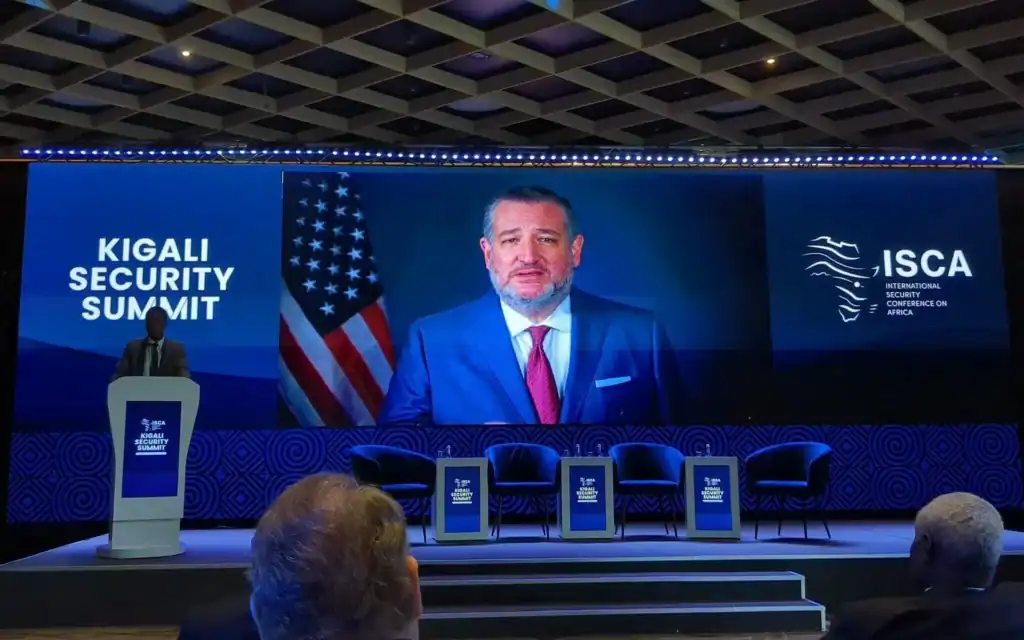
Sens. Ted Cruz (R., Texas) and Jacky Rosen (D., Nev.) made international history a few weeks ago as part of the first-ever Kigali Security Summit, which was a trilateral dialogue featuring American, Rwandan, and Israeli leaders that dealt with security, innovation, and shared values. That conference highlighted what Rwandan leaders in particular views as roles the country can play that deserve more attention from Washington.
The summit brought together representatives from ten African nations, Israeli stakeholders, and influential pro-Israel advocates from the United States, including AIPAC’s President Emeritus Lee Rosenberg. Cruz and Rosen both addressed the summit, as did President Donald Trump’s former National Security Advisor, Robert O’Brien.
The bipartisan message from Washington was unmistakable: Rwanda is not a peripheral interest. It is a strategic asset.
Africa is “vital to our national interests,” Cruz said. The continent is at the forefront of America’s competition with China — and U.S. strategy on the continent “should include our Israeli allies, which are central to Africa’s integration and success.” For years, Rwanda has worked to be at the center of that calculation.
Rwanda and Israel have a lot in common as small nations — Israel with ten million people, Rwanda with 13 million — surrounded by hostile neighbors with limited strategic depth.
Both have faced existential threats. Both carry the living memory of genocide — a weight that both countries have shown does not make a nation weak, but forges an unbreakable commitment to survival, sovereignty, and security.
Shiri Fein-Grossman of the Israel-Africa Relations Institute observed that that shared experience “creates not only empathy, but strategic clarity. Security is not theoretical for us, it is foundational.”
That clarity matters in concrete, operational ways. Just as Israel confronts Iranian-backed proxy forces on multiple fronts, Rwanda faces the Democratic Forces for the Liberation of Rwanda (FDLR) — a group viewed by many as a genocidal militia with roots in the 1994 Rwandan genocide against the Tutsis — operating in eastern Congo for over 30 years.
The tactical parallels are precise: Hamas operates from Gaza, directly adjacent to Israeli population centers, and the FDLR operates from eastern Democratic Republic of the Congo (DRC), directly adjacent to Rwandan centers of population.
Both groups espouse eliminationist ideologies. Both exploit ungoverned spaces. Both benefit from international inaction. And both nations have learned the same hard lesson: you cannot outsource your security to institutions that will not act, speakers emphasized throughout. Accepting that weak international organs like the UN cannot keep the peace is not aggression. It is the doctrine of a nation that has survived the unsurvivable.
Israel has spent decades developing security, intelligence, and technology capabilities that come from fighting for its survival. Rwanda, under President Paul Kagame, built one of Africa’s most capable militaries and most effective governance records — earned in the field in Mozambique, Darfur, the Central African Republic, South Sudan, and Libya. The combination of Israeli expertise and Rwandan capacity, underwritten by American strategic support, was presented as a powerful model for stability in a region that badly needs it.
One Rwandan attendee told the Washington Reporter that “this partnership also fits squarely within the Trump administration’s vision of how alliances should work. Trump has been clear: America is done subsidizing partners who won’t stand on their own. Rwanda doesn’t need that message. It already lives it. When Trump moved to dismantle USAID, most African leaders reacted with alarm. Not Kagame. Asked how the shutdown might affect his country, he was direct: ‘I think from being hurt, we might learn some lessons.’ He added of Trump: ‘I completely agree with him on many things.’ That is not the response of a supplicant. It is the response of a leader who has always intended to build something that doesn’t depend on someone else’s generosity.”
“With nearly 6,000 troops deployed as international peacekeepers — the third-largest contributor in the world — Rwanda doesn’t come with its hand out,” the attendee added. “It comes ready to work.”
The summit also devoted attention to genocide memory and the fight against denial, with a panel featuring Efraim Zuroff, longtime director of the Simon Wiesenthal Center in Jerusalem and one of the world’s most prominent Nazi hunters. The message was clear: Holocaust denial and denial of the Genocide against the Tutsi in Rwanda are not merely historical disputes — they are active threats to the norms that protect vulnerable peoples everywhere. Israel and Rwanda understand this from the inside. The United States has long led the world on Holocaust remembrance, and that same moral leadership animates this emerging trilateral partnership.
On the economic front, Saul Singer, co-author of Start-Up Nation, argued that Rwanda possesses the foundational ingredients — disciplined governance, human capital investment, a business-friendly environment, and strategic vision — to become an “Israel in Africa.”
“That is not hyperbole,” another attendee told the Reporter. “It is a roadmap. Israel turned scarcity and adversity into a global technology powerhouse in cybersecurity, agritech, and defense innovation; precisely the sectors where Africa’s needs are greatest. The United States should want a stake in that outcome.”
“America’s adversaries spent years building influence across Africa through infrastructure investment, arms sales, and diplomatic pressure,” a national security expert explained to the Reporter. “China is not sitting on the sidelines. Iran is not. Russia is not. A U.S.-Israel-Rwanda framework offers an alternative grounded in security cooperation, technological partnership, and the moral authority of two nations that refused to let genocide be their final word.”
“America and Israel need allies who share their values, carry their own weight, and stand firm under pressure,” the national security veteran continued. “Rwanda checks all three boxes. The Kigali summit was a first step toward formalizing what is already an obvious alignment of interests. Washington should take the next step and build on the cornerstone of the U.S.-Israel relationship by extending its architecture into Africa, beginning with the one partner that has already proven it belongs in that company.”