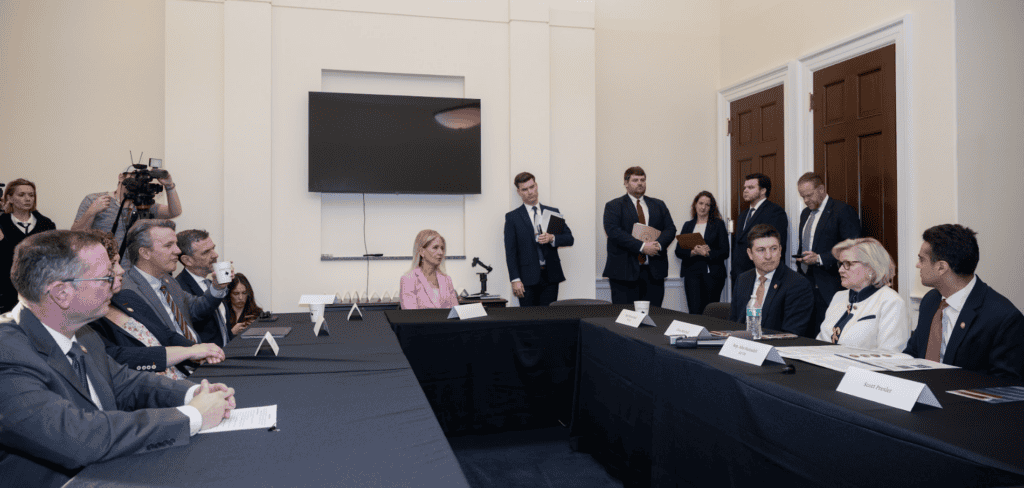
The Republican Study Committee (RSC) continued its election integrity measures by bringing in some of the most prominent advocates for secure elections to complement its legislative agenda.
Rep. Abe Hamadeh (R., Ariz.) led a roundtable for RSC members alongside Rep. Bryan Steil (R., Wis.), the chair of the House Committee on Administration. They were joined by Scott Presler, a conservative activist who has made election integrity his cause, and Cleta Mitchell, an election integrity expert.
“I hear from voters all the time, and they say ‘Scott, what’s the point of me voting if my vote can be negated and diluted by a fraudulent vote? Why should I come out and work tirelessly to elect candidates when elections could potentially be stolen via fraud?’” Presler said. He also addressed potential concerns from the right about the federalization of elections. “It was the Democrat Party in 2019, the first bill out of the House of Representatives was HR1, the For the People Act. There is precedent from the Democrat Party pushing for election reform on the federal level, and while I myself am a federalist and I believe in the separation of powers between the federal government and state governments, our Constitution specifically and definitively says that Congress may regulate our elections. We’re not asking for anything other than guardrails.”
Throughout the discussion, they were joined by Reps. Ben Cline (R., Va), Eric Burlison (R., Mo.), Celeste Maloy (R., Utah), Michael Rulli (R., Ohio), Mary Miller (R., Ill.), Beth Van Duyne (R., Texas), and John Rose (R., Tenn.).
During the roundtable, Steil told the Washington Reporter that he is “optimistic that we’re going to build on our bipartisan support on this.” He also commented about reports that Democrats require photo ID to attend their events “tells you that we’re winning the debate with the American people, because the American people know that you need photo ID to do almost everything, and it’s such a core component of election integrity, that we need to put this into law and enforce it across all 50 states, so that states like where Mary Miller lives, are also using photo identification.”
Miller told the panel that she wants provisions “to coerce [blue states] to cooperate.” She cited problems with Gov. JB Pritzker (D., Ill.). Steil responded that the SAVE Act and the MEGA Act would require states like her home of Illinois to comply. “Every state needs to have baseline standards in place, so that the American people can have confidence in our elections.”
Throughout the roundtable, lawmakers addressed a series of concerns, and proposed several ideas that could ease the passage of bills like the SAVE America Act and Steil’s Make Elections Great Again (MEGA) Act.
Van Duyne noted that Texas’s provisions “made it easier to vote and harder to cheat”; but she cited Democrats’ votes in 2021 to “take over all of the states’ election laws, allow people who are 16 to vote, allow people who are here basically illegally to vote, to outlaw having IDs, so we need to be careful with what we do and recognize that if we lose this majority, what we seek could be flipped on its head, and opening up the idea that the federal government is in charge of state laws on election integrity is scary to me. I don’t want D.C. to come in and tell Texas what to do.”
“We want states to have some sort of flexibility,” Burlison added. “But,” he noted, “let’s be clear. The Constitution’s Article I, Section IV, Clause One, says that the federal government has the authority to supersede over state law, and I think that it is philosophically appropriate for us to define the parameters for states when it comes to federal elections. When John Duarte lost in California, that had an impact on my constituents all the way in southwest Missouri.”
Rulli, a former state lawmaker in Ohio, pointed to his home state’s success in enacting a series of election integrity reforms, and he urged his colleagues in Congress to work with their state representatives to ensure that both state and federal lawmakers remain on the same page. In Ohio, “we addressed Zuckerbucks. We made that illegal. We addressed drop boxes and we addressed ballot harvesting, and we curtailed that back.”
Cline, the RSC’s vice chair, noted that his home state of Virginia is at a “crossroads” and is poised to take the opposite track under Gov. Abigail Spanberger (D., Va.). “We had a governor in Glenn Youngkin who took action…to clean up our voter roles.” But, he added, Virginia Democrats have “abused a lot of the process,” and Spanberger has accelerated that process.
While Hamadeh led the roundtable, lawmakers praised Steil for his work on the MEGA Act in particular. “I’m convinced that your MEGA Act is the best of the solutions,” Rose told him.
The House has passed several election integrity provisions, but most still are waiting for a vote in the Senate. Maloy looked to the future, asking “how do we convince voters that they can feel comfortable with our election results once we pass these?…Do we have a plan for how to get out and convince people that they do need to get out and vote?” Presler responded that “we just proved it” with the decisive wins by President Donald Trump and Republicans up and down the ballot in 2024.
Rose told the Reporter that Presler’s contributions to this push were incredibly valuable. “No one worked harder than Scott Presler to get out the vote for President Trump in 2024, and now no one’s doing more to push Leader [John] Thune to bring the SAVE America Act to the floor of the U.S. Senate,” he said.
Following the event, Hamadeh noted that “election integrity never disenfranchised a single soul, but a single act of election fraud disenfranchises us all. That is why America’s elections must be secure, and all voters should be American citizens. The SAVE America Act is supported by 80 percent of Americans across racial lines. The American people are clear: they support Voter ID. Let me be clear: election security is national security.”
Van Duyne added to the Reporter that “it was great to join my colleagues in a roundtable with true election integrity champions — Scott Presler and Cleta Mitchell. I stood with House Republicans to ensure that we have secure and fair elections by passing the SAVE America Act — requiring a valid ID and ensuring only American citizens can vote in U.S. elections. I sincerely hope the Senate is making this a red hot priority to pass.”
Following the House’s passage of the election integrity measures, all eyes turn to the Senate, and Rose told the Reporter that “it’s time for Leader [John] Thune to bring the SAVE America Act to the floor for debate. Any Senator — Republican or Democrat — who opposes this commonsense election integrity bill will have to explain to the American people why they’re standing against 83 percent of the country. I’m proud to team up with my Republican Study Committee colleagues to get this moving in the Senate.”