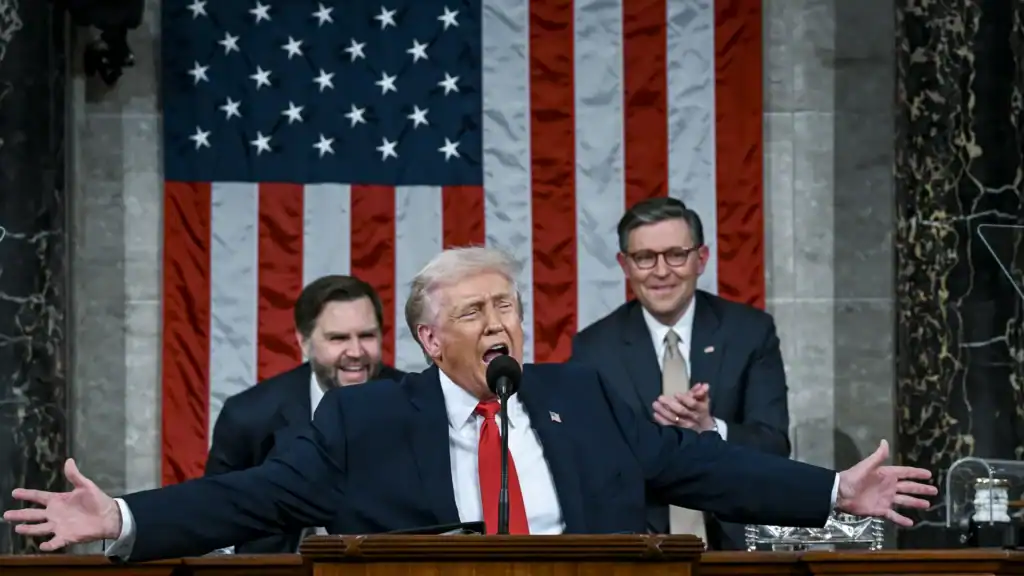
Dozens of guests that House Republicans brought to President Donald Trump’s State of the Union address represented the GOP’s top agenda items, namely small businesses, workers, farmers, law enforcement officers, veterans, health care workers, and more, a Washington Reporter analysis found.
The GOP’s guests stood in contrast to some brought by their Democratic counterparts. Rep. Seth Moulton (D., Mass.), for example, invited an illegal immigrant as his guest; Moulton’s guest, “is referenced in two police reports that Massachusetts authorities have declined to release, citing exemptions involving ‘sexual assault and juveniles,’” as Fox News reported.
Republicans, on the other hand, brought guests who spotlighted their policy goals.
Heath Sykes, for example, is a server who was invited by Majority Leader Steve Scalise (R., La.). Sykes, Scalise noted, “no longer has to pay tax on tips. And he gets to celebrate what that means for having more money in his pocket, being able to do more for his family.”
That’s exactly the type of message that Republicans, under the stewardship of House GOP Conference Chair Lisa McClain (R., Mich.), wanted to showcase.
“Our mission was simple: put a human face to the policies that are Making America Great Again,” McClain explained. “From No Tax on Tips and No Tax on Overtime to the Small Business Deduction and Working Families Tax Cuts, these aren’t just statistics; they are massive wins for the forgotten men and women of this country. I am incredibly proud of our Conference for bringing these Americans to the Capitol to not only witness the incredible comeback of our nation under President Trump’s leadership, but to be the leading example of how these policies are benefiting them, their families, and communities.”
The guests of senior and freshmen lawmakers alike helped make Republicans’ points for them. Doug Darling, a farmer in Monroe County, Michigan, was brought to the speech by Rep. Tim Walberg (R., Mich.), the chair of the House’s Committee on Education and Workforce. Darling explained that “the Working Families Tax Cuts are making a real, day‑to‑day difference for farmers, allowing us to reinvest in our operations…[Trump’s] policies are providing families like mine with certainty so we can keep our multi-generation farm alive.”
Similarly, freshman Rep. Rob Bresnahan (R., Pa.) brought Lisa Chervanka, a nurse of 30 years, to the speech. Chervanka said that she is “incredibly grateful for Rep. Bresnahan and his work to keep our hospital open, as well as everything he has done in Washington to advocate for working families like mine…keeping our doors open means our patients get the care they need, and people like me get to keep doing the work we love for our community.”
Bresnahan’s fellow Pennsylvanian, Rep. Scott Perry (R., Pa.), brought truck driver Edel Santana to the speech. Perry explained that Santana’s “business was greatly and negatively impacted by poor decisions from previous administrations…He reached out to me recently to express his thanks for the hard work that President Trump and I, and Republicans in Congress spent getting the Working Families Tax Cut passed, and how it’s been especially impactful with meaningful relief to small business owners facing burdensome regulations and rising costs, like Edel.”
Rep. Ryan Mackenzie (R., Pa.), like Bresnahan, flipped a Democrat-held House seat in 2024, and his guest, Head Start educator Sarah Arndt, thanked the lawmaker for “helping to highlight this critical service, and for everything that he’s doing in Congress to support working families.”
Another small business owner, Kristin Chorne, was invited by Rep. Julie Fedorchak (R., N.D.). Chorne is the owner of the Gratitude Spa and Salon, and she said that “it is a once in a lifetime privilege to sit in the House chamber and represent the hardworking spa and salon professionals, as well as all tipped workers and individuals working over-time across our state…The no tax on tips is a game changer for my team at Gratitude Spa and Salon.”
McClain, for her part, followed through on her advice to her colleagues and brought Ben Hockenberry, a veteran and a small business owner, to the speech. Hockenberry noted that “the last few years have been about working harder than ever just to stay ahead.” But, he added, “thanks to the Working Families Tax Cuts, my business finally has breathing room. The 23 percent small business deduction will allow me to invest back into my company…this is also going to help grow other small businesses that will be the landing spot for the vets I work with. This isn’t just about my business, it’s also about my family. My three young kids. The expanded Child Tax Credit means more stability…And with the new Trump Accounts, my children will have a real financial foundation as they grow up.”
The pro-business policies that the GOP passed were a focus of Dean Dally, the Chairman of Blaine Brothers, who was invited by Majority Whip Tom Emmer (R., Minn.).
“Blaine Brothers is a family-owned business that services the transportation industry, with just over 400 coworkers within our organization,” Dally said. “Thanks to the new tax law, our business is benefiting from lower taxes, less regulations, and 100% immediate full expensing.”
Another business leader is Jeff Ball, the CEO of the Orange County Business Council, who was a guest of Rep. Young Kim (R., Calif.). Ball celebrated the “many great accomplishments that we’ve seen in the first year of this…second Trump administration. For business, the key is stability. And many of the things that he has brought thanks to your leadership such as the Big Beautiful Bill, the SALT passage, it all helps to create the stability that we need in our markets. That of course is important for business.”
One guest, Sherman County Commissioner Joe Dabulskis, doubles as a wheat farmer. Dabulskis, who was Rep. Cliff Bentz’s (R., Ore.), guest, first read Trump’s Art of the Deal in 1988 while he was training at Fort Knox. He said that since then, “it was clear to me that President Trump was a results-driven leader who understood how to get things done. As president, that focus has shown up in important policies that matter to Oregon communities like my own.”
Another small business owner, Billy Walkowiak, was able to “speak to how the Working Families Tax Cuts are making life more affordable for small business owners and hardworking families,” Rep. Tim Moore (R., N.C.), who invited him noted.
Chuck Bills, the president and CEO of Ohio Logistics, was brought by Rep. Bob Latta (R., Ohio), and he said that the Trump administration has benefitted families, businesses, and communities across Ohio and America.
Rep. Mike Kennedy’s (R., Utah) guest said that he appreciates the Trump administration’s “pro-business” outlook. “That’s what matters to me, focusing on putting more take-home pay back into the pockets of everyday Americans.”
Likewise Jim Greene, the Chairman of WG&R Furniture Company, who was Rep. Tony Wied’s (R., Wis.) guest, noted that “we are very dependent on people having money in their pockets and this tax season so far has been the best sales season of my 30-year career. We’re up 22 percent over last year, which means people have money in their pockets.”
Another guest, Alex Wilson, is the co-founder and COO of Ridgenet Network Group. Wilson, Rep. Hal Rogers’s (R., Ky.) guest, said that he has “seen firsthand how President Trump’s administration has made small businesses a top priority…President Trump has enacted policies that reopened the economic pipeline and strengthened access to capital for entrepreneurs across the country…helping businesses like mine grow with confidence. Because of that access to capital and pro-growth policies, we’ve been able to hire more employees, invest in critical equipment, and expand our facilities to better serve both our clients and our team.”
A trio of guests, brought by Reps. Juan Ciscomani (R., Ariz.), Adrian Smith (R., Neb.), and Michelle Fischbach (R., Minn.) helped Republicans showcase the importance of farmers and ranchers. Ben Menges, a fifth-generation rancher and President of Graham County Farm Bureau, was brought by Ciscomani. Menges said that “it is refreshing to know Congressman Ciscomani has worked on behalf of those who produce our food and fiber. He contributed lines to the One Big Beautiful Bill for cattle ranchers who have suffered cattle losses as the result of the presence of federally-protected Mexican Gray Wolf.”
David Briggs, the CEO of Sustainable Beef, was brought by Smith, and he noted that “we have 1,000 employees working at our plant in North Platte. Last year we had zero and also we’re at capacity today at 1,500 heads per day. So very happy with the success. Also happy that the support our workers have through the tax bill to actually reduce their tax liability due to no tax on overtime.”
Another veteran farmer, Dan Glessing, was brought by Fischbach, and he said that “it is important that agricultural voices are represented in conversations about our country’s future.”
While business owners were a clear priority for Republicans to highlight, so too were health care workers. Rep. Mike Lawler (R., N.Y.) was at the forefront of that, bringing Jennifer Shannon, the Director of Nursing for Critical Care at Montefiore Nyack Hospital, as his guest. Lawler scored a two-for-one by also bringing along police captain Mike Shannon. Lawler noted that the couple “represent[s] the very best of our district, hardworking public servants who give back every day.”
“Like so many New York families, they’re balancing demanding jobs and an affordability crisis,” Lawler added. “Their desire to serve, thrive, and stay in New York is why my top priority remains lowering the cost of living.”
Other lawmakers who highlighted health care workers and advocates included Reps. Gary Palmer (R., Ala.), John Moolenaar (R., Mich.), Morgan Griffith (R., Va.), and French Hill (R., Ark.).
Palmer brought along Cynthia Fisher, the founder of PatientRightsAdvocate.org. Fisher said that Trump’s “Great American Health Plan [] to deliver maximum price transparency for the American people [and] to have prices upfront so that they can benefit from competition and choice in their medical services across the spectrum” is an important policy. “It’s a very exciting time because the House has done a major move,” Fisher added.
Moolenaar brought Doctor Jeff Smith as his guest, and Smith said that “policies [that Moolenaar] and President Trump support, like the Rural Health Transformation Program will benefit my patients and improve access to life-saving care for rural residents seen at medical offices in places like Alma and Clare.”
Griffith brought Marcus Stone, a rural health advocate, to the speech, and Stone — the CEO of Connect Health + Wellness — observed that “as one of Virginia’s Community Health Centers, we are proud to be part of a statewide network committed to ensuring every family, regardless of income, background, or geography, has access to high‑quality, affordable primary care.”
Hill’s guest, Lowry Barnes, is the Chancellor of the University of Arkansas for Medical Sciences, and Hill said that “Barnes understands firsthand how vital UAMS is to training physicians, driving medical research, and ensuring families around our state, especially in rural communities, have access to high-quality care close to home.”
Finally, Republicans like Reps. Monica De La Cruz (R., Texas) and Keith Self (R., Texas) helped spotlight the importance of veterans.
De La Cruz brought veteran John Herring; she noted that for him, the “legislative wins of the past year are more than just headlines. They are a reality.”
“On his own land, he has seen a tangible difference,” she explained. “Secure border policies have significantly reduced trespassing. At home, the impact is just as clear — the historic tax relief we delivered provided his wife’s small business the critical breathing room needed to thrive.”
Finally, Self brought Kevin Daughtery, a veteran, paramedic, and small business owner.
Daughtery spoke about how the GOP’s agenda has directly helped his employees.
“Hourly employees that receive tips, no tax on tips, no tax on overtime. How can that be a divisive thing?” he asked. “These are all wonderful, common-sense things that have been implemented…My employees are seeing benefits. They’re going to see even more whenever they get their tax returns back shortly.”