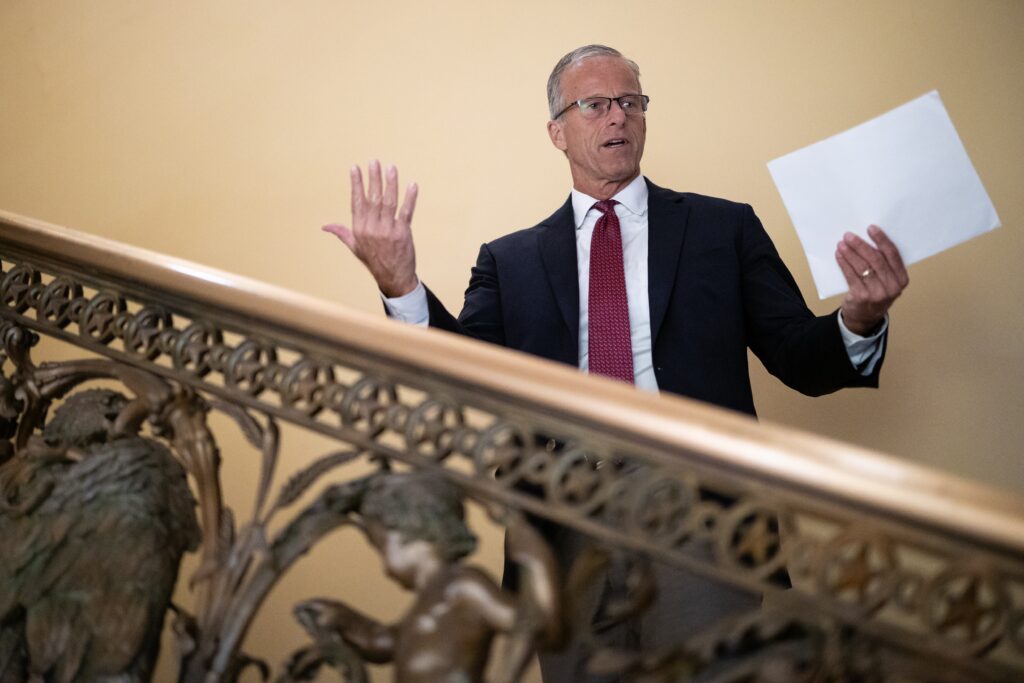
Ahead of the election, incumbent Senator Democrats in tough races took a tough vote that could cause problems for them at home in November. Senate Republicans, led by Senate Majority Leader John Thune (R., S.D.), forced a full floor vote on the bipartisan Stop Insider Trading Act, which cracks down on congressional stock trading and implements commonsense voter ID requirements.
The bill, which passed the House on a broad, 232-198, bipartisan vote, was rejected by the Senate, even though many Senate Democrats have claimed to support its twin popular provisions as early as this year in some cases.
Sen. Pete Ricketts (R., Neb.), the main lead on the bill, made it clear what its purposes are: “This bill would ban congressional insider trading,” Ricketts explained. “We need to pass this commonsense legislation and restore integrity to Congress.”
While Democrats like Sen. Mark Kelly (D., Ariz.) said this month that “banning members of Congress from trading stocks” would “rebuild trust in government,” he joined all of his colleagues in opposing Ricketts’s measure. “It’s the clearest way to prevent insider trading and make sure leaders are serving the people, not themselves,” Kelly, a potential 2028 presidential candidate, added.
Both Sens. Jon Ossoff (D., Ga.) and Chris Van Hollen (D., Md.), Kelly’s fellow potential 2028 contenders, have similarly backed banning congressional stock trading, before voting against Ricketts’s provision. “Members of Congress have a responsibility to act in the best interest of the American people — not their personal financial portfolios,” Van Hollen said. “By removing any financial conflicts of interest and increasing transparency, Congress can better serve our constituents and uphold the public trust.”
“Members of Congress should not be playing the stock market while we make federal policy and have extraordinary access to confidential information,” Ossoff said.
Both Sen. Kirsten Gillibrand (D., N.Y.), the current chair of the Democratic Senatorial Campaign Committee (DSCC), and Sen. Tammy Baldwin (D., Wis.) had expressed support for banning stock trading in the past as well, before voting against the bill.
“The American people need to know that their elected leaders are putting their constituents’ interests — not their own financial interests — first,” Gillibrand said in 2022. “That is the job we were sent to Washington to do.”
Baldwin had added in the past that “elected representatives should not be using confidential information to trade stocks and line their own pockets. It’s just wrong. Our constituents send us to Congress to serve them, not our own financial interest.”
Ricketts’s bill also includes a measure that would require voter ID in federal elections; recent polls show that majorities of Americans, and of Democrats, broadly support such a provision. As recently as March 2026, Senate Minority Leader Chuck Schumer (D., N.Y.) claimed that “Democrats support voter ID.” However, Schumer called the provision a “poison pill” this time around.
Other Democratic senators who have backed voter ID provisions in the past include ambitious politicians like Sens. Ruben Gallego (D., Ariz.), Raphael Warnock (D., Ga.), Cory Booker (D., N.J.), and Elissa Slotkin (D., Mich.), as well as longtime lawmakers like Sens. Mark Warner (D., Va.), Tim Kaine (D., Va.), Jack Reed (D., R.I.), Chris Coons (D., Del.), and Sheldon Whitehouse (D., R.I.).