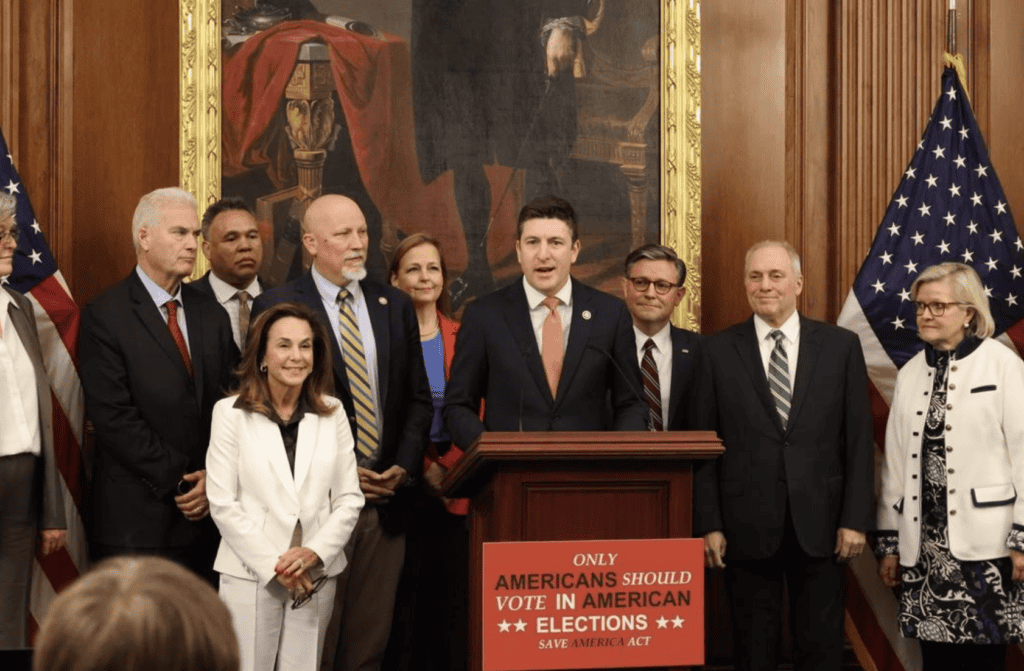
The Committee on House Administration continued its push for election integrity with a recent hearing on “How to Restore Trust and Integrity in Federal Elections.”
The committee, led by Rep. Bryan Steil (R., Wis.), invited Wyoming Secretary of State Chuck Gray, Michigan State Rep. Ann Bollin, Judicial Watch’s Russ Nobile, and Advance Elections’s Karen Brinson Bell to serve as witnesses for the hearing.
Republicans’ agenda was implementing citizenship verification, which has been a priority of Gray’s for years, as he told the Washington Reporter in an interview following the hearing.
During the hearing, Steil and Gray went back and forth about what Steil described as “the fearmongering [from Democrats] that we’re hearing today.”
Under Gray’s leadership, Wyoming implemented a “documentary proof of citizenship requirement” over the objections of his state’s Republican governor. And in 2025, the state had its first election with the requirements. “We had a very clean bond election last year,” Gray said. “It was very clean, no issues, no complaints. It was just very well run and people were excited that we implemented this commonsense measure.”
“From a disenfranchisement standpoint, what you ended up with was a good, solid, clean election,” Steil told Gray in response. Following the hearing, Gray said the event was “another example of how radical the Democrats have gotten. They were just out of control. They really would not allow questions to be answered, which is disappointing, but not surprising, but disappointing, but I still think the conversation was important…It was great to engage in the back and forth with the radical left and show just how radical they’ve gotten.”
Rep. Norma Torres (D., Calif.) mispronounced Steil’s last name as “steal” during her questioning, and Rep. Terri Sewell (D., Ala.) said that there is no evidence of widespread voter fraud.
On the flip side, Gray said that he “really appreciated the opportunity from the House Admin Committee, they’ve been great to work with over the years. Chairman Steil is just an incredible person.”
Another priority of Steil and his colleagues was to debunk the “Jim Crow 2.0” myth that Democrats, ranging from Senate Minority Leader Chuck Schumer (D., N.Y.) to President Joe Biden have invoked when trying to undermine voter ID requirements.
“Having been a child during the Jim Crow era, I can assure you that the Make Elections Great Again bill is not Jim Crow,” Rep. Morgan Griffith (R., Va.), said during the hearing. “But let’s talk about Jim Crow in Virginia. In 1902, the Virginia Constitution was rewritten by Democrats. They didn’t take it to the people to vote on it. They just did. It assembled in Richmond. And the concept was, everybody will recall, to disenfranchise African Americans. But what people don’t recall is it was also to disenfranchise poor white Republican voters in the western part of the state, the very part of the state that I now have the great pleasure and am proud to represent.”
Griffith added that “all American citizens should have the right to vote. I do, however, disagree that the desire to have all Americans being able to vote has been bipartisan in the past.”
The efforts by Virginia Democrats to disenfranchise white and black voters in the state, Griffith continued, was done “because the Republican populist coalition was challenging the dominant Democrats in the state, and the Democrat Party did that, led by E. Carter Glass of Lynchburg, Virginia. And it would take some time to break that coalition up.” It took “the federal government interfering,” Griffith continued, “in the states and telling them you can’t continue to run your elections with poll taxes, with complex, subjective registration processes and having an ‘understanding clause,’ making sure that people understood what was going on in the election that broke that up in the mid 60s.”
“I assure you,” Griffith told Steil, “your bill is not Jim Crow. I’ve got to tell you, it was an interesting time to live in, and I’m glad it’s passed. And what we want to do is to make sure American citizens can vote.”
Lawmakers on the panel also asked the witnesses what steps they believe that Democratic-run states like Michigan and Illinois should take “to maintain clean and accurate voter rolls.” This has long been a priority for Rep. Mary Miller (R., Ill.) in particular.
“We need to reset these universal base standards,” Bollin told Miller. “Number one. Number two is I do think that the post-election audits would help in this regard with the list maintenance. And I think that we should be working in concert with the Michigan legislature at the federal level as well, to make sure that these records are turned over. And the responsibility, you know, in Michigan, we have very decentralized elections…And if there is funding, I think the funding should be tied to compliance…These are not partisan reforms. We should all be on board trying to allow people to vote.”
Finally, Rep. Laurel Lee (R., Fla.) addressed the “connection between timely election results reporting and voter confidence.” She posed that question to Nobile who, she said, explained in his written testimony, said “that election ballot deadlines past Election Day…violate federal law.”
“It’s not just us,” Nobile said. “The Court of Appeals for the Fifth Circuit said that. We’ve been litigating this for five years. When Congress enacted the first election integrity provision in the history of Article II, it enacted Election Day. And in all times, Election Day ended on Election Day.”
“But in the last 15 years,” Nobile continued, “there’s been this activist effort to get state legislators to extend ballot receipt deadlines in a way that, frankly, makes elections disorderly and unreliable and suspicious. And it’s radically reduced public trust in elections. And for the last 15 years, we’ve been suffering through two weeks of post-election uncertainty because people aren’t just getting their ballots returned in time. And frankly, the denominator of ballots outstanding continues to increase, which when people go to bed at night, they need to know how many ballots are outstanding. They need to know how many ballots are left to be counted, and they don’t need to wake up three days later and find out there’s an additional 150,000 ballots coming in.”
“It’s just, frankly, radically undermining elections,” Nobile said.