

Ted Cruz’s reconciliation wins, how the media is aiding Senate Democrats, Congress takes on China, and more!
Gavin Newsom wants to further gerrymander California, James Lankford is building grassroots support for OBBB, and more

July 29, 2025
Let’s dive in.
INTERVIEW: Sen. Ted Cruz discusses his landmark expansion of federal school choice legislation and key reconciliation achievements
Heard on the Hill
MOST INFLUENTIAL: Jason Stverak joins the Reporter’s list for his work advocating for credit unions
EXCLUSIVE: How Georgia media is running ads for Jon Ossoff
SCOOP: Gavin Newsom plots to gerrymander up to six House Republicans out of office
SCOOP: Sen. James Lankford showcases grassroots support for the One Big Beautiful Bill
SCOOP: Congressional hearing focuses on China's abuses of America's legal system
OPINIONATED: Connie Partoyan on new ways to lower health care costs and David Cook on how publicly available clues can avert the next Lone Wolf attack
A message from our sponsor.

We must protect American leadership in the life sciences and avoid damaging drug pricing policies. Meanwhile, China is making significant strides in clinical trials, drug approvals and new breakthroughs. Now is the time to strengthen American innovation, not hinder it. Learn more.
If you have a tip you would like to anonymously submit, please use our tip form — your anonymity is guaranteed!
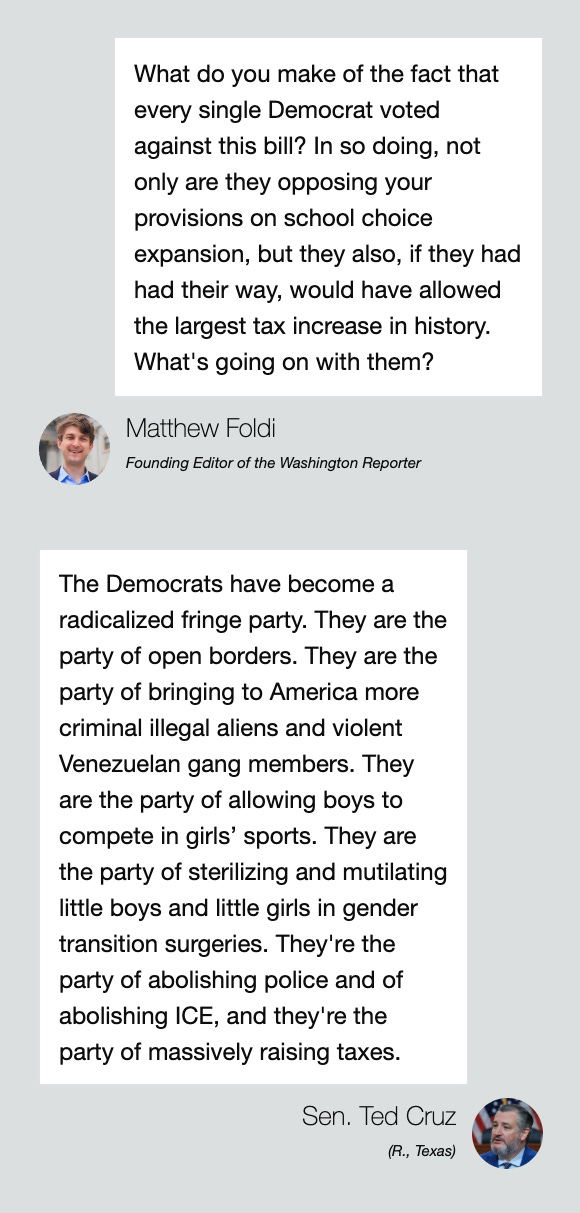
INTERVIEW: Sen. Ted Cruz discusses his landmark expansion of federal school choice legislation and key reconciliation achievements
by Matthew Foldi
THE LOWDOWN:
Sen. Ted Cruz (R., Texas), a known poker star, walked away as one of the biggest winners of the One Big Beautiful Bill (OBBB) with a series of policy wins on issues important to him and the Texans he serves.
Cruz told the Washington Reporter that one topic, in particular, stands out to the Texan: school choice, which he said is “the civil rights issue of the 21st century.” Thanks to Cruz, families and children across America can use expanded 529 college savings plans and a federal tax credit to cover K-12 education.
The Texas Republican has spent years working on expanding 529 savings accounts, dating back to at least the 2017 Trump tax cuts, which “included an amendment I authored to expand college 529 savings plans to include K-12 education,” he explained.
Cruz said that the Democrats, “by shutting down schools, hurt children across America, but in particular, they hurt low-income kids. The Texas Republican said the Democrats also “hurt African-American kids, hurt Hispanic kids, and not a single Democrat cared, because all that matters to them on this issue is millions and millions of dollars for the teachers union bosses.”
Sen. Ted Cruz (R., Texas) was one of the biggest winners of the One Big, Beautiful Bill. The veteran lawmaker scored a series of policy wins on issues important to both him specifically and to Texans more broadly in the bill’s final version.
“Without exaggeration, there are more conservative victories in this One Big, Beautiful Bill than in any piece of legislation that has ever passed into law in the history of our country,” Cruz told the Washington Reporter in an interview.
But one topic, in particular, stands out to the Texan: school choice, which he said is “the civil rights issue of the 21st century.”
Thanks to Cruz, families and children across America can use expanded 529 college savings plans and a federal tax credit to cover K-12 education.
“In this bill, we passed the single most far-reaching federal school choice legislation that has ever been enacted,” he said. “One provision, which I wrote, creates a federal tax credit for every taxpayer in America. You can give up to $1,700 a year to a scholarship-granting organization in the states, and you get a dollar-for-dollar tax credit on your federal income taxes.”
Cruz said that provision “will produce billions and billions of dollars of scholarship money in the states for K-12 education, and it is transformational federal school choice legislation.”
“On top of that, a different provision that I wrote and that passed into law in this bill, expands college 529 savings accounts,” Cruz said.
Heard on the Hill
DEMOCRAT DECEPTICON: The Senate Leadership Fund (SLF) welcomed former Gov. Roy Cooper (D., N.C.) into the open Senate race in North Carolina with a total takeover of X’s (former Twitter) banner ad space, pitching the group’s new microsite, RadicalRoy.org, which describes the Democrat as a “radical liberal in disguise.” Republicans are coalescing behind Michael Whatley, the current RNC chairman, as their pick.
NEW DIGS: Sens. Tim Scott (R., S.C.) and Elizabeth Warren (D., Mass.) are working on the bipartisan ROAD to Housing Act of 2025, which is the first bipartisan housing markup in over a decade. The bill aims to both expand housing supply and improve housing affordability. Sen. Katie Britt (R., Ala.), a supporter of the bill, noted that “homeownership is a hallmark of the American Dream. The ROAD to Housing Act of 2025 is a great first step to making that dream a reality.”
EAGLE EYED: American Eagle’s embrace of Sydney Sweeney, the actress who comes from a Republican family, in its latest ad campaign has many wondering — and hoping — that another blow has been struck against woke capital.
FAFO: Sen. Bernie Moreno (R., Ohio) escalated his feud with “the do-nothing, extreme liberal Mayor” of Cincinnati, Aftab Pureval, in the wake of high-profile attacks on the city streets. Pureval “won’t lift a finger to protect his streets and restore order, so it’s time to bring in professionals who will,” Moreno said.
SPOTTED: While Canada might not be the 51st state any time soon, Canada’s controversial former prime minister, Justin Trudeau, was seen out with America’s Katy Perry.
FACT CHECK: How historic is the obstruction from Senate Democrats? 0 percent of President Donald Trump’s civilian nominees have been confirmed by either a voice vote or via unanimous consent this term. During President Joe Biden’s only term, 57 percent of his civilian nominees were confirmed by either voice vote or via unanimous consent, according to Ryan Wrasse, Sen. John Thune’s (R., S.D.) communications director.
A message from our sponsor.
We must protect American leadership in the life sciences and avoid damaging drug pricing policies. Meanwhile, China is making significant strides in clinical trials, drug approvals and new breakthroughs. Now is the time to strengthen American innovation, not hinder it. Learn more.
MOST INFLUENTIAL: Jason Stverak joins the Reporter’s list for his work advocating for credit unions
by the Washington Reporter Editorial Board
Jason Stverak, Chief Advocacy Officer of the Defense Credit Union Council (DCUC), earns his place among D.C.’s most influential advocates through his deep Capitol Hill connections, savvy media presence, and relentless fight to protect all credit unions.
With a track record as a top lobbyist and strong relationships with lawmakers, Stverak is leading the charge against the Credit Card Competition Act, which threatens to undermine credit unions’ ability to serve their 142 million members with affordable financial services.
Our Hill sources say, “DCUC punches above its weight and a big reason is because of Jason. He understands the intersection of politics and policy, he’s extremely hardworking, and he can run a campaign.”
His strategic leadership positions him as a pivotal voice in the potential upcoming battle to preserve credit unions’ tax-exempt status during a second reconciliation, ensuring these institutions can continue supporting service members and veterans with unmatched dedication.
EXCLUSIVE: How Georgia media is running ads for Jon Ossoff
by Matthew Foldi
THE LOWDOWN:
Sen. Jon Ossoff (D., Ga.) is one of the Democratic Party’s top fundraisers, but Georgia media is running what several strategists described as in-kind contributions to his 2026 campaign.
The Atlanta Journal-Constitution is currently running Facebook ads, according to the Facebook Ad Library, that read like press releases for the vulnerable freshman Democrat.
Chan Jones, the chairman of the 8th District GOP, told the Reporter that “it is beyond shameful that the Atlanta paper is paying to promote what effectively amount to pro-Jon Ossoff campaign advertisements on social media.”
Both Reps. Buddy Carter (R., Ga.) and Mike Collins (R., Ga.) are sitting Republican officeholders who are challenging Ossoff in next year’s election. The AJC is currently running zero ads featuring either of their names, a search by the Reporter revealed.
Sen. Jon Ossoff (D., Ga.) is one of the Democratic Party’s top fundraisers, but Georgia media is running what several strategists described as in-kind contributions to his 2026 campaign.
The Atlanta Journal-Constitution is currently running Facebook ads, according to the Facebook Ad Library, that read like press releases for the vulnerable freshman Democrat.
One active AJC ad simply reads, “U.S. Sen. Jon Ossoff, D-Ga., asked Trump administration officials pointed budget questions at two different congressional hearings this week.”
The ad links to an AJC story called “Back from paternity leave, Ossoff takes on Trump administration officials.” The ad has been live for almost a month.
“It is fucking crazy,” a Georgia Republican unaligned with any Senate campaign told the Washington Reporter. “They are so in the tank for him.”
“Half their stories are just ripping his press releases verbatim and putting the AJC masthead on it,” the Georgia Republican said.
SCOOP: Gavin Newsom plots to gerrymander up to six House Republicans out of office
by Matthew Foldi
THE LOWDOWN:
Gov. Gavin Newsom (D., Calif.) is under fire for working to “disenfranchise California voters and overturn [the state’s] independent redistricting commission.”
Nevertheless, Newsom was joined by House Democrats from out of state as he mulls what experts explain could be a complicated push to draw as many as six House Republicans out of office in next year’s midterms.
Newsom justified his plans in apocalyptic terms. “If we don’t put a stake into the heart of this administration, there may not be another election in 2028,” he said.
Amidst Newsom’s mulling, a group of civic groups in California wrote to Sacramento lawmakers of both parties to defend the state’s current map, which “enforces strict conflict-of-interest rules, ensures diverse and balanced representation, and mandates public input at every stage.”
Gov. Gavin Newsom (D., Calif.) is under fire for working to “disenfranchise California voters and overturn [the state’s] independent redistricting commission.”
Should Newsom proceed with his plan to force through a mid-decade gerrymander, he would need to circumvent his state’s Citizens Redistricting Commission, which the state’s Republican delegation noted has “the sole authority of drawing California’s congressional districts.”
Nevertheless, Newsom was joined by House Democrats from out of state as he mulls what experts explain could be a complicated push to draw as many as six House Republicans out of office in next year’s midterms.
Newsom justified his plans in apocalyptic terms.
“If we don’t put a stake into the heart of this administration, there may not be another election in 2028,” he said.
The 2028 election remains scheduled as planned. California Republicans explained that even under the current congressional maps, they are already drastically underrepresented.
“As it stands, Republicans only hold nine congressional seats out of 52 despite winning 38% of the vote statewide,” the Golden State GOP said.
The state’s current map is already viewed by many as being “Democrat-friendly.”
SCOOP: Sen. James Lankford showcases grassroots support for the One Big Beautiful Bill
by Matthew Foldi
THE LOWDOWN:
Sen. James Lankford (R., Okla.) is turning to the most powerful group in politics to make the case for the One Big, Beautiful Bill (OBBB) and its importance to farmers, seniors, law enforcement, and more: his constituents.
President Donald Trump carried all of Oklahoma’s 77 counties, so support for the president and his agenda is not a surprise. However, Democrats have extensively messaged against the OBBB since before its passage. In Oklahoma, that message is falling flat.
When it comes to seniors, Marilyn Olson from Bethany, Oklahoma, explained that “mature person[s]” will benefit from “the benefit of not being taxed, of being able to keep more of the Social Security that I paid into is essential, because many of us are using that for most of our living expenses, with the intention of not drawing down all of our reserves, our savings, for today, and yet there are expenses that come up.”
When it comes to protecting family farmers, one from Altus, Oklahoma, put it simply: “the Big Beautiful Bill is quite possibly one of the biggest capital infusions, possibly of my lifetime.”
Sen. James Lankford (R., Okla.) is turning to the most powerful group in politics to make the case for the One Big, Beautiful Bill (OBBB) and its importance to farmers, seniors, law enforcement, and more: his constituents.
President Donald Trump carried all of Oklahoma’s 77 counties, so support for the president and his agenda is not a surprise. However, Democrats have extensively messaged against the OBBB since before its passage.
In Oklahoma, that message is falling flat.
“The One Big Beautiful Bill is delivering real relief to hardworking Oklahomans. Marilyn, a senior in Bethany, can now keep more of her Social Security benefits. Todd, the police chief in Moore, will no longer pay taxes on his overtime, putting more money back in his pocket. Rheanna, a server from Yukon, gets to keep a bigger share of her hard-earned tips to support her family. And Keeff, a fourth-generation farmer from Altus, sees stronger protections that help Oklahoma’s farmers and ranchers thrive. This law puts Oklahoma families first, and it’s making a big difference.”
Todd Gibson, the Police Chief in Moore, Oklahoma, will help with “recruiting and retention for a career field that’s really taken some hits over the last several years in getting quality people to step up and do the job.”
“Financially,” Gibson explained, “it’s gonna make a big impact because police officers do work a lot of overtime, and any bit of money that a police officer can pour back into their family with, into their home with, is a positive thing.”
SCOOP: Congressional hearing focuses on China's abuses of America's legal system
by the Washington Reporter
THE LOWDOWN:
A Judiciary Committee hearing helmed by Rep. Darrell Issa (R., Calif.) exposed how vulnerable America’s legal system is to manipulation, distortion, and subversion from the Chinese Communist Party.
Emily de La Bruyère, one of the witnesses, is a senior fellow at the Foundation for Defense of Democracies (FDD). During the hearing, she laid out how “Chinese abuse of the U.S. legal system takes offensive and defensive forms.”
China’s efforts, she noted, include “bids to shape U.S. policy as well as to impose costs on adversaries in U.S. courts.”
China’s massive investment in this lawfare puts American companies at a disadvantage, even when they are right on the legal merits. “This entire system benefits from Chinese government resourcing,” de La Bruyère said.
A Judiciary Committee hearing helmed by Rep. Darrell Issa (R., Calif.) exposed how vulnerable America’s legal system is to manipulation, distortion, and subversion from the Chinese Communist Party.
At a hearing on foreign abuse of U.S. courts, Issa honed in directly on China, a longtime priority for one of the GOP’s leading voices on foreign policy.
“Today, there is no greater threat to America’s economy, national security, or research and development than the Chinese government’s quest to achieve superiority over our country by any means necessary – both legal and illegal,” Issa told the Washington Reporter.
“To put it simply: China is manipulating our courts, rules of litigation, and even stealing what is ours while at the same time availing themselves of the legal and regulatory protections that America created to keep faith with the rule of law,” Issa continued.
“This will not stand,” he added.
Emily de La Bruyère, one of the witnesses, is a senior fellow at the Foundation for Defense of Democracies (FDD). During the hearing, she laid out how “Chinese abuse of the U.S. legal system takes offensive and defensive forms.”
China’s efforts, she noted, include “bids to shape U.S. policy as well as to impose costs on adversaries in U.S. courts.”
OPINIONATED
Op-Ed: Connie Partoyan: New ways to lower health care costs
by Connie Partoyan
For millions of Americans, going to a hospital provides a shocking reminder that high healthcare costs remain a constant strain on their family budget. According to a recent Pew Research poll, 67 percent of the country views healthcare affordability as a “very big problem.”
Last week, the Centers for Medicare & Medicaid Services proposed a new rule for site neutrality on drug administration, a positive step toward lowering healthcare costs for Medicare patients and an indication that changing the way hospitals conduct business is at the forefront of the current administration's agenda.
But now is the time for Congress and the Administration to be bold and go further in alleviating financial stress on an American public still reeling from years of record inflation. A comprehensive, site-neutral payment policy — backed by bipartisan support in Congress — can be the catalyst for real reform and savings.
At its core, site-neutral payment simply means that Medicare pays the same amount for the same service, regardless of whether it takes place in a hospital outpatient department or a doctor’s office. This sounds obvious. Why should a basic medical service cost hundreds — or sometimes thousands — more simply because it's performed under a hospital’s roof instead of an independent clinic? Unfortunately, under the current system, Medicare reimburses hospitals at significantly higher rates for routine services like lab tests, imaging, and check-ups. These price differences have nothing to do with quality or complexity; they are the product of a billing system riddled with distortions and loopholes.
This unequal payment system is fueling a dangerous trend of consolidation in the healthcare industry. Hospitals have strong financial incentives to acquire independent physician practices, convert them into "hospital outpatient departments," and charge higher facility fees for the same services. A new National Bureau of Economic Research study found the share of physician practices acquired by hospitals rose by 72 percent between 2008 and 2016.
Op-Ed: David Cook: How publicly available clues could thwart the next lone actor terror attack
by David Cook
On 21 May 2025, a 31-year-old Chicago native Elias Rodriguez gunned down two Israeli Embassy employees outside Washington’s Capital Jewish Museum. Police pinned him to the pavement as he shouted, “Free, free Palestine!” — words that echoed months of online essays in which he praised “direct action” against “Zionist targets.”
Eleven days later, on a sun-soaked pedestrian mall in Boulder, Colorado, Mohamed Sabry Soliman ignited two Molotov cocktails and a backpack-mounted flamethrower, burning elderly demonstrators who had gathered to demand the release of Israeli hostages. Witnesses heard the same slogan — “Free Palestine!” — while investigators quickly uncovered a year-long YouTube binge on bomb-making tutorials and a Telegram archive filled with fantasies of setting “Zionists” alight.
These atrocities are horrifying, and there are indicators beforehand to help law enforcement and security professionals to flex resources for known events like the one in Boulder. In each case the perpetrators littered the internet with what counter-terrorism professionals call “leakage” — public signals of grievance, capability building and intent. Rodriguez’s Medium essays migrated from anti-war polemics to martyrs-in-waiting rhetoric; Soliman left a viewing record of how-to videos, bulk purchases of glass bottles, and rants on fringe chat channels. While some of this information requires compiling different forms of data and information, none of it required a warrant to access.
The pair joined a dismal roster of recent domestic terrorists who announced themselves online. In July 2024, Thomas Matthew Crooks searched Google for rally venues and posted the ominous Steam message “July 13 will be my premiere, watch as it unfolds” before firing at a campaign appearance for then-candidate Donald Trump in Butler, Pennsylvania. And on 13 April 2025, Cody Balmer scaled a fence at the Pennsylvania Governor’s residence and hurled petrol bombs while Gov. Josh Shapiro’s (D., Pa.) family slept inside — after years of social media posts featuring Molotov-cocktail embroidery and violent anti-government screeds.
