

SCOOP: Trump administration unveils "Super Bowl" of American energy dominance
Secretary Doug Burgum, EPA Administrator Lee Zeldin, and Undersecretary of Energy Wells Griffith rolled out the latest energy policies from the Trump administration to great fanfare.

The Trump administration’s latest push for American energy independence is akin to the “Super Bowl” for coal, according to Rep. Julie Fedorchak (R., N.D.), one of the House’s top energy experts.
Trump’s Department of Interior (DOI) partnered with the Environmental Protection Agency (EPA) and the Department of Energy (DOE) to open up 13.1 million acres of federal land for coal leasing; that milestone is more than just a Super Bowl for the energy industry — it is triple the benchmarks set by the landmark One Big Beautiful Bill Act.
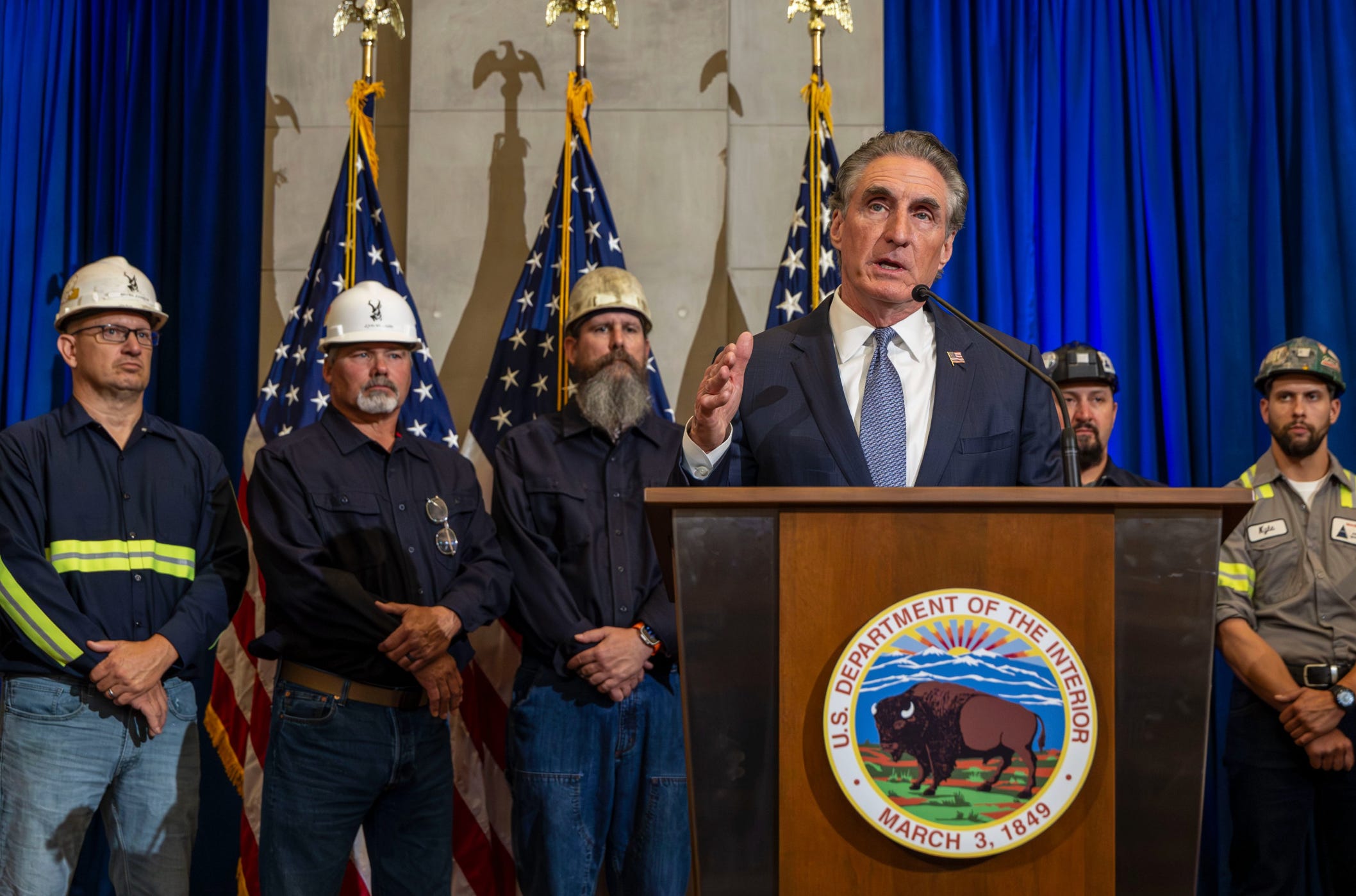
The Washington Reporter was on scene for the historic announcement, where Secretary Doug Burgum was joined by EPA Administrator Lee Zeldin and DOE Undersecretary Wells Griffith signed memorandums alongside Fedorchak, Sens. John Barrasso (R., Wyo.) and Cynthia Lummis (R., Wyo.), and Gov. Mark Gordon (R., Wyo.). The policymakers were flanked by a line of coal miners; Lummis reassured the miners that, under the Trump administration, that they’re “not just eye candy.”
The stakes, as Burgum laid out, are incredibly high. “This is as critical as any Manhattan Project we’ve ever worked on,” he said. Throughout his remarks, the well-coiffed secretary focused on “innovation, not regulation,” the importance of critical minerals, the need to increase ship-building at home, and why it is important to “drill baby drill,” “mine baby mine,” and “map baby map.”
From the DOE standpoint, Griffith stressed that coal is needed for America’s grid to be able to compete for the needs of both the present and the future.
And that sort of competition was front of mind for Zeldin, who once represented the Ryder Cup’s turf in Congress. While America narrowly lost the Ryder Cup, Zeldin stressed that other cups, like the energy dominance cup and the AI cup, matter far more.
Under President Donald Trump, Zeldin said that America is firmly where it needs to be in those competitions.
Energy experts told the Reporter that major moves like those announced by Burgum are a “strong step,” but “we need to think bigger.”
“America’s future lies not only in tapping traditional resources, but in building a circular economy that maximizes every ounce of value from what we already have,” Yechezkel Moskowitz, the founder of Curio LV, explained.
Moskowitz wants the Trump administration to focus on “treating coal, minerals, and byproducts as inputs for advanced manufacturing rather than just legacy fuels,” as well as “using call-for-credit mechanisms to prioritize critical materials for U.S. industry [and] recycling and repurposing nuclear waste into next-generation fuel and medical isotopes.”
“Pulling together all federal agencies under one national strategy that aligns energy, defense, and industrial policy,” Moskowitz added. “The NEDC was built to do this and empower them to do it on super drive. If we approach resources this way, we won’t just be competing — we’ll be manufacturing the future here at home.”
Moskowitz’s energy company, Curio LV, describes its work as focusing on the “Second Nuclear Era” and this has led to a focus on commercializing the case for a closed fuel cycle. Curio’s patented technology, NuCycle, takes spent nuclear fuel and recycles and repurposes it for new energy use. Curio’s vision under Moskowitz is to take waste from America’s existing nuclear infrastructure and facilities and to invest recycled resources to keep reactors online and running.
Curio Advisory Board Member Bonnie Glick has hailed President Trump’s deregulation agenda as critical for the energy economy. She said, “EPA Administrator Zeldin’s work to ensure we look at all energy sources, including clean coal and recycled nuclear waste, is vital to unleash American energy independence and grid resilience. The new energy future will depend on it.”