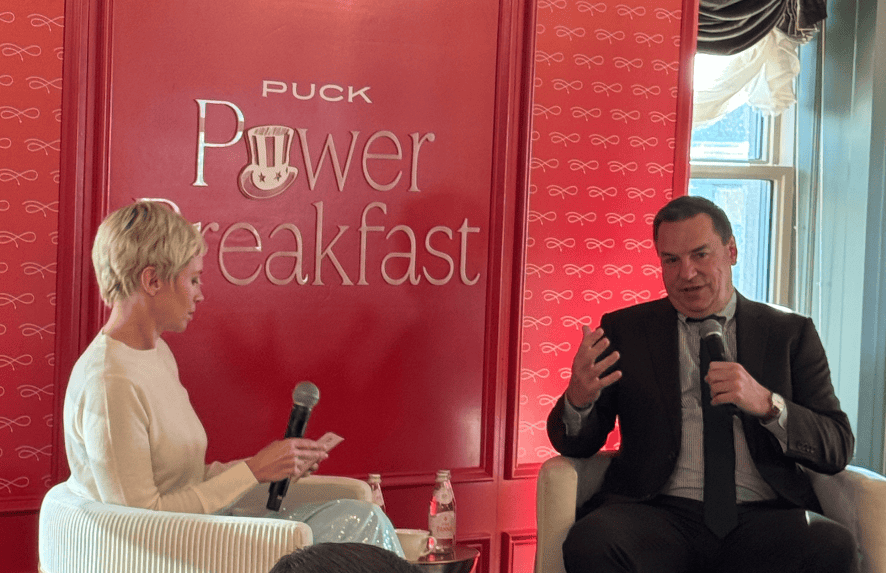
The chairs of the National Republican Congressional Committee (NRCC) and the Democratic Congressional Campaign Committee (DCCC) predict that their respective parties will control the House of Representatives after next year’s midterm elections.
“I’m confident we are going to win the House,” Rep. Richard Hudson (R., N.C.) said at the latest Puck Power Breakfast, moderated by Puck’s Leigh Ann Caldwell. Before the event, Hudson told the Washington Reporter that the Democrats’ messaging going into 2026 is disingenuous.
“Their argument is that Republicans need to fix what they broke,” he said. The Republican party, he lamented, is often judged by outcomes, whereas Democrats are judged by intentions.
Hudson predicted that Republicans would “hold the House” even if the economy doesn’t markedly improve. He cited President Donald Trump, who is a “net positive everywhere” as one of their top selling points; he “definitely” wants campaigning in swing districts, Hudson added.
“We’re going to defy history” in part because “we’ve got some of the best candidates we’ve ever had.” Hudson specifically singled out Kevin Lincoln, the former mayor of Stockton, as a candidate to watch. Lincoln “will upset Adam Gray” next year, Hudson predicted.
He also added that the Democrats’ “activist base is tearing their party apart.”
On the other hand, when asked if her organization would dedicate resources to helping Reps. Katherine Clark (D., Mass.) or Dan Goldman (D., N.Y.) against their primary opponents, DCCC Chair Suzan DelBene (D., Wash.) demured.
“We are always focused on the purple districts,” she said, specifically singling out vulnerable Democratic “frontliners.” While DelBene didn’t commit to sending resources to either Democrat, she said that Clark — the number two House Democrat — is “doing a great job.”
Hudson noted that while the party out of power in the White House historically has successful midterms, the NRCC is investing in a “record amount” of data to help fuel momentum for Republicans. That data will complement the twelve field offices the NRCC has across the country, as well as others it plans to open.
“We delivered almost the entire Trump agenda in the first 11 months,” he said. “Come April 15th, a lot of people are going to see more take home pay…[because of] Republican policies.”
Hudson acknowledged sky-high Democratic turnout, and said that “it’s voter contact now, it’s letting them know what policies we’re passing” in order to offset momentum for the other side.
“We’ll have a campaign plan, we’ll give it some cool name, and we’ll give it to the voters,” he said of his party’s plans for 2026.
“Donald Trump realizes this problem also,” Hudson said. Losing the House is “even more severe” from Trump’s standpoint than losing the Senate would be, because of the chamber’s majoritarian policies. The “Trump majority is dead” if Democrats win the House, he cautioned.
Hudson also discussed the ongoing nationwide redistricting wars, which he said Democrats started by gerrymandering states like Massachusetts, Illinois, and California, in contrast to how relatively well Republicans perform on the state level.
But, he conceded, “everybody’s got blood on their hands.” To that end, he said that he’d like for Gov. Ron DeSantis (R., Fla.) to proceed with mid-decade redistricting in Florida, although he added that “I’d love to see it not happen again.”
Much of it, he said, is up to the Supreme Court, which he’d like to have add “serious guardrails” to the redistricting process.
“Let’s stop doing this,” he said. “Let’s do redistricting once a decade.” He added that it’s up to Trump to decide if he wants to spend dollars primarying the Indiana state Senators who did not vote to gerrymander the state’s federal delegation. “The guy has raised $2 billion since the election, I’d love for him to spend some of that on the House,” he said.
Hudson also said that he doesn’t want the Supreme Court to overturn Trump’s tariff decision, though he acknowledged the “painful transition” he sees happening.
“The plan is to reset our trade alliances, to reset the world stage for trade for America because we’ve been getting a raw deal for a long time,” Hudson said. “This is a painful transition…we’re going to land the plane at some point,” and he believes the administration will get trade deals with Europe and China.
In his home state, he said, “our farmers are struggling…as we’re working through this tariff issue.” Once we have more open markets, “they’ll be in a much better situation…we’re going to try and get a little bit of relief to them.”
Hudson pushed back on Democrats’ claims that the president called affordability issues a “hoax” during a recent rally in Pennsylvania. President Joe Biden “created the greatest affordability crisis in American history,” and Republicans “are trying to mop it up.”
“The Democrats’ strategy [more broadly] is ‘we broke it, let’s blame the Republicans for it,’” he said, adding that the full fruits of the GOP’s One Big, Beautiful Bill haven’t materialized yet. He also added that the GOP has a “messaging problem” on health care, but that he and his colleagues are “passing individual policies” to fix it.
“At least Hudson answered questions,” a Democrat in the audience told the Reporter after the Puck event. When asked, for example, about which demographics will be swing voters in 2026, DelBene said “I don’t know.” Hudson simply said Hispanic voters are the swing voters.
DelBene mentioned recent successes from Democrats, in races from New York City to Miami.
“The trend we’ve seen since 2024 is Democratic overperformance,” she said, even in races where her party came up short, when now-Reps. Randy Fine (R., Fla.) and Jimmy Patronis (R., Fla.) won. “Even in the Miami mayor’s race, a Democrat won for the first time in 30 years.”
DelBene, who categorized her 2026 outlook as “confident and paranoid,” said that across the country, the “economy is the number one issue,” including topics like housing costs, food prices, health care, and more.
While she refused to commit to helping her colleagues in safe blue districts, she said that some of her top priorities are the 14 Democrats who won in districts carried by Trump. It is “absolutely critical for us to win in purple districts across the country,” she said.
Her cause is helped, she argued, by how “prices are going up [and] families are struggling” across the country. “Farmers are being hit incredibly hard” between tariffs, money going to Argentina, and more, she said, which is why there are three House seats in play in Iowa, even though the state has jolted rightwards in recent years. Those districts are currently held by Reps. Ashley Hinson, Mariannette Miller-Meeks, and Zach Nunn.
DelBene added that failed congressional candidate Jonathan Nez, who is running against Rep. Eli Crane (R., Ariz.), is someone to watch.
Finally, she defended her party’s quest to gerrymander Republicans out of office from coast to coast, saying that her party will “continue to fight back” and gerrymander; she specifically noted the “resounding vote in California,” which could result in the elimination of five GOP-held seats.
Among those present were Victoria Garrastacho, John Gizzi, Nate Brand, Matt Gorman, Ambassador Georg Sparber, Reema Dodin, Mitchell Rivard, Yemisi Egbewole, Jonathan Martin, Sumi Somaskanda, Liz Gough, Matt Kaplan, Kristin Sharp, Matt Mowers, Matt Paul, Michael Lewis, Christina Wegelin, Jonathan Cousimano, Michael Block, Richard Cushnie, Lee Kane, Lance West, Lee Slater, Chanse Jones, Tori Taylor, Ben Cantrell, and Lila Nieves-Lee.